

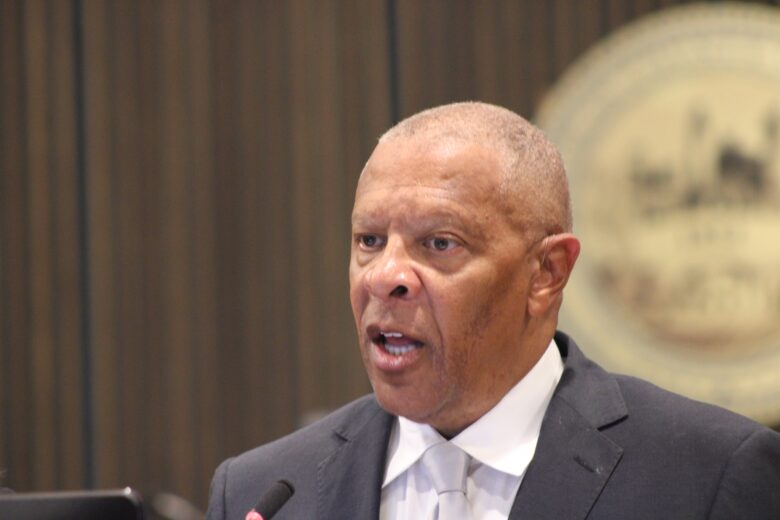
What does Omaha Mayor John Ewing intend to do about the shortage of police officers? Is Omaha’s streetcar project on schedule and what direction does Omaha grow now that it’s reached boundary limits on the south and east? Dale Johnson reached out to the mayor for answers, starting with a police shortage of over 100 officers.
Dale Johnson: Curious, sir, with your 25 years of experience in the Omaha Police Department, retiring as a deputy chief, does that give you any leverage, or to what extent does it give you leverage more than other mayors when taking on an officer shortage?
John Ewing Jr.: I’ve actually done recruiting, and I’ve done the background process, and I’ve helped develop the recruiting process while I was on the police department. So I think that gave me some insights, as well as understanding the deficiencies that we had back then, and some ways to be able to make things more efficient. So one of the things they’re doing a really good job of in human resources now is they’re giving people multiple opportunities to test and to apply, and then they tell them when the class is going to start, and that gives people an opportunity to kind of pick when they want to start, and also allows for us to continue to gather applications on a continuous basis versus a set application period. And so what we’re seeing, quite honestly, is they are being able to hire a significant number of police officers. By this time next year, we should have hired pretty close to 100 police officers, which, depending on how many people retire next year, puts us in a significant position to be able to address the shortage. So we could be somewhere very close to full strength by the end of next year.
Johnson: Let’s shift to city growth. It’s anticipated that Omaha will run out of undeveloped land by 2050 So what’s the plan?
Ewing: We are increasing the density instead of the large-scale developments that we’ve had in the past to try to conserve land. That does two things. One, it hopefully delays that point where we run out of land. But secondly, the more densely populated an area is, the better a city is able to actually provide police, fire and other services to that population. That will also help us when it comes to economic development. As we look at our core, we will be able to create more jobs downtown and in that urban core. The city of Omaha lost about 30,000 jobs from the downtown area. Our estimates are that we should be able to increase by at least that 30,000 jobs that we lost in the past downtown.
Johnson: Just enough time, sir, to talk about Omaha’s streetcar. There are listeners hearing our conversation right now that are learning that Omaha’s new $421 million streetcar project is underway, and are asking, why does Omaha need streetcars? Your answer?
Ewing: It will give us the opportunity for those 30,000 jobs downtown. It will also give us $4 billion worth of economic development in the first 15 years. And then as you go further out into the future, getting closer to 25 to 30 years, it will give us an opportunity to have $8 billion to $10 billion of economic activity. There’s also some other things that are part of that streetcar financing, such as the affordable housing effort and bike lanes and some of those things. We should have up to $100 million for affordable housing, and we’ve already started the process to invest $40 million, which will be housing in the urban core and then allow us, when that money turns over, to be able to expand outside the urban core and begin to address the affordable housing issue that we have much sooner than what was set up in the original plan, which would have started in 2032. Those are my primary reasons, as well as I think it’s a cool thing that will draw and help retain young people and then potentially be expandable to allow us to create economic opportunities in other areas of the city as well.
Johnson: Mayor Ewing, thank you so much for joining me today.
Ewing: You’re very welcome.
Johnson: Omaha Mayor John Ewing joining me. I’m Dale Johnson.