

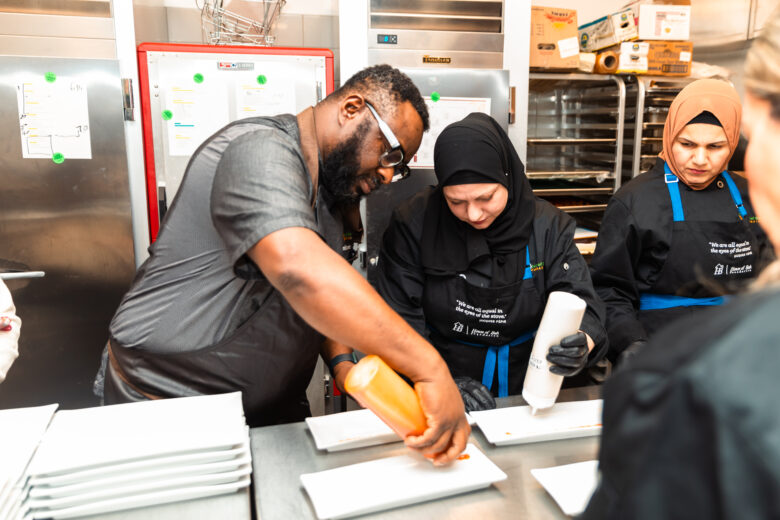
Before becoming a chef acclaimed for his social impact, Djamil Djibril Bah-Traore, a native of Togo, West Africa, crunched numbers in corporate America. But his real passion was cooking.
He left spreadsheets for cutting boards in his late 30s to follow his heart and heritage, attending culinary classes by day and driving a taxi at night to support his wife and four children In Omaha, as well as family back in Togo. It wasn’t long before he disrupted the status quo by making culturally affirming cuisine and diversity in menus and kitchens a reality.
Against his homeland’s cultural norms, he learned to cook as a boy from his mother and grandmother in Togo. That shared activity forged bonds.
“I owe it all to my mama,” he said. “I know she’d be proud because she gave me something that I’m utilizing. Anytime I cook I remember her.”
But he adhered to tradition when he came to the U.S. to attend Bellevue University, earning a degree in accounting and business administration. He worked at PayPal and CitiBank before “making the leap” with a dramatic life and career change.
“I was asking myself what is that one thing I want to be doing at 90 that would fill my heart,” he said. “Cooking was that. I knew I needed to drop everything because I didn’t want to chase two things. There was no way I could be in a conference room and say I still wanted to be a chef. It was a risk – I wasn’t young anymore.”
He enrolled in Metropolitan Community College’s Institute for the Culinary Arts (ICA), where even though most students were recent high school grads, they possessed food industry experience.
“I knew I had to catch up,” he recalled. “I didn’t have any knowledge or experience about the professional culinary world. But if you have a passion for something you have to do what it takes to really find out what it’s all about. It humbled me. It also showed me that I’m really dedicated.”
ICA associate dean Brian O’Malley said mid-career pivots “into the kitchen” are common but Bah-Traore’s, “is exemplary for many reasons, most notably that it was about serving others.”
“Many of the mid-career folks are seeking a way they can do something that will be more enriching to them,” O’Malley said. “His mission is about creating something enriching for others. He has that special combination of characteristics that are essential for success as an entrepreneur – a meaningful connection to the thing and a dogged work ethic.”
Bah-Traore grew up fast when, at 13, his father died.
“Very early,” he said, “I learned how to be responsible because I was the oldest.”
After graduating from ICA, Bah-Traore honed his cooking and management chops in restaurants and hotels. He earned an online master’s in restaurant management and hospitality from the University of Houston.
“The curiosity in me and the lifelong learner in me led me to study hotel management. I wanted to have a degree that would serve me later on,” he said.
Frustrated by the standard fare American menus he was required to prepare in commercial spaces, he derived satisfaction whenever he could bring African flavors to guests who requested something different and perhaps closer to their own culture’s cuisine.
“People were loving it,” he said.
But he had to do it on the sly because his employers forbid it. When he tried convincing them of the value-add of diversified menus, they balked. Aware Omaha is a destination for international business visitors and students and home to many immigrants and refugees, in 2015 he launched House of Bah Food Group, his African fusion catering company. He soon made a name for himself and his food catering events and staging popups.
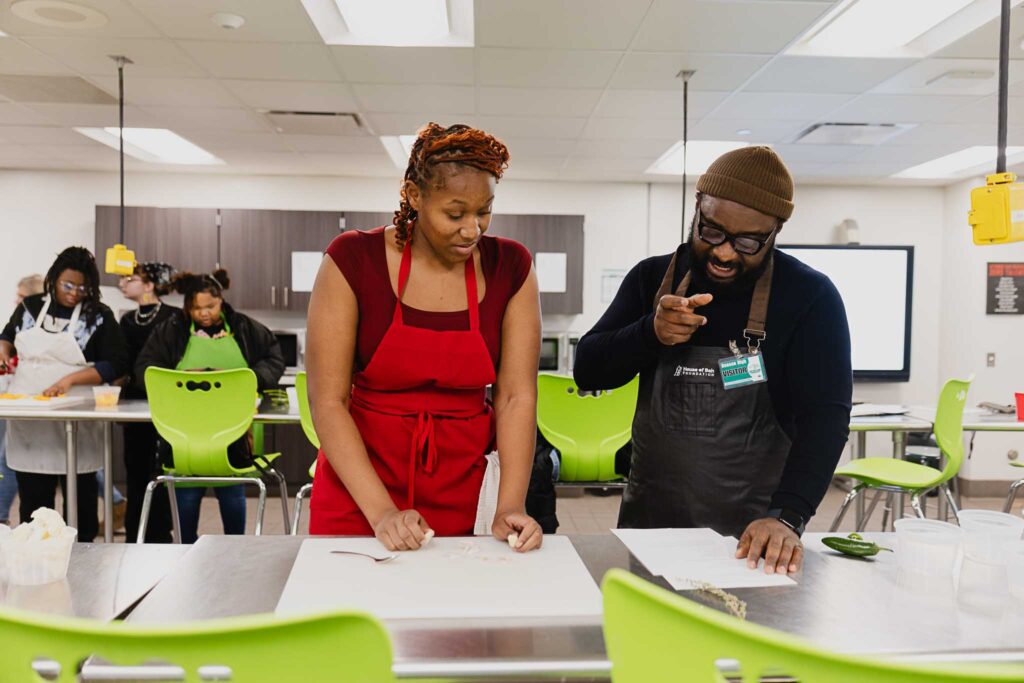
“African cuisines have flavors that are unique and exciting. Omaha does not have enough of it, especially in casual or fine dining form,” he said. “A big part of this is normalizing this food.”
O’Malley champions what his former student is doing.
“I share chef’s dream of seeing Jollof rice on school cafeteria menus throughout Omaha,” he said. “We have seen it appear on our banquet menus here with some success – a success we would not have been able to enjoy without the guidance and training we have received from chef Djamil.”
Bah-Traore is encouraged by progress he’s seen.
“The community is changing and seeking it more,” he said. “The word is spreading. One of the proudest moments for me was when I was able to go back to Metro and help with a Midlands African Chamber event. They needed an Afro-centric menu and we delivered it.”
All that’s required for a culturally diverse cuisine ecosystem to flourish is for people to try it.
“With a little bit of education and community building we can get to the point where a Nepalese or Congolese or Togolese can go to any hotel and say, ‘I want this dish,’ and they won’t be afraid to consider it,” Bah-Traore said. “As it stands right now new Americans have spending power, but don’t have access to places that make their food because the industry is not willing to open up to the new cultural trends. If food on the table is a reflection of the community then we are doing it right. If you have someone on staff from one of these cultures then what have you got to be afraid of? What do you have to lose?”
In 2021 he won the Midlands African Chamber’s inaugural Pitch Black competition. The grand prize was $10,000. A message he shared then and still shares now made an impression.

“There’s a bigger problem and barrier – an invisible one – of commercial food operations rejecting culturally diverse menus,” he said. “If we don’t do anything about it it’s going to be more of the same. Instead of just pointing fingers and saying it’s not right I wanted to do something about it. I said we need to have an entity that can use food as a catalyst for change.”
Local philanthropist Katie Weitz heard his message and embraced it, becoming a donor. Her support led the chef to found House of Bah Foundation (originally called Eat N’ Talk Africa).
“One year into doing the work we knew it was a problem extending across populations from many cultures and nations,” he said of industry resistance to diversity.
Both the foundation and the catering company share a mission of bringing culturally affirming food of the African diaspora to the mainstream and giving newcomers the skills to celebrate and maintain their cultural cuisines and, if desired, to enter the industry. It’s also about using food as a community building and common ground tool that fulfills the American dream.
“This place has been so welcoming to everybody from everywhere,” he said of his adopted country. “Now more than in any moment with there being so much polarization we need to find channels to bring us together and I think food can play that role.”
He added one of his favorite sayings is: “If you love somebody’s food, it’s hard to hate them.”
“The more we interact with each other we’re going to be less biased because you’ve gotten to know me, I’ve gotten to know you,” he said. “What better way to do that than by food? Food is that catalyst to really get to know people. The work we’re trying to do is using food as a catalyst to build this community of connection. We have been doing this work, as have so many other organizations across the nation, with the shared mission of using food to spread love and unity.”
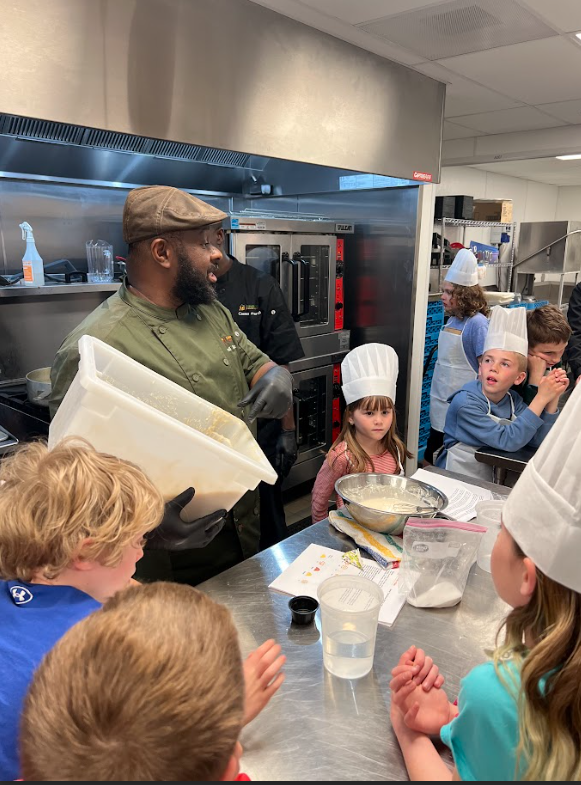
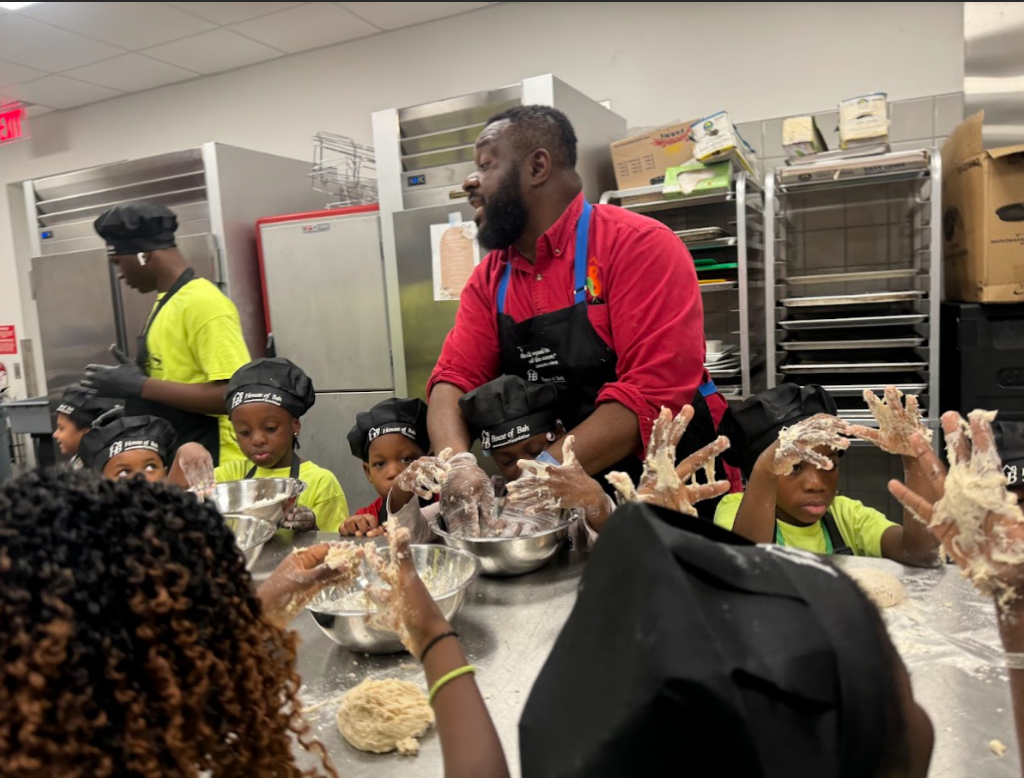
The foundation offers education programs for youths and adults and the company offers employment and training opportunities. Through African Immigrant Family Services (AIFS) House of Bah Foundation works with 150 kids from some 20 different countries to help them discover their culinary heritages and perpetuate them. House of Bah Foundation also works with Countryside Community Church to teach non-immigrant and refugee kids about global cuisines.
Some global cuisine classes happen in schools, including Benson High School.
“We believe in planting seeds,” Bah-Traore said. “If you can plant those seeds early enough, it will make a difference. If I can teach a Somali kid how to use native ingredients to make their own food and teach an American how to use Somalian ingredients to make something, we’re making the world better. It’s not a world where we’re canceling each other, it’s one where we grow together.”
Several adult cohorts of mostly immigrants and refugees have completed House of Bah training.
No More Empty Pots Food Hub founder Nancy Williams said the result is that Bah-Traore, whom she calls “revolutionary,” is “significantly influencing the diversity of professional cooks in Omaha.”
“The participants are primarily women from other cultures and communities who love food and have a deft hand in the kitchen with an eagerness to learn,” Williams said. “With that curiosity and drive, the culinary trainees share the foods of their culture and learn to refine skills and recipes so they can be shared and scaled. This process encourages participants to leverage an existing talent while building community. In a place like Nebraska where the currency of community and accomplishment is amplified through relationship, connecting with others over a common interest of food sets a stronger foundation of belonging and inclusivity.”
Bah-Traore loves what happens in the cohorts.
“You can’t replace the camaraderie and bonds that we create,” he said. “Many can barely speak English. They speak in their native tongues. But they all speak the language of food.”
“Food is healing too,” he added, noting some participants make traumatic journeys to find freedom.
Olha Bevza, a Ukrainian refugee, enjoyed her immersion in Bah-Traore’s culturally affirming space.
“I had the opportunity both to work with him and to learn from him,” Bevza said. “It was a creative, productive and educational experience. I truly appreciated having that time. I also had the opportunity to teach and to lead a class for immigrants, and I was deeply moved by the chance to help and to share my professional experience as a pastry chef.”
House of Bah veteran Roukaya Alramadana, a Syrian refugee, also found community there.
“Working with chef Djamil and the foundation gives me hope and motivation to keep going and achieve the mission chef is working on to give immigrants the opportunity to bring their culture and food to Omaha,” Alramadana said. “I love the support that chef brings to the kitchen every Saturday to remind these immigrants that they have something special to share. I myself was a student and so I’m speaking from experience. That’s what made me work with him because I have a hope for a better future for immigrants in Omaha, greater Nebraska and the U.S.”
The humanistic aspects of what House of Bah does impresses Nebraska State Poet Jewel Rodgers.
“Its work is not culinary training in the conventional sense. It is folk art, rooted in preserving and sharing lived experiences through food,” she said.
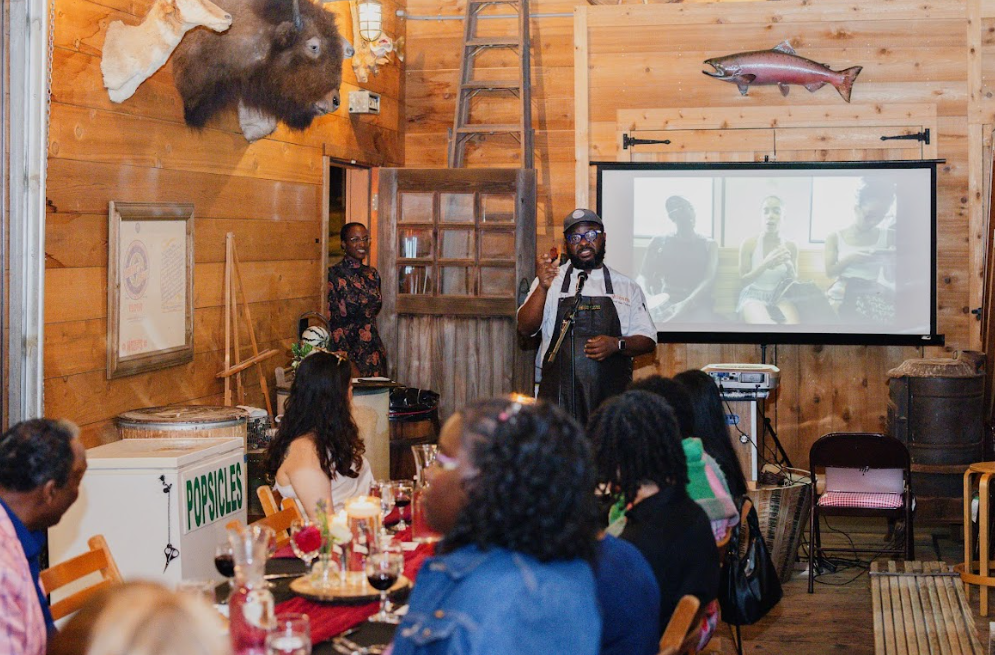
She saw this in action during a 2025 House of Bah event at Le Petit Paris Bakery in Omaha.
“Immigrants, refugees, asylees, and lifelong Nebraskans shared their stories through recipes, each dish carrying memory, struggle, and celebration,” Rodgers said. “What struck me most was how the House of Bah Foundation created a stage where food became storytelling and self-expression, affirming identities and empowering people as contributors to our community through meaningful employment.”
Rodgers saw it again when Bah-Traore and his team catered her Dinner Party fundraiser at the Historic Florence Mill last fall. As a storyteller, Rodgers said she appreciates how the organization “safeguards ancestral knowledge, transmits traditions across generations, and creates spaces where communities reconnect and belong.”
“Recipes often carry centuries of cultural wisdom passed only through story and practice.”
“Honoring those traditions,” she said, “transforms cooking into an act of artistry both deeply personal and profoundly communal … Their work inspires pride in younger generations, fosters intercultural dialogue and anchors Omaha’s cultural landscape in ways no other organization does.”
Bah-Traore appreciates it when others catch his vision for social impact.
“One of the things I’m really passionate about is helping continue the story of change where people can come together and then we can really truly see each other for who we are,” he said. “You don’t have to have the same beliefs or values but if you sit down and talk it’s just two people talking and sharing their cultures. And I think food can play a part in that. The work of our foundation is to create this continuum of connection. We really want to have an ecosystem where the food on the table is a representation of the community.”
Some House of Bah Foundation grads now have their own food truck or catering operations. Ukraine native Olha Bevza has her own business, Bevy Sweets, and is head pastry chef at Le Voltaire, a French restaurant whose chef-owner, Wilson Calixte, is a native of Haiti. Bevza’s culinary journey is now bookended by immigrant experiences.
“It is especially meaningful to support immigrants, just as others once supported me. I share chef Djamil’s mission of educating immigrants, providing assistance, and fostering a strong community in order to help people,” Bevza said.
House of Bah offers African Cultural Academy courses for individuals of African descent. Bah-Traore envisions a class for non-African chefs looking to broaden their culinary horizons and sharing what they learn on their menus. All he asks is that fellow chefs “add a little culture – maybe one night out of the week feature an African special. If we start slowly like this … it will become the norm.”
His focus on community has been recognized by the Emerson Collective, for which he is a Fellow, and by the Jacques Pépin Foundation, which honored him as a Local Leader. He was the only Nebraska chef selected to prepare a multi-course meal in official celebration of Pépin’s 90th birthday in 2025 at Le Voltaire. Being feted by the nonprofit named after the iconic French chef affirmed for Bah-Traore he’s on the right path.
“Chef Pépin understood himself as an immigrant that food can be a connector, bring people together, reach gaps, break barriers and create community in a different way,” he said.
The Pépin Foundation recently announced House of Bah Foundation as a winter 2026 grant awardee. House of Bah will use the $10,000 grant to provide general operating support, increased chef Instructor hours for class prep, curriculum development and program outreach. House of Bah Foundation will also receive JPF branded aprons for students and a group membership to the Pepin Foundation.
As word has spread about House of Bah’s work it has catered signature events for the Malcolm X Memorial Foundation, Bohemian Gardens, Tri-Faith Initiative, Kiewit Luminarium and many other organizations.
“We’re privileged to do it because we get to turn people into ambassadors,” Bah-Traore said. “People will walk away more informed, less biased. That’s the goal. It’s all about raising awareness.”
None of it may have happened if he hadn’t heeded the pull he felt to return to “his roots.” He comes from a long line of Imans on his father’s side and from a long line of chiefs on his mother’s side. He didn’t know it at the time but growing up he was heavily influenced by the experiences of his great-grandfather, who variously worked for French and German employers in the former French colony of Togo and defied tradition by learning to cook in a culture where the kitchen is reserved for women. The cooking tradition was passed to Bah-Traore’s grandfather, who passed it to Bah-Traore’s mother, who passed it on to him. Despite his father being a devout Muslim who traveled widely as an Islamic emissary, he sent his eldest son to Catholic schools. That’s why it’s no coincidence Bah-Traore is an evangelist for using food as a bridge to break barriers and to bring people of different cultures together.
“In terms of what I got from my Iman father, who broke the norm by sending me to a catholic school, and the diplomacy he practiced,” Bah-Traore said. “I’m able to do the work of bringing people together.”
His diversity focus got him invited to be a keynote speaker at the Tri-Faith’s 2025 Race, Religion and Social Justice Conference.
“It’s almost like all my life I was preparing to one day give that keynote speech there,” he said, “because I’ve always grown up in an interfaith environment.”

Until last fall, House of Bah Foundation quartered on the Tri-Faith campus. Before that, it operated out of Yates Illuminates and No More Empty Pots. Bah-Traore’s located his endeavors at whatever community organization he’s partnered with at any given time. Mindful of building capacity in order to keep both the catering business and the foundation sustainable, he’s looking to secure a long-term lease somewhere to administer and showcase the mission. Ironically, he’s found a new home in Omaha and plenty of temporary spaces to operate from, but he’s still unsettled in the sense that he’s still seeking a more permanent place that House of Bah can call its own.
As of late February his search was ongoing.
“We are still in no-man’s land,” he said. “We do what we do best and borrow space to bring our mission and program to the community.”
Having a fixed home for his “social enterprise work” would mean everything to him. He envisions it being a full-time hub where people of different backgrounds can share diverse foods and cultures, engaging in conversation – whether breaking bread or making bread – learning, training, swapping recipes and telling stories.
“What’s not to like about it? Especially if you’re going to have your belly and soul full,” he said.
He eventually wants to establish House of Bah as a public benefit corporation cooperative whereby trainees who become paid staff, “own shares in the enterprise as we earn and grow together. We see this model across the country but it’s unique in Omaha.”
He has said “no” many times to prospective investors wanting him to open a restaurant as he wants to complete his community-based vision first. He’s ever more committed to that vision now that a number of immigrants and refugees have gone through his training program. He’s afraid that if he opened a restaurant it would take his focus away from the foundation’s work.
“I’m always a practical person,” he said. “I’m always evaluating myself and what I’m doing. Mind you, we are a small nonprofit. I’m the only full-time employee. I wear many hats. From 2022 to early 2024 I was doing all the programming. In 2025 we were finally able to add some part-time chefs to help do the work.”
He expects House of Bah will work with more adult trainees and school-age youths over time. There’s currently a capacity issue that requires more funding. The same holds true for his dream of holding a Midwest African food expo bringing African chefs and food producers in the region “to showcase the culture and what African cuisine is about.”
One thing Bah-Traore’s certain of is that he lives his purpose in the work he does and that in this time of growing division there is increased urgency around it.
“More than ever, we need something that can bring us together that celebrates our differences and our shared love of food, conversation and community,” he said.