

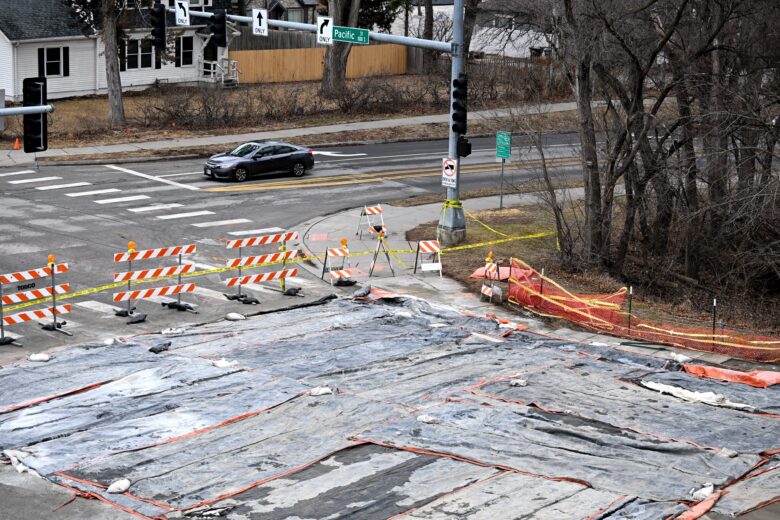
The dramatic video has been viewed more than 20 million times across social media.
A pickup truck and an SUV pull up to a stoplight heading west at the intersection of 67th and Pacific streets in Omaha. After waiting for a few seconds, the road underneath the vehicles collapses and swallows them both into a sinkhole. Bystanders rush to the hole to pull the drivers out.
No one was injured in the Feb. 24 incident, which Omaha Mayor John Ewing has described as a “freak circumstance.” It took about a week and a half for the road to be repaired – and as of Thursday, traffic was flowing again along Pacific Street.
But there still isn’t a concrete answer as to what led to the collapse. The City of Omaha and the Metropolitan Utilities District, or MUD, do not agree on the cause – though they concur that a breached storm sewer pipe helped carry away eroded soil, creating a void underneath the pavement.
MUD, which operates more than 3,000 miles of water distribution mains underneath Omaha’s streets, maintains that its investigation revealed no evidence of a water main break. Stephanie Mueller, MUD’s vice president of customer experience, said in a statement that the only damage it identified on the water main was caused by the street collapse.
“Our preliminary investigation concluded the street collapse was caused by the City’s deteriorated storm sewer,” Mueller said. “There was no evidence of a water main leak in the area prior to the street collapse.”
That assessment was disputed by Omaha City Engineer and Assistant Public Works Director Austin Rowser, who said the utility’s explanation “defies all logic, common sense and science.” He said he knows of no other water source that could have caused the erosion, and there is no way that dry soil could have been sucked into the breached storm drain.
Mueller said the utility plans to submit the costs of the water main repairs to the city for reimbursement. After MUD submits its claim, the city’s law department will decide whether or not to approve reimbursement. If it denies the claim, MUD could file a civil lawsuit.
Every sinkhole is caused by erosion, Rowser said, or soil being eroded and carried elsewhere. To carry the soil away, you need water and a pathway for the water and soil to escape to.
“If we have a water source that develops underground, there’s usually an initial phase where it’s saturated,” Rowser explained. “Water will look for that pathway to try to get out of there. It wants to go towards the center of the earth with gravity. Water tends to move around until it finds a way out – and once it finds a way out, it’s just a matter of time before the erosion happens to a point where we see some kind of a surface void.”
Those surface voids don’t usually take the form of a large sinkhole. Often, Rowser said, they’ll see pin holes develop in nearby grass patches, or pavement settlement.
Though the city and MUD disagree about the source of the water, they agree that the water found a path through a city-owned storm sewer that was breached. Storm sewers transport excess rainwater and snowmelt to waterways.
“We try to make them as watertight as possible,” Rowser said of storm sewers. “But over time, gaskets corrode. Things break. Things happen underground, and ultimately, there’s a path that can develop into a pipe to carry soil away.”
Does Omaha have a sinkhole problem?
This kind of road collapse isn’t a sinkhole in the geologic sense, which is caused by the dissolution of limestone and other soluble rocks. Those sinkholes are most common in places like Florida and China, which have lots of limestone bedrock, called karst topography.
Nebraska has very little, if any, karst topography. But Rowser said the process that led to the Pacific Street sinkhole isn’t dissimilar to a karst sinkhole.
“In karst landscapes, you’ve got some kind of a cavity in the limestone where it dissolves the limestone and creates a big void,” Rowser said. “Ultimately, you’ve got enough of a void that it can’t support the structure above it anymore, and so you get kind of this collapse of rock layers. It’s a similar thing that happens here.”
One factor that could contribute to Omaha’s sinkhole problems is the abundance of loess soil in eastern Nebraska. It’s a type of wind-deposited sediment found across the Midwest, and in parts of Central Europe and China.
While loess soil is highly fertile for agricultural use, it’s also very prone to erosion when wet. That can create all kinds of issues, Rowser said.
“It’s a highly erosive soil bed that we live on – that our entire city is built on,” he said. “So erosion is a constant problem that we deal with in all areas of public works.”
Nebraska’s State Geologist, Matt Joeckel, said it’s possible that loess has some similar characteristics to karst that could lead to similar collapse phenomena. But Nebraska isn’t a hotbed for natural sinkholes. Though aided by the state’s highly erodible soils, they are almost always caused by some sort of infrastructure failure.
“Nobody should think that we have sinkhole problems of the sort and magnitude that occur in Florida, Central America and other places – where a sinkhole will appear one day and grow to immense size within a matter of weeks to months and swallow up part of a neighborhood or whatnot,” Joeckel, said. “That is not going to happen here. I can be 99.99999% sure.”