

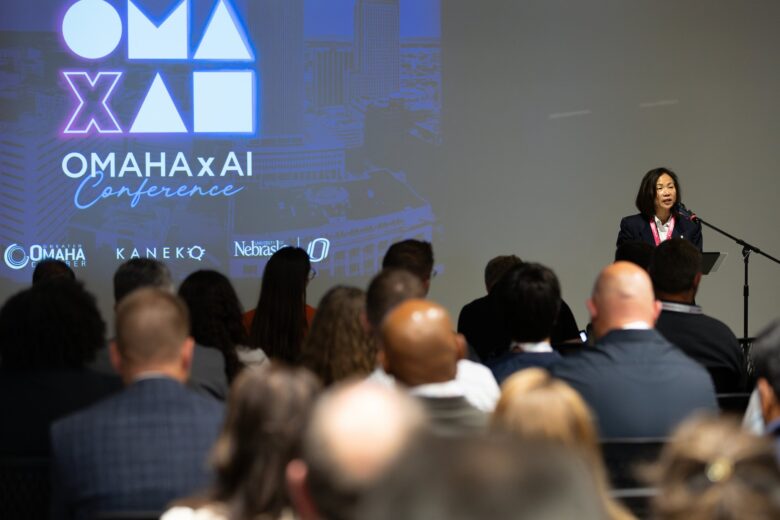
The University of Nebraska at Omaha introduced several artificial intelligence initiatives within the past few years — a new AI degree, the AI Learning Lab for faculty and staff, and a conference focused on the new technology in education and the workforce.
The University of Nebraska system as a whole is betting big on AI. Earlier this year, the system announced its launch of an “AI Institute” for artificial intelligence research. In the February announcement, NU President Jeffrey Gold said the new system-wide AI Institute will “position Nebraska as a national leader in shaping the future of responsible, human-centered artificial intelligence.”
Each NU campus will have a specialty of AI, and for UNO, that will mean housing the Center for AI, Urban Innovation and Business with focuses on developing “smart urban infrastructure solutions.”
“AI is not going away. AI is not coming. AI — it’s here,” UNO Chancellor Joanne Li said. “As your public research university in Omaha, we really believe that we must take that leadership and help our community to learn how to use AI in the regular business life and regular life.”

Li said with the rise of AI, it was important for the university to respond. The chancellor said the conversation about AI and higher education at UNO dates back to 2023. The campus started with working to introduce an AI degree, which debuted in the spring 2025 semester.
“I think that was not enough,” Li said. “So, in 2023, I literally asked my colleague, I said, ‘Make UNO AI-enhanced,’” Li said. “What does it mean? In order to convince our learner why AI is part of our life, we got to do it by practice.”
UNO created the AI Learning Lab to ensure faculty and staff are trained up on artificial intelligence and the best ways to use it. Li said more than 2,000 UNO members have received training, and she expects that all UNO faculty and staff will have AI training by the end of the year.
For students, Li said UNO professors are also integrating AI in their curriculums, and the campus started offering microcredentials in AI, which are shorter courses for those looking for a new skill.
“Most employers say, ‘Well, these days we won’t even hire any students or any graduate that never really touch AI or learn how to use AI,’” Li said. “If UNO is presenting this value proposition to our learners and believing that we are going to have AI-enhanced curriculum, most of our curriculum will be touch base, and we will expose our students to AI, different kinds of tools.”
One of the concerns Li hears is using AI to cheat in their classwork. According to a 2025 Pew Research survey, 59% of teenagers believe using AI to cheat happens regularly in their school. To help with those concerns, Li said university officials and professors created guardrails to help students use AI in a responsible way.
“We have an attitude of understanding we can use AI responsibly. We can use AI ethically,” Li said. “We can use AI with a very active human mind, but not passively taking whatever information they spill out, we take it for granted.”
However, Li said she believes the biggest challenge with AI is how fast it’s evolving.
“That means we have to really run, not just walk, to catch up, to understand and constantly upskill ourselves, the knowledge about AI, the different types of AI tools out there, and the computing power we must equip,” Li said.
UNO will host its second annual AI conference on Tuesday to explore uses for artificial intelligence in business. Li said it’s a chance for the community to connect about the growing topic of AI.
“It doesn’t matter whether you’re a small entrepreneur, whether you are working for a nonprofit, whether you’re a teacher, whether you work in an architecture firm, we have everything for everyone,” Li said. “Our goal is the same: come learn with us, we’ll grow together.”