

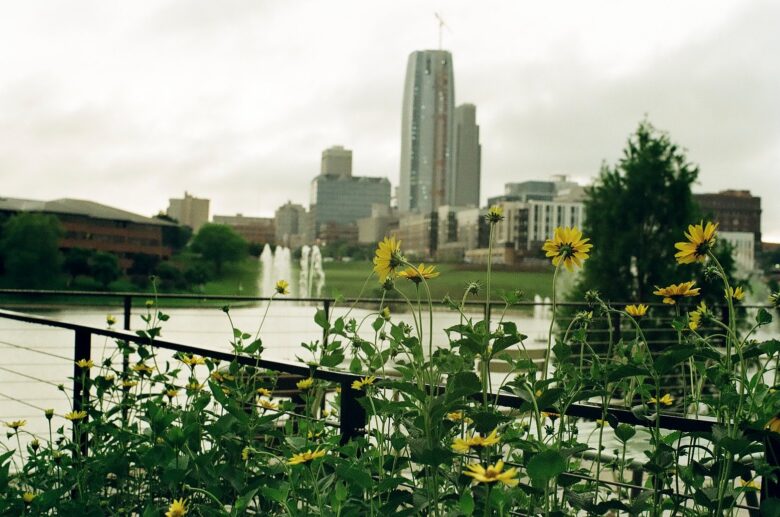
Jacquelyn Morrison sat at a picnic table in the Gene Leahy Mall on a humid summer morning. The nine-acre park in the heart of downtown Omaha was bustling with activity. Children played on a climbing structure, construction workers bought lunch from a food truck and employees of nearby companies walked along trails lined with native plants.
The space is a success story of private-public partnerships and the product of a philanthropically assisted $325 million overhaul of the city’s three riverfront parks completed in 2022. Morrison sees the downtown parks as just the beginning in a transformative era for Omaha’s public park system.
As interim parks director and the city’s first director of transformation and strategic partnerships, Morrison is tasked with bridging the gap between the City of Omaha and the metro’s philanthropic community. Her ultimate goal is to make Omaha a top 10 park city. A recent $5 million donation will help get the ball rolling.
“We’ve been hovering around 39 and 40 so we’ve got quite a bit of ways to go,” Morrison said.
Philanthropy and public spaces
The idea of philanthropic dollars contributing to public spaces isn’t unique to Omaha, said Steve Jensen, a longtime city planner and mayoral advisor. But the level of investment seen in the metro is far ahead of many comparable cities.
“For the most part, I think other cities rely more on taxpayer dollars,” Jensen said, “and here in Omaha, we again have some large foundations that are very willing to put money into public projects and to really benefit the public as a whole.”
Despite a healthy amount of funding for specific projects, like the downtown parks, the rest of the city’s public spaces are falling behind. In 2024, city leaders hired a consultant to analyze the park system and establish a master plan that would guide the next 20 years of Omaha’s parks.
They found that the city’s per-capita and per-acre spending on parks is lower than comparable cities such as Kansas City and Cincinnati. Staffing shortages impact available programs, and recruitment remains difficult, especially for seasonal and part-time roles within the parks system.
Most residents live near a park, but park conditions vary widely by location, the consultant found. Underserved areas often lack investment, and many parks require upgrades to improve safety, usability and ADA access.

“We are about $5 million short on our operating expenses annually,” Morrison said, “and about four and a half to $5 million short on our capital investments, compared to our peer cities.”
Mayor John Ewing announced in March a $5 million investment from undisclosed philanthropic donors meant to close the funding gap and address needs highlighted in the study. He said the city aims to match that amount and called the contribution a public-private partnership with “transformational potential to do more than plug a maintenance hole.”
Any level of private funding in a public entity is often met with some degree of unease.
The Omaha City Council in April approved a five-year agreement with the Miller Park Trust to maintain and make improvements at Miller Park in North Omaha. The trust is funded by the Lozier Foundation, a nonprofit that has invested heavily in Miller Park for nearly a decade and added the trail, playground, splash pad and fountain.
When the agreement was introduced in late 2025, former State Sen. Justin Wayne raised concerns on social media. He called the move a “quid pro quo” that would be bad for North Omahans.
“So we’re really doing this? A $40 million check gets you your own ‘public park’ in a private trust?” Wayne wrote on Facebook.
Before the approval, Ewing and City Council members noted that the city will retain ownership of the park and can cancel the agreement with 90 days’ notice.
Unease around philanthropic contributions may come from a lack of understanding, said Jensen.
“If you’re concerned about that side of things, I guess I would take a look at the usage of the parks, and I think you can see that the public is really benefiting from it and enjoying the parks,” Jensen said. “If the goal is to provide opportunities for free to the public, this is a great example of what can be accomplished with that public-private partnership.”
Looking forward
Omaha’s more than 250 parks add up to about 10,000 acres of green space, 130 miles of trails and numerous rec centers, sports fields and courts. Each year, the Trust for Public Land evaluates and rates park systems in the 100 most populated cities in the United States.
Omaha’s 2025 “ParkScore” placed it at 40 out of 100.
The published findings state that across the country, parks serving low-income households are four times smaller yet serve four times more people per acre than parks serving high-income households. In Omaha, residents in low-income neighborhoods have access to 16% less park space per person than those in the average Omaha neighborhood and 27% less than those in high-income neighborhoods.
Parks are important to the well being of a community — economically, mentally and physically, Morrison said.
There are two things Morrison and fellow city leaders will examine as they prepare to shape the future of Omaha’s park system.
The city will again hire an outside firm, this time to analyze each individual park within Omaha. There will also be a renewed focus on facilities such as swimming pools, buildings and infrastructure. The findings will guide how the city makes millions of dollars in new investments.
“(Parks) are a way that we can bring communities together in public spaces, despite the technology that has really separated us,” Morrison said. “These are gathering places that we can protect and maintain.”
