
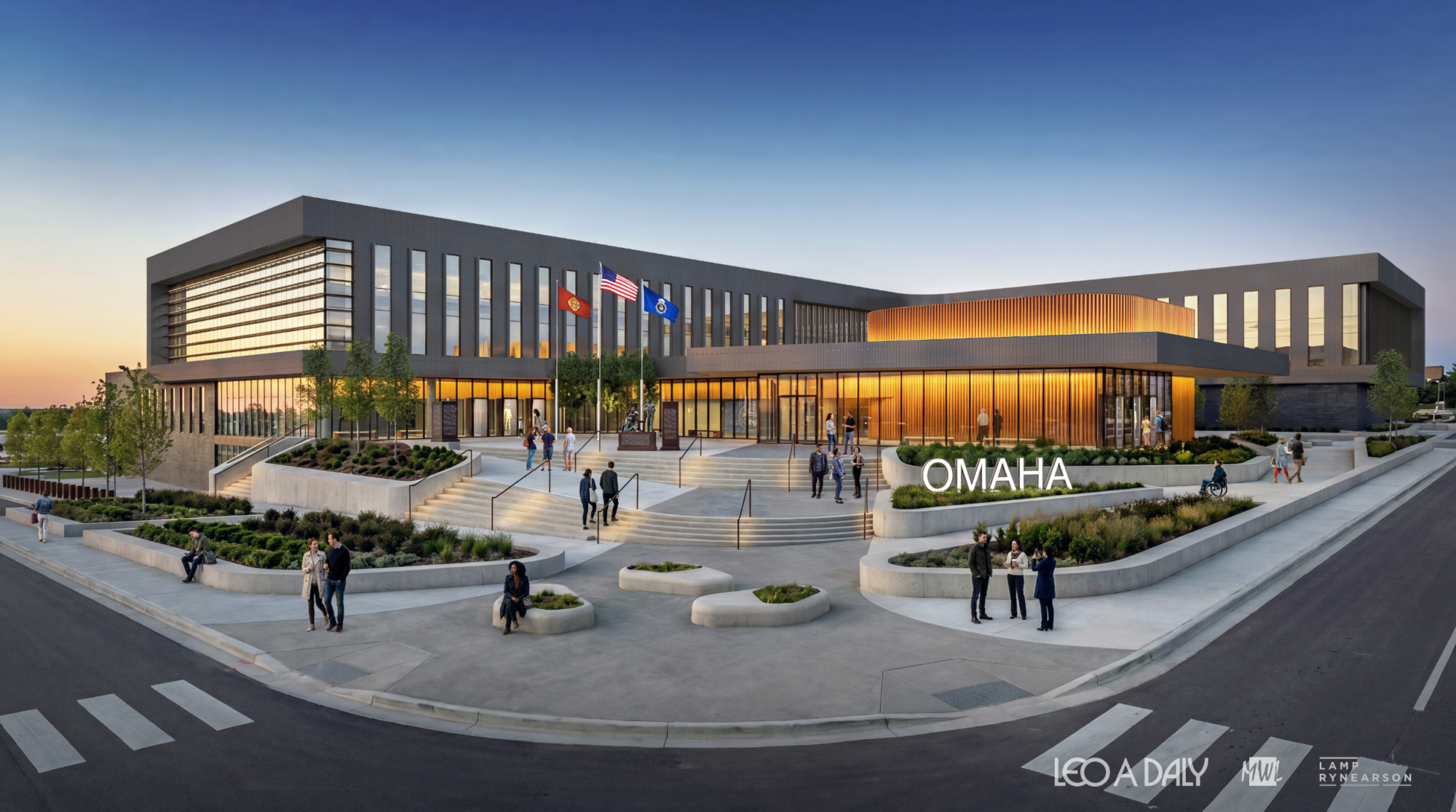

Omaha’s new public safety headquarters is planned to take shape within the long-awaited Crossroads development. City leaders say the $181 million facility will “move us into the 21st Century.”
The 275,000-square-foot development is slotted for a 3.2-acre site between Cass and Chicago streets near 74th Avenue. It’s estimated to hold more than 300 public safety professionals from the Omaha Police Department and Omaha Fire Department.
The public will not see police sirens or fire trucks deploying from the building, Mayor John Ewing said during a press conference Monday.
“This is an office building that gives us an opportunity to house the leaders of police and fire together for the first time in the history of the city of Omaha,” Ewing said.
It will ultimately be up to voters whether to approve the project. The city will seek $155 million in bonding authority on the November ballot. Approval would not require a tax levy increase.
The current police headquarters, located in downtown Omaha, was built in 1970 and is 112,000 square feet. Police Chief Todd Schmaderer said the space lacks proper ventilation and is regularly tested for asbestos.
“With this new headquarters, it will really focus on our community policing aspect because there will be shared community space, an opportunity for the community to come in and be a part of our building,” Schmaderer said. “You don’t really have that where we are at right now.”
If voters approve the bonds in November, the design phase would continue into late 2027, with construction beginning in January 2028 and the project scheduled for completion in the spring of 2030.
The Omaha City Council would be asked to approve a professional services agreement for Leo A. Daly, the project’s current designer.
The facility would include investigative units, a forensic laboratory, emergency medical services support, a real-time crime center, evidence processing and fire prevention and public education programs. It would not serve as a police precinct or fire station.
“This will be the last headquarters that most of us see in our lifetime, and so it’s important that we get it right,” Ewing said. “I believe this project gets it right.”
