

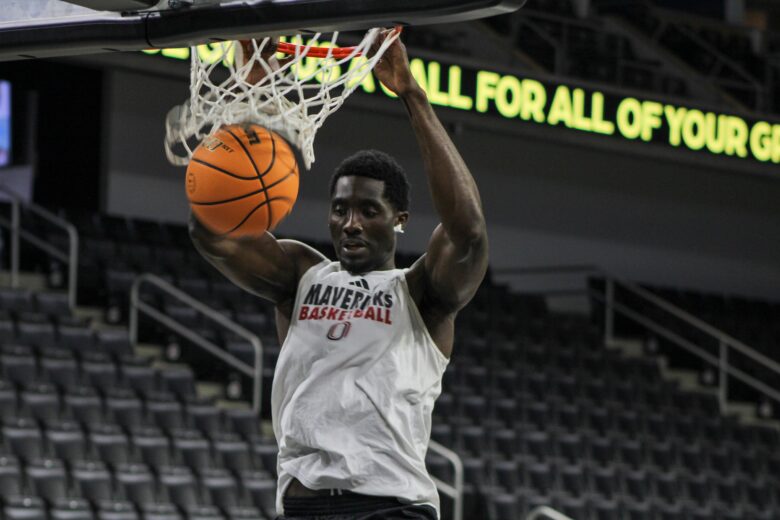
It’s months before the weather cools and the season tips off for the Omaha Mavericks men’s basketball team. But on a steamy July morning, the players start their morning by running sprints down the newly painted, gray Baxter Arena floor.
At this summer practice, the team is also running through defensive rotations and offensive sets — hoping to make it muscle memory by November. A basketball program likes to keep the details of its best plays and defensive curveballs under wraps. But one preseason strategy wouldn’t be contained within the athletic department’s walls.
That would be the program’s new marketing strategy. When the team jogs out of the tunnel onto the court this winter, Omaha’s jerseys will sport a company logo on the chest. The Mavericks are the first to agree to a jersey patch deal among the state’s three Division I schools.
Placing corporate logos on football or basketball jerseys and equipment was long outlawed by the NCAA. That was until January, when the Division I Cabinet voted to allow it.
And the University of Nebraska at Omaha athletic department wasted no time making moves.
“We kind of saw that coming,” said Omaha General Manager Brianna Chavez with college sports marketing giant Learfield. “So, we were already preparing for that on the backside, for several months leading up to that approval process.”

Learfield partners with the Mavericks to sell sponsorships, like radio commercials or stadium banners.
Under the new rules, programs can add two commercial logos on jerseys or apparel and another for equipment like a football or hockey helmet. For conference championship games, schools can sell an additional logo on jerseys. That development is one of the numerous examples of increasing commercialization in college athletics.
About one month after uniform patches got the yes vote, the Mavericks announced a multi-year deal with Omaha-based technology company Control Services for the team’s hockey uniform. It was the first-ever deal in Division I hockey.
“This is a historic moment for Omaha Athletics and our hockey program,” Director of Athletics Adrian Dowell said in a press release at the time.
That move places Omaha among the first group of schools to agree to a jersey patch deal in any sport. At least 26 total athletic departments have gotten in on the action, as of late July, according to a database published and updated by the Sports Business Journal.
But Omaha wasn’t done there.
Last month, the athletic department inked a second deal with another Omaha firm. MCL Construction will have a patch on the Maverick men’s basketball uniforms this winter. The approach in offering different patches for different sports is unique nationally.
“Having those different opportunities to kind of segment it out by sport will be really impactful for us here,” Chavez said. “Now, other sport programs and athletic departments have decided to go [with] the all-sport patch, which is also a great thing.”

As of late July, Omaha and Wisconsin were the only two schools in the nation to sign an agreement with more than one company. Chavez could also see a world where the Mavericks group sports together in a jersey patch deal or sell a patch for all women’s sports.
“Wisconsin was a great example of that, and kind of a trailblazer in that approach,” Chavez said. “They had all their women’s sports paired together, and so it truly just depends.”
MCL’s deal with Omaha was the first in the Summit League. The Mavericks compete in a different conference for hockey called the National Collegiate Hockey Conference.
Travis Justice, the company’s vice president of marketing and business development, said the advertisement was a way to connect with a school that has produced plenty of employees for it.
“So I think it’s a good partnership that can engage a community a lot more than maybe it previously had — besides the traditional way of marketing and advertising in a game,” Justice said.
The company built on the existing relationship with Omaha, including winning the contract to build the athletic department’s new training facilities.
‘Any revenue helps’ in House settlement era
Omaha men’s basketball associate head coach Kyan Brown said the program is excited about the opportunity. The NBA started selling jersey patches in 2017.
“They were selling patches, and they thought it’s a good revenue generator for college sports, and I actually couldn’t believe it when I first heard it,” Brown said. “But, the things that have changed in collegiate athletics over the last three to five years have been pretty substantial. So, when we decided to go that route, it was pretty special that we did it.”
The Maverick athletic department wouldn’t disclose the specifics of the deal, but the number of eyeballs that see a jersey patch is high, Chavez said.
“The jersey patch is arguably one of the most, if not the most, valuable assets in college athletics, because you are directly associated with a team, specific athletes,” Chavez said. “They’re always wearing your brand proudly on their chest, and so that goes for home games, away games.”
That’s not to mention how prominent the logo displays during TV broadcasts and on social media photos.
Ben Portnoy has covered the changing world of jersey patches for the Sports Business Journal. Deals range from an average of $1.2 million annually with the top 50 biggest men’s basketball programs. Deals among the most noteworthy Power Four conference football programs can creep near the $10 million range, Portnoy said. Rules have been changing in the commercial sponsorship space for a while. Last year, universities could put corporate logos at the 20-yard line of their home football field for the first time.
These moves are designed to keep up with the changing times. Ever since the House settlement was approved, schools pay athletes directly. It’s also known as revenue sharing or “rev share,” for short. In total, rosters across all sports will cost some athletic departments $20 million per year or more, which is a new expense some schools are struggling to come up with.
“As schools were facing increased challenges related to commercialization and increasing costs and rosters and retention and things of that nature,” Portnoy said, “the NCAA basically took a look at, sort of, what commercial options could they open up that were previously limited, in order to help schools basically supplement and offset those costs.”
Chavez said valuable uniform sponsorship dollars will help sustain those programs and build rosters.
“That money, or part of that money, is directly impacting and benefiting that sport program,” Chavez said. “For now, at least, our men’s basketball and hockey programs are directly benefiting from some of that revenue.”

For a basketball program like Omaha, it’s competing against schools in non-conference play that could be spending $10 million to $20 million on their basketball roster alone.
“It obviously will help,” associate head basketball coach Brown said. “Any revenue helps in these days, especially when you’re a low-to-mid-major university like we are. We can stretch a dollar. We can make it work, so anything we can get coming in really helps generate our roster and keep things moving forward.”
Get on board or get left behind
The decision by the NCAA and ensuing deals by universities is just one move aimed at increasing revenue in the new age of college sports. Athletic departments need more money. Companies want more exposure.
“We’re still calling it amateur sports. I’m not sure if it is amateur sports,” Brown said. “But it’s just cool how college basketball is changing. Kids are getting paid now. It’s well deserved. It’s about time. Yes, are there things we can clean up and get things back right? Have things got a little bit out of control? Probably, but the genie’s out of the bottle with a lot of these things, and things are moving in this direction. So, it’s either: you’re going to get on board or you’re going to get off and be left behind.”

He tipped the cap to his athletic director for having a game plan ready when the rules changed.
Traditional college sports fans have certainly been in for a ride the last five years, Brown said, given the changing world of NIL and commercialization. Many fans and some schools were hesitant when first hearing about the idea of jersey patches, Portnoy said.
“Oh my gosh, this is turning into NASCAR, right?’ And I think that that’s not really the case, and I think most people would tell you, eventually people just get over it,” Portnoy said.
Fan uproar about the sanctity of jerseys in the MLB and NBA fizzled out.
“I think there is definitely some, for lack of a better term, maybe some pearl clutching around the idea of commercializing these assets,” Portnoy said. “But when you look at college sports — and college football and college basketball in particular — for what they are, which is enormous money makers and really sort of pseudo-professional sports, I think that you’re seeing more and more administrators, and by proxy more and more fans, be sort of open to this idea.”
Chavez said the main idea is that athletes and programs benefit from the new opportunities.
“I think, again, having an open mind and knowing that it’s helping our program and our student athletes is really the key message here,” Chavez said.
And for brands, a jersey patch presents the chance to grow. Chavez said Control Services and Omaha Athletics have worked together for years, with the business tech firm supporting hockey often.
“Over the years, we’ve grown the partnership,” Chavez said. “[We] added more sponsorship assets to their agreement, including more premium signage and an in-ice logo. And then, when jersey patches became available this past year, they were one of our first asks.”
It’s common for jersey patch sponsors to have an existing deal with the university, Portnoy said.
On a national scale, 18 of the 26 schools currently agreeing to deals are mid-majors. That means programs outside of the Power Four conferences: the Big Ten, SEC, Big 12 and ACC. Regional, mid-sized companies are largely owning the jersey patch space — both in college and professional sports, Portnoy said.
“Because of that, I think there’s a lot of opportunity for mid-major schools to lean into that,” Portnoy said.

Smaller, local companies highly associated with a particular program are probably not creating enough margin to explore those sponsorships, because of the high price tag. And many big corporations aren’t jumping into this space yet. This could give schools like Omaha a better chance to compete.
“But I do think that there’s still a conversation to be had about how can schools in that realm still compete and stay competitive and retain guys,” Portnoy said. “And I think that this is certainly a way to do that.”
Whether those deals are enough to close the gap between mid-majors and the big boys remains to be seen.
“What is USC or Ohio State or Michigan or schools like that — when you think about sort of the biggest brands in college football and college basketball — they haven’t necessarily taken those steps yet,” Portnoy said.
That could change tomorrow, with the fall season weeks away and a new deal announced seemingly every day. The timing is the only remaining question for big name college sports brands.
“I’d be really surprised if Nebraska didn’t sell a field logo or a jersey patch at some point,” Portnoy said. “Now, if that happens in the next month or two, maybe that’s a little tighter of a timeline, but I’d be pretty shocked if at some point not every Power Four school, at the least, in the country has some kind of jersey patch.”
A Nebraska Athletics spokesperson recently told Nebraska Public Media News there are no current plans for jersey patches. Creighton’s athletic department said it’s discussed multiple partnerships but also doesn’t have a jersey patch yet.
For Omaha, the change in rules lines up with interest from brands.
“We’re seeing that our partners are more hungry to get more involved,” Chavez said.
That means Omaha jersey patch news is likely far from over, especially considering some companies already had their budgets set when the rules changed in January.
For this round of patches, it took months of conversations before and after the NCAA vote. The Mavericks athletic department had to answer lots of questions internally about how big to make the logos, whether to match color schemes, whether to sew or iron them on, if they’ll look for helmet patch deals and when to order the patches, Chavez said.
But in just a few weeks time, the dust will settle on these first two deals. As per usual, social media will see the new basketball and hockey threads first, following media days.