

Ai’Yauna Young was 10 years old when her mother, Camisha Hollis, went missing.
She was 14 years old when her father, Marvin Young, was convicted of manslaughter. And she was a junior in high school when her mother was declared legally dead. Her body hasn’t been found.
Ai’Yauna Young is now 18. She’s lending her voice and experience to help shape a new initiative in Nebraska. With the backing of recently passed legislation, law enforcement and nonprofit partners are working to improve how missing persons cases involving Black women and children are reported, investigated and tracked.
“This is a real person,” Ai’Yauna Young said of her mother, “and she can show that these are real people that are being impacted.”
Hollis is one of the roughly 700 Black women and children who go missing each year in Nebraska, according to the Nebraska State Patrol. Her story was one of many that motivated state Sen. Ashlei Spivey to introduce LB751 in early 2026.
The legislation requires the State Patrol to coordinate a study into how more investigative resources could help report and identify missing Black women and children, and create ways to increase the reporting and investigation of those cases.

“I speak a lot about Camisha Hollis,” Spivey said. “I was an adult when she went missing. Kenyatta Bush, I was a kid when she was murdered. Amber Harris, I was a teenager. So there’s these instances of harm that stick with you and kind of color your perspective.”
In her day job, Spivey is executive director of I Be Black Girl. The nonprofit based in North Omaha aims to address systemic inequalities by centering the experience of Black women and girls.
The study is the first step in taking action at the state level, Spivey said.
“It’s about how do we understand the data and the lived experience of people that are impacted to craft legislation that would address this epidemic,” Spivey said.
The Nebraska State Patrol and the Nebraska Commission on African American Affairs are currently considering proposals for a research and policy consultant that will assist with the study. The research will take place from November of this year to June 2027, when the report is due to be published.
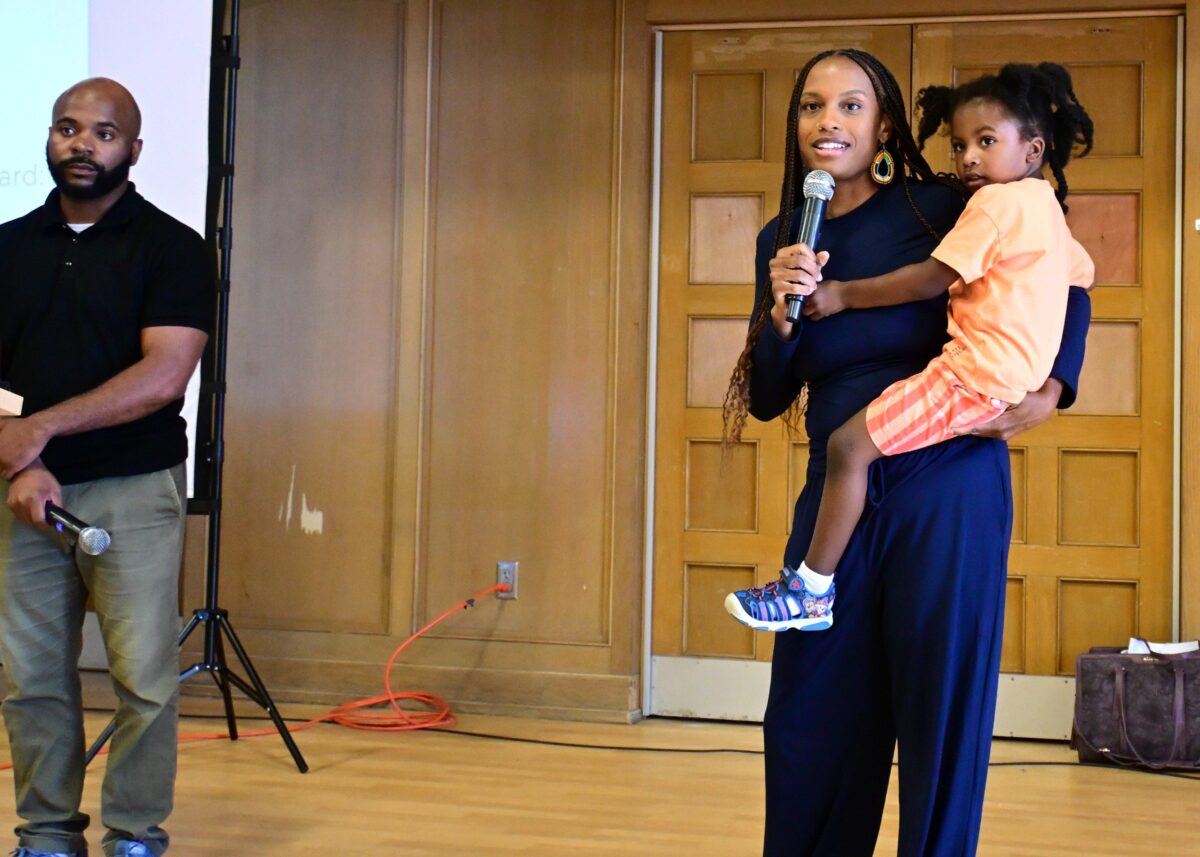
Ai’Yauna Young is one of several community members serving on an implementation committee meant to help guide the upcoming study. She’s grown closer with the team behind I Be Black Girl in recent months.
“We had our first meeting last month, and Ai’Yauna shared really great ideas,” said Joy Kathurima, legal counsel for I Be Black Girl. “I think it’s important for people in that room to see someone young who’s advocating for themselves and sharing their own experiences.”
In 2022, 271,493 girls and women were reported missing in the United States. Black women or girls made up 36% of that total despite accounting for only 14 % of the U.S. female population at the time, according to statistics from the National Crime Information Center.
Ai’Yauna Young is the eldest of three sisters. She doesn’t remember much of the evening her mother disappeared, but she does recall instances of physical abuse.
“She always tried to like put up a front, act like she wasn’t hurt,” Ai’Yauna Young said, “even though I could see her bleeding and stuff like that. And I think it’s okay to be vulnerable, and it’s okay to let us know because I always thought that was normal, and so I grew up thinking that was normal, and that’s how you develop broken people.”
Prosecutors would later share video surveillance of Marvin Young with Hollis’ car at the 402 Hotel near 22nd and Douglas streets. Officers located the car five days after she was last seen.
According to police reports, detectives found evidence of a physical altercation at the home, including Hollis’ blood and two spent shell casings. Prosecutors alleged that Hollis had told Young to move out of their home shortly before her disappearance.
Authorities and volunteers searched multiple times for her body at the Schilling Wildlife Management Area along the Missouri River, but they found nothing.
Ai’Yauna Young became emotional as she described her mother during a recent interview at the I Be Black Girl building in North Omaha. There are gaps of time in her childhood that she struggles to remember, but her answer came quickly when asked to describe a favorite memory with her mother. It was an afternoon spent in Memorial Park. They walked together past flower bushes and when Ai’Yauna stopped to pick a few, Hollis sat with her, picking some of her own.
“She always, oh my goodness, she would always tell me education was important,” Ai’Yauna Young said. “She said no one can take your knowledge from you.”
She carried that advice into adulthood. Ai’Yauna Young recently began her freshman year of college at the University of Nebraska at Omaha. She’s pursuing a degree in criminal justice and a minor in psychology.