

In the Nebraska Legislature’s District 12, a close race has candidates out knocking on doors in the last few weeks before the election.
It’s important to get in front of voters, Christy Knorr said before she rang a doorbell in a southwest Omaha neighborhood.
“Hello. How are you today?” she says to a man who answers. “My name’s Christy Knorr, and I’m running for state legislature here in District 12, and I’m out knocking doors and meeting voters and introducing myself.”
Knorr is a hospice nurse and Democratic challenger to longtime Republican Sen. Merv Riepe in one of Douglas County’s most politically diverse areas.
The district is often a toss-up for both Democrats and Republicans. Riepe, a Republican and frequent swing vote in the Legislature, led the primary with 40% of the vote, but Democrats received 60% of votes – with Knorr taking 36%.
Riepe is also putting his soles to the pavement.
“I’m going to every door because of the nature of the purple district,” Riepe said in a phone interview. “I’m not just going to, you know, one party or the other.”
At 84 years old, Riepe is running in a district he’s won twice before, first in 2014 and again in 2022.
But this year, the stakes may be a little bigger.
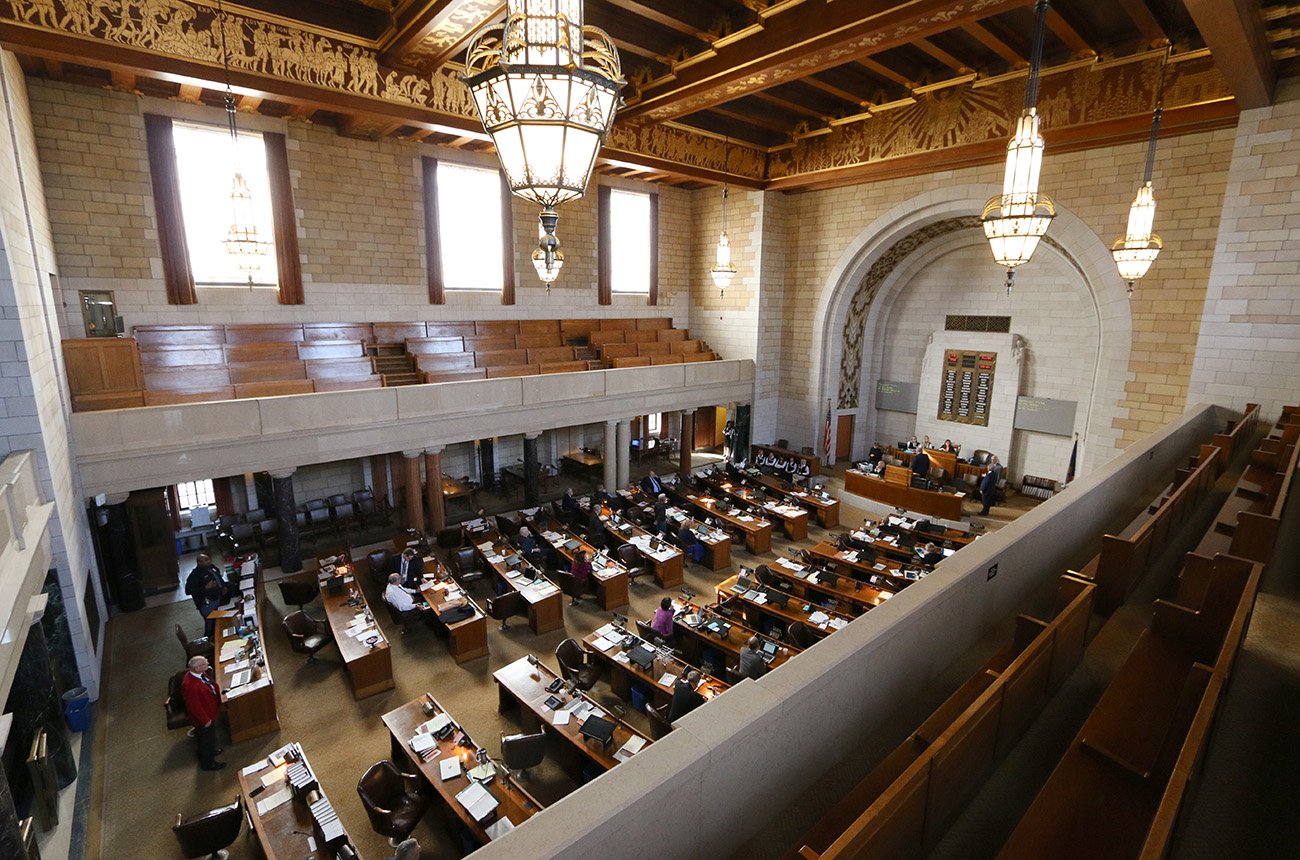
Republicans currently hold 33 of the 49 seats in the Legislature, giving them a two-to-one advantage in the number of votes, referred to as a “supermajority.” Even though Riepe does not always vote with his colleagues, he still provides them with a crucial vote on some issues that can withstand a filibuster from the chamber’s 15 Democrats and one independent.
As University of Nebraska-Lincoln political science professor Kevin Smith explains, those 33 seats can equal a lot of voting power.
“You can effectively push through any bill you want, because you need 33 votes to end debate to invoke cloture,” Smith said. “So if you’ve got 33 votes, you know, in blunt terms, basically what it means is you don’t have to negotiate if you’re united.”
Twenty-four of the chamber’s 49 seats are up for election in 2026. And strong showings by Omaha-area Democrats in the primary may point to a potential shake up in the upcoming general election. Several races will likely determine whether Republicans return to Lincoln with a filibuster-proof Legislature.
The Republicans have had a supermajority since the 2024 elections, which has allowed them to pass stricter abortion restrictions and limits on participation in athletics by transgender students.
But thanks to Riepe, Republicans have failed to pass some signature issues, such as winner-take-all in presidential elections. During his second term, Riepe was the deciding vote against a bill that would have banned abortions at about six weeks of pregnancy.
“I have sent some marketing over to Democrats that I hope will have some level of understanding that I don’t vote down party line,” Riepe said. “I vote according to what I think is good legislation.”
He said in this election, an end to the supermajority is a real possibility.
“It’s an off year, and so they have probably a pretty good chance of going after some seats,” Riepe said. “I don’t know. Hopefully not mine.”
District 12 is not the only district where Democrats could flip a seat.
In District 4 Sen. Brad von Gillern, a Republican, once again faced off with Cindy Maxwell-Ostdiek, a registered nonpartisan. Maxwell-Ostdiek received 52% of votes, to von Gillern’s 48%. The two candidates went toe to toe in 2022, with von Gillern taking the seat by 802 votes.
In District 36, Republican Sen. Rick Holdcroft finished second in his primary to Democrat Darin Tompkins. Tompkins received 53% of votes in the district that includes Papillion, Bellevue and Gretna.
District 14 encompasses north-central Sarpy County. There, Democrat SuAnn Witt led the primary field of three with 42.5% of the vote. She will face Republican Bill Bowes, who received 34%. Bowes and Republican competitor Jay Jackson received a combined 58% — meaning the district may still favor a Republican.
District 18 in northern Douglas County ended the primary with Republicans in receipt of a majority of votes. Democrat Jess Goldoni was first in the primary with 43%. She will face Republican Taylor Royal, who received 34%. Derek Schwartz, a Republican, finished third with 24%.
Outgoing speaker of the Legislature John Arch told Nebraska Public Media News in May, after the primary election, that
Strong primaries aren’t necessarily indicative of a strong general election, but Smith said Democrats appear excited about getting out to vote.
“Whether that excitement translates into majorities when the vote really counts in terms of who is going to hold office, well, you know that remains to be seen,” Smith said.
Predictions and primaries aside, no one can say for certain what the Nov. 3 General Election will bring for the Unicameral. Ultimately, the voters will decide.
