

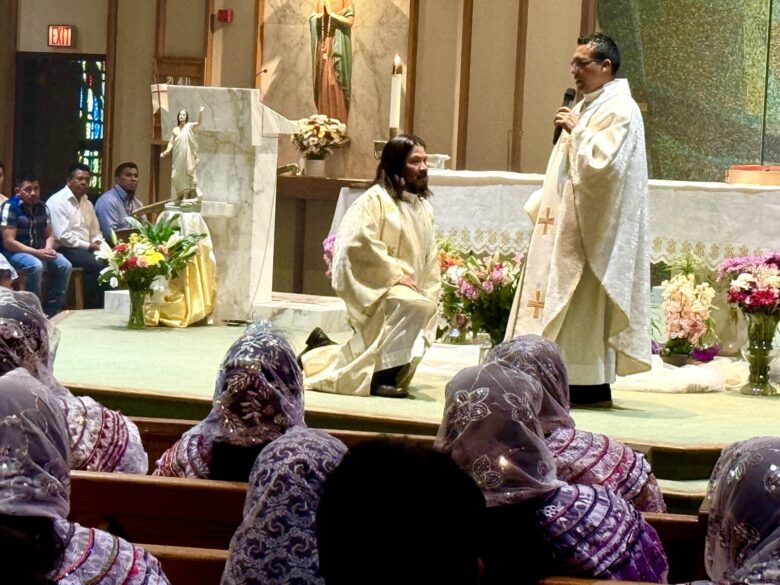
Sounds of an indigenous Mayan language, along with Spanish prayer, guitar strumming and ceremonial incense, filled the South Omaha church previously a home base to European newcomers.

The current congregation, many wearing traditional huipil garb, was celebrating its rare spiritual leader, believed to be the country’s only permanent Catholic deacon who hails from the Q’anjob’al-speaking highlands of Guatemala.
More specifically, the gathering earlier this month marked three years since Rolando Lorenzo Nicolas became a deacon in the 23-county Omaha archdiocese. His 2023 ordination was such a big deal it drew a pope-appointed cardinal from Guatemala and was officiated by the highest-ranking Catholic in northeast Nebraska.
Nicolas has carried the four years of diaconate training invested by the local archdiocese into a service ministry focused on the area’s Maya community. He assists at Masses, counsels couples, inmates and youth and presides over pivotal events such as baptisms, funerals and weddings.
But since mid-April, the migrant who shepherds a few hundred members at St. Francis of Assisi Church has carried a different weight: He must wear an ankle monitor so federal immigration agents can track his every move.
He’s subject to frequent home visits by federal authorities. And he lives in an uncertainty that he could at any moment be detained and deported.
“They’re controlling me with the monitor,” Nicolas, 46, said in an interview with the Nebraska Examiner. “I really don’t know what is going to happen.”
Distinct role
In President Donald Trump’s aggressive push to deport noncitizens, Nicolas’ case stands out for his distinctive role and standing in Nebraska’s biggest religious denomination.
The local Catholic church has seen a population influx over the past few decades from the Santa Eulalia area of Guatemala, where the dominant Mayan dialect is Q’anjob’al and where Nicolas was raised. The trilingual deacon understands both cultures and has become a key conduit between that indigenous community and a faith that has long been short on full-fledged priests.

Indeed, the archdiocese — which oversees 230,000 Catholics in 23 counties of eastern and northeastern Nebraska — has launched a holy intervention on Nicolas’ behalf, including a letter-writing appeal to the U.S. Department of Homeland Security. A dozen or so clergy, from priests up to Omaha Archbishop Michael McGovern, submitted testimonials vouching for his character.
Chancellor Tim McNeil, who also heads diaconate training, which is akin to studying for a theology degree, said it was an easy letter to write. He described Nicolas as a “gift.”
“He gives himself away every day to people, mostly people in need,” McNeil said in an interview. “To extract or remove someone like him from our community doesn’t make sense. We need to insert more people like him, not only into our community but the world. He is just a humble loving servant and asks for nothing in return.”
U.S. Immigration and Customs Enforcement did not respond to requests for comment about Nicolas and his situation. But adhering to Trump’s campaigning against illegal immigration, the administration has touted its ramp-up of detention space, overhaul of immigration courts and policy changes aimed at thinning out migrant populations of various statuses. The stated focus of federal enforcement efforts was the “worst of the worst,” though the administration also said that no one was “off the table.”
1999 border crossing
Nicolas, who is married and buying a house, has a complex immigration history that began when he crossed into the U.S. without authorization at age 20 more than a quarter-century ago.

According to legal documents, archdiocesan leaders and Nicolas himself, he moved to Omaha less than a year after arriving in Los Angeles in late 1999. It was a time of growing migration from Guatemala, where a civil war traumatized Maya communities.
Nicolas applied for asylum. In the meantime, he was issued a permit to work and a Social Security number. He said asylum was denied and he was removed from the U.S. in 2005. He returned several months later and in 2015 was detained and accused by a federal grand jury of illegal reentry.
By that time he was immersed as a leader in the Maya community and local Catholics went to bat for him then, too. Supporters and Nicolas himself testified that his life would be endangered if he were returned to Guatemala.
They feared reprisal against indigenous Maya leaders who fought for human rights and against government-backed corporate mining methods reportedly causing fertility, health and natural resource problems in Nicolas’ hometown.
Homeland Security pushed back, arguing then that Nicolas failed to prove the Guatemalan government was unwilling or unable to intervene in the persecution of the Maya community.
At the end of the 2015 immigration court proceedings, Immigration Judge Daniel Morris granted “withholding of removal” — a form of relief that doesn’t open the door to permanent U.S. residency status but at least temporarily fended off deportation.
“They told me to stay away from crime and you will be okay,” Nicolas said. “Or you will be deported — not to Guatemala but to another country.”
From then on, he checked in once a year at the local immigration office. What he thought would be another routine January check-in visit, however, ended in what Nicolas said were distressing words from an officer: Are you ready to go?
Nicolas recalled the conversation: “He said, ‘I am giving you three months to pack up your things. If you refuse to go, then we’re going to put you in custody and we’ll find you a country, don’t worry.’”
Nicolas said he recently received a government letter citing a 2002 drunken driving offense. He said he had completed an alcohol education course for that two decades ago. The violation did not come up at his 2015 court hearing, he said, and he thought his record had been cleared. “Now they are mentioning it,” Nicolas said, as an apparent justification for removal.
After losing a $1,500 consultation fee to one attorney who rejected his case, Nicolas hired another who accompanied him to see immigration officials in April. They did not jail him, instead ordering the ankle monitor, twice-a-month check-ins at the local immigration headquarters and monthly home visits by federal officials.
“I said, ‘I’m not going to run away,’” Nicolas said. “I’m paying for a house. I love my work and my community.”
More targeted enforcement
Nicolas’ case reflects what immigration experts view as a shift by the federal government toward more targeted and quieter interior enforcement tactics. It’s a change, for example, from the high-profile immigration raid last June at Omaha’s Glenn Valley Foods, which roused protests and arrested roughly 80 undocumented workers, and Minneapolis sweeps where two American citizens were fatally shot by federal agents in January.

Consider a situation earlier this year: ICE agents reportedly plucked a migrant out of the Douglas County courthouse while he awaited a hearing for a driving under suspension allegation. The man’s attorney, Robert Larsen, told the Examiner he had stepped away for a brief consultation when his client went missing. He said he searched and found the client handcuffed in a hallway.
“It’s crazy how stealthily they were able to get him out of there,” said Larsen.
In another example, ICE agents knocked on the door of a Guatemalan mother of eight in Omaha, after she said they detained a friend of hers outside. The immigration agents did not immediately arrest the undocumented woman, who was tending to several pre-schoolers, but gave her a date to report to federal authorities. At that meeting, an official noted her numerous dependents and let her return home with an ankle monitor.
Also this year, immigration agents pulled over a father of three from El Salvador as he was driving to his Omaha job. He was detained for three months until legal nonprofit groups intervened and an immigration judge granted his release on bond. In central Nebraska, federal officials in March took custody of a longtime Kearney restaurateur as he was in a county jail for a local offense. He was ordered deported.
Lawyers with the Nebraska chapter of the American Civil Liberties Union advise migrants not to underestimate seemingly routine immigration appointments, warning of what to them appears to be increased incidence of on-the-spot detentions.
“Be prepared,” said Mindy Rush Chipman, executive director of ACLU Nebraska. “You need to know what your options are, if any. You need to have plans made to ensure your family is not in a situation where they can’t function because you’ve been detained suddenly without notice.”
Meanwhile Nicolas, who by day earns a living by driving for a construction company, must ask for time off for more frequent visits with immigration officials.His friends think it’s the government’s way to make him miserable enough to self-deport.
‘Literal bridge’
In off hours, Nicolas and wife Isabel tend to the needs of the St. Francis of Assisi families — a bond evident by the turnout at the recent church service and anniversary celebration.

That evening’s Mass, said in both Spanish and Q’anjob’al, was led by a visiting Guatemalan priest who did not bring up Nicolas’ immigration predicament but spoke of the importance of service.
He blessed a kneeling Nicolas at the altar before leading a procession into a nearby hall for anniversary festivities and a traditional meal prepared by parishioners.
Charlie Petro, director of the local IXIM group that formed in the early 2000s to build relationships with the Guatemalan Catholic diocese of Huehuetenango, said he believes Nicolas is the only Q’anjob’al permanent deacon in the U.S.
He calls Nicolas a “literal bridge” between still-arriving Santa Eulalia newcomers and Nebraska. Successful immigrant groups, Petro said, have had leaders who ease their transition into spiritual, business and community life. On the flip side, he said, Nicolas helps Nebraska Catholics understand their new neighbors.
Petro recalled a recent Las Posadas Christmas celebration hosted by a downtown church in Omaha, the state’s most populous city. Nicolas explained the meaning of the Hispanic tradition, in both English and his native tongue, to the mix of attendees.

“He supports not only the spirituality, but the whole person,” said Gregorio Elizalde, a deacon who also manages the archdiocesan Hispanic Ministry office, said of Nicolas.
The Rev. William Safranek is head priest for a four-church partnership that includes St. Francis, which since its founding in 1899 served Polish and other ethnic groups that settled in South Omaha, known historically as an immigrant landing place, before assimilating into the larger community.
Safranek called Nicolas his “right-hand man” at St. Francis who not only serves its people but sings and plays the marimba musical instrument dear to his homeland. He said changing immigration policy and enforcement has created uneasiness in and beyond the parish.
Jenny Lorenzo, 15, is a St. Francis member who speaks four languages. At Saturday’s service she read in her native Q’anjob’al. Afterward, she spoke to a reporter in English.
She said Nicolas guided her quinceanera religious birthday celebration and leads her church youth group.
“He’s very respectful, generous and wise,” she said of the deacon. “It would not be the same without him.”