

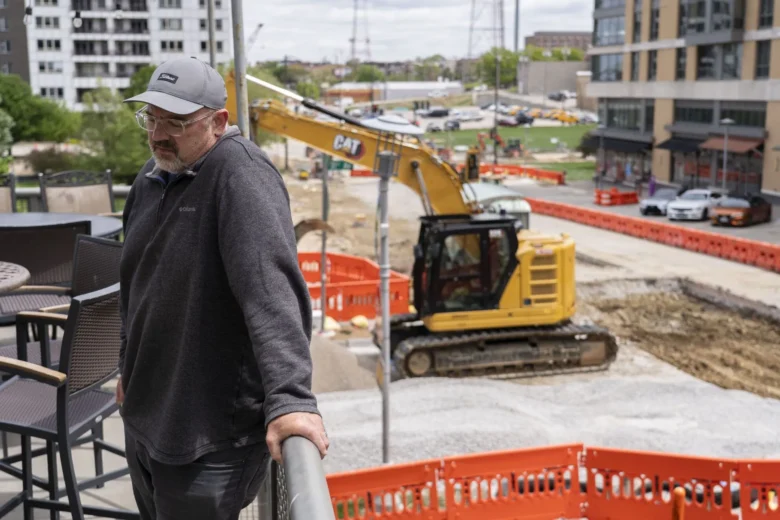
The local business owners flanking Mayor John Ewing on the patio of Smokin’ Oak Wood-Fired Pizza smiled and clapped as he trumpeted progress on the Omaha streetcar line to TV cameras and a crowd of dignitaries.
When the speeches finished, party guests picked up colored markers and ceremonially signed their names on a segment of steel rail to be placed in the ground.
But the celebratory mood at the photo op did little to distract its host from the problem facing his restaurant: Smokin’ Oak isn’t selling enough pizza.
Dan Yaksich said he hasn’t paid himself a salary and has been living off savings since streetcar construction in Midtown Crossing began dampening sales more than a year ago. The 2028 opening day seems a long way off, the restaurant’s owner said.
“To say we’re going to put you under constant construction for four years … it’s de facto shutting you down,” Yaksich said.
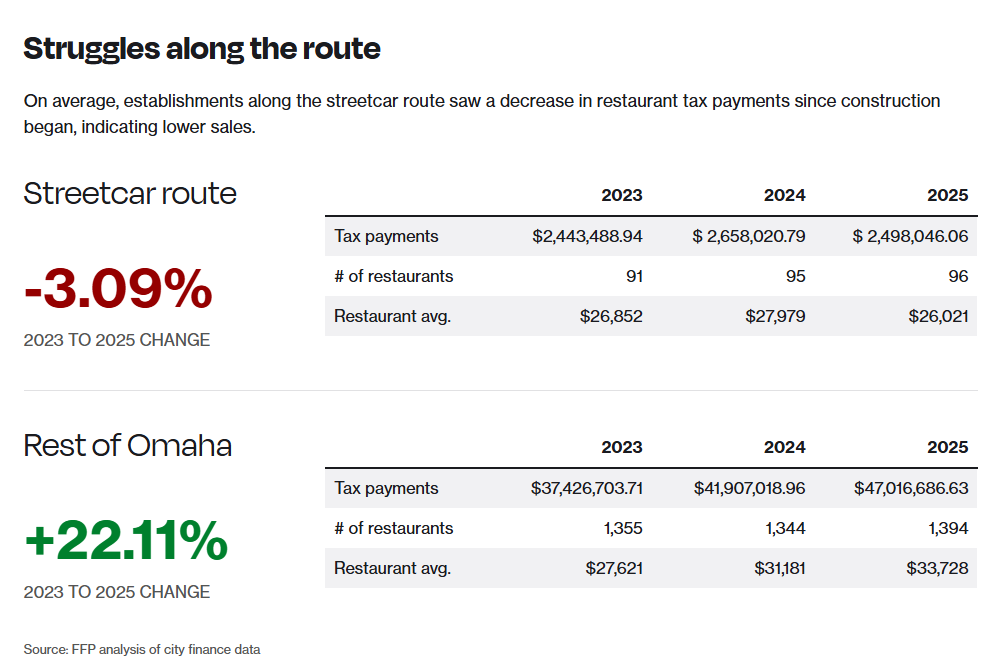
A post-pandemic upswing in dining out has driven rising sales for Omaha restaurants and bars, but it’s a different story in the path of streetcar construction.
On average, bars and restaurants along the route saw a 3% decline in city restaurant tax payments between 2023 and 2025, indicating a drop in sales. The rest of Omaha’s restaurants saw a 22% increase in average tax payments over that time period, a Flatwater Free Press analysis of city data found.
Those figures don’t factor in inflated food costs since 2023, which restaurant owners say have hurt their bottom line.
City officials note that the data isn’t perfect since some restaurants are behind on their 2025 restaurant taxes, which are levied on all prepared food and drink sales. But they acknowledge the construction has impacted establishments along the route.
Ewing spokeswoman Erin Grace said the city will do everything it can to help restaurants live to see the streetcar boost their businesses.
The city backed a Greater Omaha Chamber program that provided financial aid to many businesses last year. Officials hope new initiatives to offer discounted parking and to help patrons maneuver streets under construction will drive more business for places like Smokin’ Oak.
The roadwork, they say, is becoming less obstructive as deep utility replacements give way to laying rail.
“The big thing that we can do right now is build confidence in the rest of the city that this is not impassible,” Grace said.
The restaurant tax data obtained by Flatwater through a records request doesn’t reveal how individual businesses are faring. That picture is varied, and some have been able to weather the construction better than others, said Steve Jensen, a mayoral adviser and Streetcar Authority board member.
Despite contending with a block-long fence on Farnam Street for several months, Red Lion Lounge had its best year on record in 2025, roughly doubling sales from two years prior, co-owner Chad Shoeman said.
Shoeman chalks up the success to the Blackstone bar’s unique offering of no-cover jazz shows, its dedicated staff and loyal customers.
Having lived in Minneapolis, Shoeman supports expanding public transportation in Omaha, but he feels for some restaurants in Midtown Crossing and downtown that have had it harder with construction than Red Lion.
“It’s a pain in the butt,” Shoeman said. “Growth hurts.”
Mercury in retrograde
Coming off the pandemic, Mercury looked to be on the rebound.
In 2023, the downtown cocktail bar nearly hit seven figures in sales as the bar-going public returned to old routines.
But two years later, Mercury’s sales dropped by almost half as streetcar construction pinched off access to the bar sandwiched between Harney and Farnam streets, said owner Clark Ross.
This year is shaping up to be even worse, Ross said. On a recent Thursday, the bar did just $30 in sales.
“We thought, ‘OK, well at least we bottomed out (in 2025),’” Ross said. “It is seriously unlike anything I’ve ever seen.”
But city data suggests the effect of construction on businesses isn’t felt evenly. Half of the roughly 100 establishments along the route showed growth in restaurant tax payments between 2024 and 2025, according to a city analysis. Still, rising food and labor costs eat into those gains.
And despite several high-profile closures, more restaurants have opened than shuttered along the route since construction intensified last year, a Flatwater analysis found. That’s likely, in part, because landlords are offering robust rent incentives in hopes of getting new businesses established before the streetcar opens, Jensen said.
Earlier this year, Ross founded the Streetcar Impact Alliance, a loose association of construction-affected businesses and residents. Pedestrian safety and wayfinding tools have improved since his group began meeting with city leaders, he said.
But those are changes on the margins, he said. Without a financial lifeline, businesses like his that have endured construction-depressed years won’t survive. Ewing and other officials have maintained that providing direct aid to businesses would be illegal.
“Right now, the city is broadcasting a message that that is an acceptable amount of collateral damage for their streetcar,” Ross said.
Shoeman said aid for businesses should have been built into the cost of the more than $400 million project, but he also thinks some struggling restaurants blaming the streetcar didn’t have a great product to begin with.
City officials, though often well-meaning, haven’t done enough to offset the turbulence caused by heavy road closures, dusty excavation and jarring worksite noise, Yaksich said.
“I feel like obviously we’re a very low priority and have been since the inception,” Yaksich said. “Otherwise, we would’ve been considered at the beginning of this process.”
In hindsight, the city could have better involved businesses from the start of the project, Jensen said, but there was serious consideration for how construction would impact them.
Before the most intense construction started, the city helped coordinate the donor-funded Chamber program that distributed $1.25 million in rent relief and cash to more than 50 Blackstone and midtown businesses. That’s more money than Kansas City and other cities have funneled to businesses during similar construction projects, Jensen said.
“We’ve always anticipated the problem would come,” Jensen said. “We tried to get out in front of it with something … pretty significant when you compare it to the rest of the country.”
Yaksich said he was grateful for the help, but the $22,000 he got covered only about 40 days of losses. That’s not going to fix the problem, he said.
The Smokin’ Oak owner called on the city to find a creative solution for easing stress on businesses, such as property tax suspensions or paying for the use of their sidewalks.
The Impact Alliance is looking to set up a multimillion-dollar loan program with local financial institutions to tide over businesses in the red until the streetcar opens, Ross said. But even with the city’s help, nailing down willing partners has been a struggle, he said.
“Every week you kick this can down the road, that is a business closed,” Ross said.
Light at the end of the tunnel
Katrin Heuser has seen it all before — the blocks of torn-up streets, the porta-potty in front of her door, the lean months where she didn’t take a salary.
A decade ago, construction on the Kansas City streetcar nearly knocked out Affäre, a German restaurant Heuser owns with her husband.
“We didn’t think we were going to make it,” Heuser said. “We got pretty close to the brink of shutting down, losing our house.”
But the restaurant in Kansas City’s Crossroads neighborhood made it out alive and recently celebrated its 14th anniversary. The streetcar, which stops 200 feet away, has brought in new clientele and spurred a neighborhood to develop around them, Heuser said.

Jensen expects Omaha’s streetcar to drive the same kind of positive development. The goal now is to help businesses through construction so they can reap the benefits, he said.
In some spots along the route, restaurants are starting to see conditions improve.
Addy’s Sports Bar and Grill took a heavy hit last year, but sales are inching up since the utility work ended and the rail laying started, owner Tim Addison said. Makeshift pedestrian bridges have helped connect the Capitol District restaurant to customers coming from the CHI Health Center, he said.
For Smokin’ Oak, May — normally one of the biggest months of the year — will be telling, Yaksich said. If sales are still lagging, that’s a bad omen, he said.
Despite his criticisms of the city, Yaksich said he’s hopeful the streetcar will be successful.
“I want (construction) to go fast, and I want it to work,” Yaksich said. “That’s the quickest way (back) to profit.”
Heuser encourages Omahans to patronize the restaurants they want to see along the streetcar route one day. She urged restaurants to hang in there and stick together through the painful construction.
“I think there’s a lot of us that kind of grew close because of it,” Heuser said. “While we’re in competition, we still learned to trust each other and help each other.”