

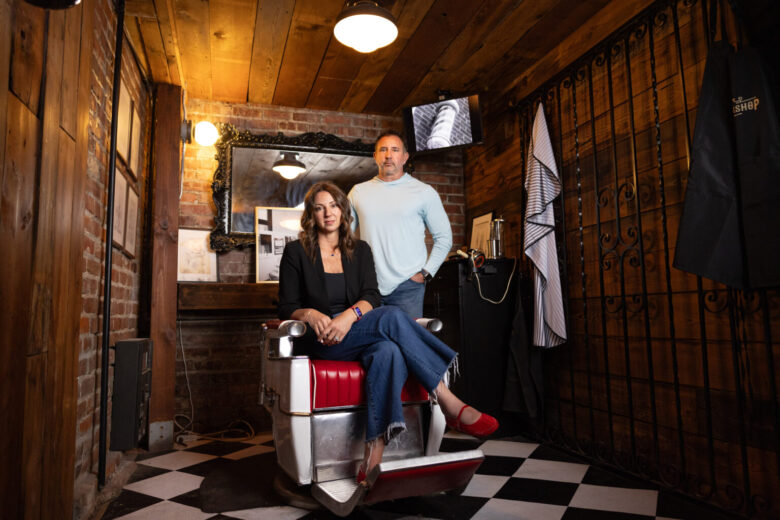
A legal setback and potentially “ruinous” state fines have forced a trio of Omaha siblings to at least temporarily rename the family’s “Barber Shop Blackstone,” a speakeasy bar they christened in honor of their longtime hair stylist dad.
Here’s the long and short of it: A state board that oversees the professional barber trade demanded a change, arguing that state law allows only licensed barbers to use the title and display the familiar red, white and blue barber pole.

Mike DiGiacomo and his brother and sister filed a lawsuit in February, alleging that the Nebraska Barber Shop Act violates their First Amendment rights by restricting “non-misleading” commercial speech. They said their marketing made clear that the barber-themed bar served cocktails, not buzz cuts and fades.
But after a federal judge’s April 20 decision to deny the family’s request for a preliminary injunction that could have prevented the state board from pursuing civil or criminal action pending a final resolution, the siblings acquiesced, sort of.
For the time being, the bar near 40th and Farnam Streets will call itself the “Censored Shop.” And the barber shop pole marking the mostly hidden speakeasy off of an alley in the popular Blackstone District will be “blacked out.”
The family says they want to avoid potentially “ruinous fines and even jail time.”
‘Common sense’
But they say their fight is not over. On Tuesday, the bar ownership’s legal team plans to file an appeal of U.S. District Court Judge Brian Buescher’s April ruling.

And as part of a stepped up pursuit for “free speech,” the national Institute for Justice public interest law firm has joined the family’s lawsuit. The University of Nebraska College of Law’s First Amendment Clinic still will be part of the legal team. The law students supported adding the weight of a national law firm, representatives said, partly because the legal proceedings are expected to last longer than a semester.
Robert McNamara, deputy litigation director for the Institute for Justice, said the group was eager to help defend the bar ownership’s right to commercial free speech.
“The facts of the case just jump out at you. It’s outrageous,” he said. “People don’t assume a barber-themed bar is a place to get your hair cut — just like people don’t assume a pirate-themed bar is helmed by a licensed sea captain.
“People have common sense.”
The bar owners have said their parents, Don and Linda, since 1977 owned the building in which the basement bar is located. Don, now deceased, had operated his hair-cutting and salon business there for more than 30 years and had been in the profession nearly 50 years. Mike DiGiacomo said they wanted to brand the bar to pay homage to their dad and other barbers.
The siblings said in court filings that the speakeasy is “intentionally discreet,” with access through a back-alley door tucked between a wall and a wood fence adorned with a small decorative barber pole. There’s no front-facing signage but social media advertises “carefully curated cocktails.”
Nebraska Attorney General Mike Hilgers and the state barber board, in opposing the injunction, argued that: “Speakeasys operate on the principle of deception. They are, by design, a public house that appears at first glance to be something else. This is often lawful.”
In this instance, the Hilgers team said, the bar’s name crossed the line. It said the state has regulated the practice of barbering for nearly a century via the Barber Act first enacted in 1927.
Kenneth Allen, the barbering board’s executive director, said part of his duties are to travel the state to inspect and investigate complaints and to ensure that only licensed barbers use the title “barber” or “barber shop” or display a “trademark” barber pole.
DiGiacomo believes the genesis of the blowout was a complaint by a barber who works in the Blackstone entertainment district. State officials referenced the complaint in court filings. They said the barber saw advertising on social media. She wasn’t sure if the DiGiacomo family’s establishment was going to offer haircuts but said social media posts indicated that patrons could expect “special guest barbers.”
“The whole theme of this place is so disrespectful to the trade I wish people would stop making money off of it, because it’s a cool idea,” the complaint said.
The Hilgers team contended that use of the words “barber shop” and a barber pole were both “inherently misleading” and misleading in context. It said the bar logo’s picture of straight razors “used exclusively by barbers” created confusion. They also said that the bar’s “Where the Buzz is Real” marketing tagline was confusing in light of actual “buzz cut” haircuts.
‘Ordinary words’
Buescher, in a 36-page order denying the preliminary injunction, agreed the buzz cut pun could be baffling.

“One would have to know that this ostensible barber shop is actually a bar to understand the pun, that is, as a reference to a ‘buzz’ from alcohol, gossip or excitement,” the judge wrote.
To that, McNamara said in an interview: “Your free speech rights shouldn’t hinge on whether government officials get your jokes.”
The judge said he didn’t think DiGiacomo and his siblings had “a fair chance of prevailing” on a constitutional claim. He said the commercial speech involved in using the name and the pole was inherently misleading. He said the family did not prove irreparable harm if the injunction were not granted.
McNamara traveled to Omaha for a scheduled news conference Tuesday to discuss the case and the family’s appeal of the judge’s decision denying the preliminary injunction. He contends the government can’t make it illegal to use “ordinary words” like barber shop without its permission.
“The government can regulate a business’ name to protect consumers from fraud or confusion,” McNamara said. “But it doesn’t have a free hand to take words out of the dictionary and put them under the control of a state board.”
