
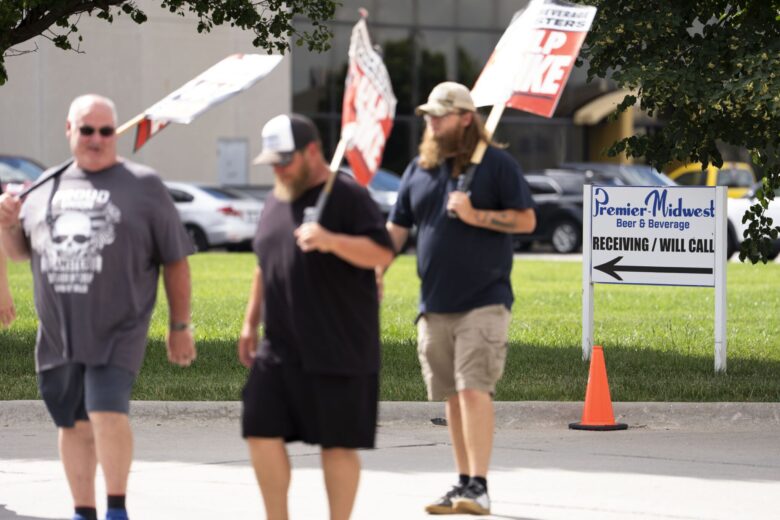
Rich Slobotski used to have Miller Lite, Pabst Blue Ribbon, Glacial Till Cider and Samuel Adams on tap at his Omaha bar. Now, he doesn’t sell any of them.
Thirsty customers at The Underwood Bar have frequently asked Slobotski when their favorite beers and ciders will be back behind the counter. But the bar is one of a handful of local spots that are purposefully choosing not to carry some of their biggest sellers.
The reason? They are supporting union workers who are on strike after the company they work for was bought out and the new owners demanded contract changes.

Since Feb. 2, unionized workers at the beverage distributor Premier-Midwest Beer & Beverage, previously known as Premier-Midwest Beverage, have been on strike after contract negotiations with the company stalled. Premier was bought three years ago by Texas-based Glazer’s Beer and Beverage, but the union contract did not come up for renewal until January of this year.
The contract with Premier had been in effect for more than 30 years. Teamsters Local 554 represents about 47 members who are warehouse employees, delivery drivers and merchandisers at Premier on strike to maintain their benefits.
Nebraska operates on a three-tier liquor distribution system that separates alcohol producers, distributors and retailers. That means businesses must buy most products only from state-licensed distributors, like Premier, rather than directly from a producer or other retailers.
Premier, which serves Douglas County and seven other counties in Nebraska, plus the town of Genoa in Nance County, holds distribution control over many big-name brands in the area, including Miller, Coors and Angry Orchard products. Local breweries such as Zipline, Lucky Bucket and Brickway also contract with Premier.
State lawmakers did recently pass a bill allowing small, local breweries to bypass distributors and sell directly to retailers, but this applies only to breweries without a pre-existing distributor agreement.
Eric Franz, the co-owner of Dundee’s Place Bar & Grill, said he became aware of the strike when a Premier delivery driver told him about it four months ago. He has boycotted the company and the products it distributes ever since.

It’s not easy for his bar to avoid stocking certain products, he said, but when customers know the reason, their general response is more supportive and accommodating than some may expect. Slobotski says the same.
As a small business, Franz said it’s important to stand with people in his industry, especially those who work often thankless, back-breaking jobs.
“I don’t want to discontinue carrying Miller High Life. I like Miller High Life,” he said. “But it’s more important to me to support these local workers in their struggle to maintain a fair contract that they’ve already held for years and years and years than it is to have product A.”
The contract between the Teamsters and Premier had regularly been negotiated and renewed for over three decades with little conflict, said Teamsters business agent Nathan Hall, who represents the striking workers.
This time around, the two sides haven’t sat down together for a negotiating session since Feb. 16, he said.

Both parties have leveled charges against the other alleging unfair labor practices and saying that the other side is bargaining in bad faith.
Premier did not respond to a list of questions a Flatwater reporter sent to a company official. In an emailed statement, Glazer’s, Premier’s parent company, said, “We have bargained in good faith throughout the process and have offered competitive pay, retirement savings and healthcare benefits through negotiations. While we are disappointed that the strike has not been resolved, we are thankful to the individuals who are working hard to continue serving our customers with minimal disruption. We have been able to provide a high level of service to our customers during the strike with new employees working under market-competitive wages and benefits.”
Hall disagrees that the company has bargained in good faith.
The company’s proposals, Hall said, would increase the cost of the workers’ current health insurance while also eliminating a 5% employer-funded contribution to their retirement plans. The company has also proposed reducing members’ pay and relying on performance-based metrics for potential raises, he said. The performance-based change, he said, would disproportionately impact the company’s more senior employees.

“At 50 years old, you’re probably not going to be as limber, as fast as you are at 23,” Hall said. “Delivering beer’s a really tough industry … It really breaks down workers’ bodies, their knees, their backs, and we just have no interest in working on a performance-based metric.”
At least 15 of the union employees at Premier have worked there for more than 20 years, Hall said.
Omaha City Council President Danny Begley, a Democrat, expressed his support for the workers in a Tuesday letter to Glazer’s and Premier. The letter, signed by fellow council members Pete Festersen, LaVonya Goodwin and Ron Hug, all Democrats, urged the company to reach a fair contract with the Teamsters.
Begley wrote that the workers’ “dedication has helped build a highly reputable and recognizable brand within the Omaha community.”
He added, “Omaha is proud to be home to this distributorship, and we hope to see a swift resolution that allows this long-standing relationship to thrive for years to come.”

Jeff Miller, a Premier delivery driver for 24 years, said he recently became the local company’s most senior employee. Before the strike, he said, that meant he could pick his own routes or delivery methods. But now, he said, Glazer’s wants to eliminate the perks of seniority long afforded by the union contract, meaning Miller could be sent out lifting kegs and navigating stairs at age 56.
Miller has sarcoma, a rare cancer that has spread to his bones. When he was first diagnosed in 2024, he relied heavily on the Teamsters health insurance for treatment. For him and his fellow union members, he said, that insurance has been vital in supporting them and their families.

It’s frustrating when people suggest the workers just find another job, Miller said.
“These guys are brothers and family, and I wouldn’t know what to do without a lot of these guys,” Miller said. “ I’ve seen (their) kids grow up. I’ve been to their weddings, I’ve been to their graduations. I’ve been to everything.”
The striking workers have maintained a 24-hour presence on the picket line outside Premier’s west Omaha warehouse since February. Paul Smith, who has worked in the Premier warehouse for 18 years, said he hasn’t seen his family as much since the strike began.
“It’s not fun,” Smith said. “I should not be having to miss weekends with my children … walking, getting just pounded with the wind constantly.”
The main reason he’s doing it, he said, is because his family could not afford the health insurance plan the company is offering, one with higher premiums, deductibles and out-of-pocket costs.
Everyone wants to get back to work, said Chris Carson, one of the union stewards and strike captains. Their lives, he said, are on hold.
“I’m angry. I didn’t ask to go on strike. None of us asked to go on strike,” Carson said. “That changes a person.”

Glazer’s has brought in workers from other states to fill the gap since the Teamsters went on strike, Carson said. Of the company’s roughly 12 distributor locations, Carson said Premier-Midwest is the only one represented by a union.
Josh Bruckner, who runs The Neighber’s bar on Leavenworth Street, said he can’t afford to stop selling Premier products entirely, but he has scaled back his orders since March in support of the Teamsters.
Bruckner said he has had problems with deliveries from the company since the strike began, as their replacement driver has misplaced products, often leaving kegs blocking his cooler door. He said he has had to call the Premier crew back to his bar three times to rearrange the cooler.
Maggie Erlandson, the general manager of Pageturners Lounge at 50th and Dodge, said the bar has stopped stocking many of its staples, including PBR, Miller High Life and Miller Lite.
When Erlandson tells her customers why those beers aren’t currently available, she said they have responded with empathy and understanding, despite the fact that those products are “some heavy hitters for us,” she said. “People who drink don’t like to have what they drink messed with.”
The Flatwater Free Press is Nebraska’s first independent, nonprofit newsroom focused on investigations and feature stories that matter.