

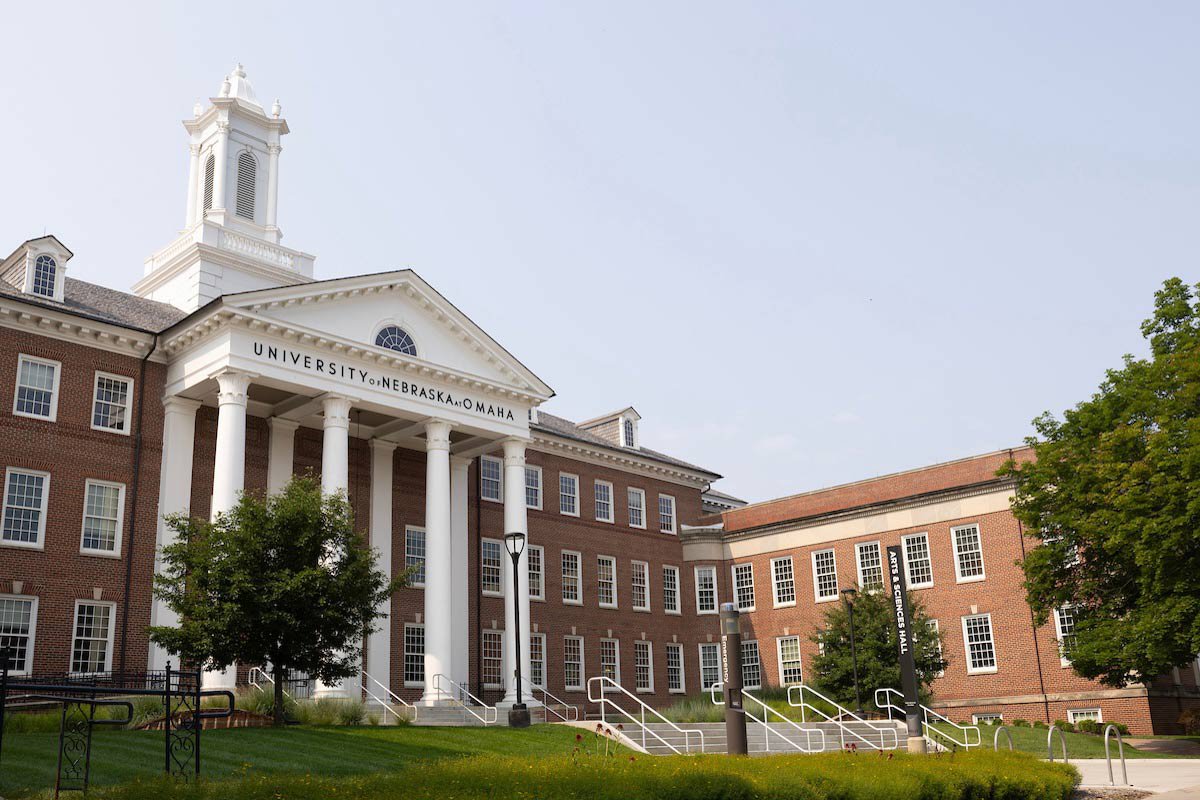
The Nebraska Center for 3D Innovation, or NE3D, officially begins operations at the University of Nebraska at Omaha on Aug. 15 — the launch of a new statewide research hub for developing 3D-printed technology for healthcare, backed by an $8 million grant UNO was awarded earlier this month.
UNO was announced as an awardee through the National Science Foundation’s Research Incubators for STEM Excellence, or E-RISE, awards. The university will use the funds to grow NE3D’s research and development in three areas: 3D-printed prosthetics, antimicrobial materials and anatomical models for surgical planning.
The program is based at UNO’s Biomechanics Research Building, which is currently under construction to add a $17.1 million addition. NE3D will be part of that expansion.
The center’s lead, UNO biomechanics researcher Jorge Zuniga, started this work as informal meetings among partner organizations in 2016.
“Back in 2016, we started a small group of people from iEXCEL, from Children’s Hospital, from UNL — essentially most of the people that are now participating,” Zuniga said. “And these conversations went something like this: How can we use additive manufacturing to help people improve the medical outcomes of individuals that may need it?”
That group has since grown into NE3D’s formal network of partners: the University of Nebraska-Lincoln, the University of Nebraska Medical Center and its iEXCEL simulation program, Children’s Hospital & Medical Center’s Mammel Innovation Center, School District 145, the Autism Action Partnership, Clarkson College’s 3D Printing and Training Center, Metropolitan Community College’s Prototype Design Lab, and industry partner Shabri LLC.
Zuniga said the center’s main mission is to provide an expedited path from UNO’s lab to people who will benefit directly from the lab’s research at minimal cost.
“We believe that all this research we do in laboratories should ultimately and rapidly benefit the community,” Zuniga said. “Because if you don’t do that, what are you going to spend your whole life working on? Things that are never going to directly benefit people?”
Prosthetics & Assistive Devices
Zuniga said the cost of healthcare is too high for those who need prosthetics. He said insurance typically covers one prosthesis a year, but children who need them often outgrow them before that year is up.
His team’s 3D-printed devices cost the lab roughly $200 to $250 to produce, a cost UNO absorbs rather than billing patients. He said a comparable mechanical device on the commercial market runs $10,000 to $20,000;one that uses electrical impulses to stimulate muscles can cost $30,000 to $50,000.
“You have to make things that are very low cost, like super accessible to people,” Zuniga said. “But that’s not the end of the story. They have to be low cost, but they have to be equal or superior to what’s in the market.”
To reach patients outside Omaha and Lincoln, the team has moved away from costly lab scanning equipment. Patients can scan the affected limb using a smartphone camera and send the images to UNO’s lab remotely.
“You take your cell phone, scan yourself… send it to our lab. Then in our lab, we take the scan and digitally develop [state-of-the-art] prosthetics,” he said.”
Zuniga emphasized the method’s importance in rural areas with fewer healthcare options, where patients may otherwise need to travel long distances just to be evaluated.
“You have to transport this person from Hastings to Omaha,” Zuniga said, describing a patient with a diabetes-related amputation. “What if we were able to do this digitally — we’re in 2026, man. What are we doing?”
One example of what that work looks like in practice is Rue Gillespie, who was born without part of her forearm below the elbow. Connected to Zuniga’s team through a contact at the VA’s Midwest prosthetics and orthotics program, the group built her a prosthetic to play golf and a device that let her ride a bike.
“She’s older now, and she’s still helping us,” Zuniga said. “She doesn’t need anything from us, but she’s helping us to make sure the devices are okay and they’re more comfortable and functional.”
Antimicrobial Materials
The center’s antimicrobial materials work started with a Department of Defense project addressing what Zuniga called a “two-week golden window” — the period after a limb amputation during which a patient is most likely to accept a prosthetic device.
The team found that standard 3D-printed plastic is porous enough to harbor bacteria.
“If you look at it under the microscope, you can see all the pores,” Zuniga said. “You have moisture in it, and that’s where bacteria will have a party.”
UNO Biomechanics partnered with Copper3D, a Chilean company known for antimicrobial 3D-printing materials, to develop the copper-based additive, carried in a mineral called zeolite, that withstands the high heat of the 3D-printing process without breaking down.
NASA has separately funded the team’s antimicrobial and in-space manufacturing research, including a $1.125 million grant in 2021, to adapt similar materials for medical devices and equipment used by astronauts, whose immune systems become weakened in space, making infection especially dangerous.
Anatomical Models for Surgical Planning
The focus of anatomical models traces back to one of the group’s earliest projects. In 2016, a family in Chile reached out after their 6-year-old daughter needed a tumor removed near her spinal cord. The team built an anatomical model of her spine to help surgeons prepare, and Zuniga flew it to Chile himself.
“It was so awesome to see… within about two weeks we came up with an anatomical model,” Zuniga said. “The parents believe that it helped the clinical outcome — none of the flexors, the control of your arm movements, was damaged.”
The work has since become personal. Zuniga said his own son had knee surgery last week, and his team built a model of his son’s knee so the surgeon could practice beforehand.
“We developed a model of his knee from CT scans, and we mimicked the bone, we mimicked the cartilage underneath the patella… We mimicked everything so then surgeons can go ahead and then kind of practice the surgery beforehand,” Zuniga said.
Zuniga said the goal is to make anatomically correct models that realistically mimic the areas of surgery doctors will practice and operate on before performing the actual procedure, hopefully improving operating time, decreasing errors and improving patient health and well-being.
Zuniga said the models could be especially valuable for residents, who currently gain much of their hands-on surgical experience on real patients.
“Well, they have to learn, right? I mean, how do you think these people learn? They learn with your grandma, they learn with my kid, they learn with us,” Zuniga said. “Maybe we should have them do some models first. It would improve things, I think.”
What’s Next
NE3D’s four-year plan is still being finalized with the National Science Foundation. Zuniga said the plan includes developing soft robotic components and sensors for more responsive prosthetics, expanding antimicrobial testing, and improving the realism of anatomical models.
Zuniga said hiring is expected to begin once the center officially begins operations.