

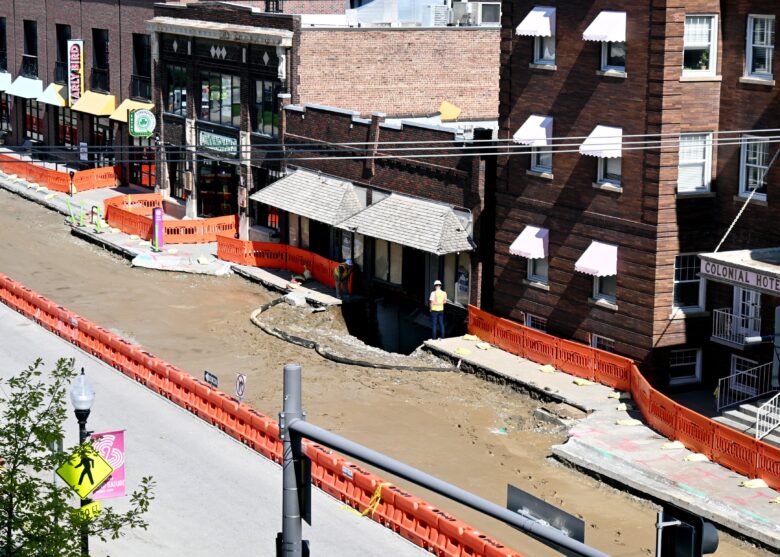
There were more sinkholes in Omaha’s Blackstone neighborhood that didn’t make headlines.
A large void opened in late June when the foundation wall of a vacant building collapsed, swallowing a sidewalk and part of the building at 3810 and 3812 Farnam St. A hole remains while the city awaits a decision from the building owners on whether to repair or demolish the property.
Nearly two weeks before that void formed, engineers working on the nearby streetcar line met to discuss sinkholes in the area, according to a timeline of events obtained by Nebraska Public Media through a public records request.
In an emailed statement shared Monday, city officials confirmed four minor voids were found roughly in the center of Farnam between 38th Street and 38th Avenue.
“Workers with Kiewit packed dirt in the voids to minimize more dirt sloughing and rain infiltration,” officials said. “Work by city contractors following the collapse indicated that the south lane of Farnam was safe for travel.”
City officials continue to investigate the sinkhole-like void on Farnam Street. Steve Jensen, longtime city planner and interim director of the Omaha Streetcar Authority, has said publicly and in internal emails that construction conditions contributed to the June 21 collapse during heavy rains.
The building, a former cocktail bar called Brother’s Lounge, sits directly on the streetcar line where significant underground utility work took place through the spring. It’s now up to the owners how to move forward. The city pledged to cover the cost of repair or demolition using streetcar funds.
Emails show that engineers working on the streetcar found water underground weeks before the void formed. Where that water came from remains a mystery. MUD, which operates more than 3,000 miles of water distribution mains underneath Omaha’s streets, found no evidence of a water main break.
A high-level team working on the streetcar met June 9 to “discuss sinkholes from 38th Street and 38th Ave.,” according to a June 9 log recorded in a detailed timeline shared with the city’s law department.
“Limits of east sinkhole have extended, however, no additional settling observed,” the log stated. “…City of Omaha will further investigate a source for water issues before stabilization efforts to commence.”
Crews checked a nearby storm sewer and water main and sent samples to a lab in an effort to determine where the mystery water was coming from. As of late August, they still don’t have a conclusive answer.
Another Omaha sinkhole — this one not related to streetcar construction — made national news when a void opened at the intersection of 67th and Pacific streets on Feb. 24, swallowing two vehicles. No one was seriously injured.
One factor that could contribute to Omaha’s sinkhole problems is the abundance of loess soil in eastern Nebraska. It’s a type of wind-deposited sediment found across the Midwest, and in parts of Central Europe and China. It’s very prone to erosion when wet.
Nebraska isn’t a hotbed for natural sinkholes, State Geologist Matt Joeckel told Nebraska Public Media in March. Though aided by the state’s highly erodible soils, local sinkholes are almost always caused by some sort of infrastructure failure.