
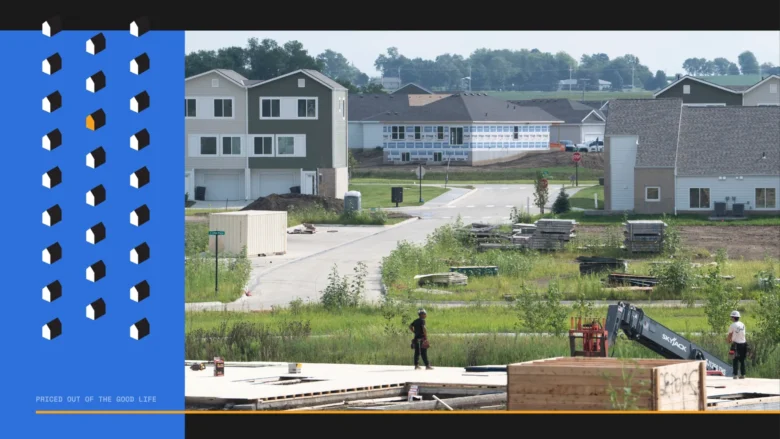
When Maddie Hall flips through Zillow listings on her phone and sees what houses sell for these days, she thinks home ownership just isn’t financially possible.
The 29-year-old event planner also worries about being tied down by a mortgage when staying mobile and flexible could help her advance in her career.
So for now, she will stick with the convenience of her midtown Omaha apartment and her easy ability to walk to favorite neighborhood restaurants and hangouts.
“I think an apartment makes the most sense for me,” Hall said.

Fueled by the experiences and thinking of people like Hall, Omaha is in the midst of its biggest apartment-building boom in generations — perhaps ever. To local housing experts, it’s an indicator of both sickness and strength within Omaha’s wider housing market.
As single-family home building has languished and pushed prices for new and existing homes beyond the means of many would-be buyers, apartments now appear to be picking up the slack.
In the past four years, more multifamily housing units — almost all apartments for rent — have been built than single-family homes. That’s a staggering change from a decade ago, when twice as many houses as apartments were going up.
Two decades ago, the ratio was five houses for every one apartment or other multifamily unit.
“The cost of buying a home is now out of reach for many young people,” said Mike Riedmann, president emeritus of N.P. Dodge Real Estate. “So they have to stay in apartments.”
Riedmann, housing advocates and experts believe that thousands of Omahans would prefer owning a house but instead continue to rent due to the lack of affordable options. And they miss out on the home ownership that for generations has been the primary means for middle-income families to build wealth.
Shannon Harner, executive director of the Nebraska Investment Finance Authority, sees danger in millennials and Gen Z becoming generations of renters — adding urgency to the need to solve the state’s housing affordability crisis.
“A house is still a pretty solid investment,” Harner said. “It meets a basic need and creates wealth at the same time.”
The apartment-building boom can be seen both in Omaha’s urban core, where it’s revitalizing older neighborhoods, and in suburban communities, where apartments were historically shunned.
It’s also producing both subsidized units for low-income families as well as luxury apartments loaded with amenities to lure young professionals. Construction of townhomes — often called the “missing middle” housing between apartments and single homes — is also on the rise.
Any new housing unit, whether an apartment or single-family home, helps to address Omaha’s housing affordability crisis, housing advocates say, boosting the housing supply and helping to bring down home prices and rents.
So until house prices and incomes get back in balance in the metro, apartments will continue to fill in the gap. Thousands of apartments have been added in recent years, and yet vacancy rates remain low.
“They come on line, and they fill up,” said David Fanslau, Omaha’s city planning director. “The market will let us know when we have built enough.”
***
The roots of Omaha’s apartment boom go back almost two decades, to the Great Recession and the financial failure of one of Omaha’s biggest homebuilders.
In 2012, HearthStone Homes filed for bankruptcy. HearthStone’s sweet spot had been building homes for under $200,000 that appealed to first-time homebuyers. Some smaller builders also exited the market. Not enough builders stepped up to replace them.
Single-family homebuilding in the metro nosedived from 5,000 new houses in 2005 down to fewer than 2,000 in 2011, and it has remained sluggish ever since. Over time, that amounted to tens of thousands of lost homes.
That huge hit to the housing supply came just as millennials — now the nation’s biggest generation — entered their prime years for raising families. That created a massive housing shortage.
“We’re still digging out of that hole,” Harner said.
With big demand and slack supply, the prices of both new and existing homes were bid up at an historic pace. A Flatwater analysis of Zillow data shows the median sale price of a home in the Omaha metro more than doubled in just over a decade, from about $150,000 in 2013 to over $310,000 in 2025.
That included three consecutive double-digit increases from 2020 to 2022, when the cost of an Omaha home rose by a third in just three short years.
“Housing affordability for ownership has really been crushed with cost escalation and interest rates,” said Jake Hoppe, CEO of a Lincoln-based housing developer. “The affordability gap is pretty large. Apartments are a lot cheaper.”
Omaha’s housing construction market ultimately responded to the demand for more housing — not with stepped-up single-family home construction, but with apartments.
According to a Flatwater analysis of Greater Omaha Chamber data, construction permits for multifamily units in the metro jumped nearly 60% in 2022. For the first time in recent history, they exceeded permits for single-family houses, which declined by 20% that same year.
The roughly 3,500 multifamily units, mostly apartments, permitted in the metro in both 2022 and 2024 were the most seen in federal data that dates back to 1988.
“The law of supply and demand is as true as the law of gravity,” said Scott Dobbe, president of GreenSlate Development Partners. “Apartments are the part of the market that is best able to respond.”
Between 2022 to 2025, there were 12,600 multifamily units started in the metro compared to 10,900 single-family homes, chamber figures show, signaling a fundamental shift in the housing market.
That shift is also happening nationally — two years ago, apartment construction hit its highest level since the 1970s. Nationally, though, single-family homes have continued to outpace apartments.
The apartment building boom has helped Omaha add housing at a much faster pace than the nation as a whole, a Flatwater analysis found. Over the last five years, Omaha added single-family homes at about 10% over the national rate, but its construction of multi units exceeded the U.S. rate by nearly 70%.
And while nationally the apartment-building boom appears to be over, Omaha has yet to show much sign of a letup.
Omaha is currently on pace for another 3,500 new multi units this year, again slightly outpacing single-family homes.
The evidence is plain to the naked eye: Drive around Omaha, and you’ll see new apartment buildings going up across the city.
***
Earlier this month, 8-year-old Sylas Golden held an oversized pair of scissors and snipped a red ribbon stretched across the doorway of his family’s new townhome in Papillion.
The family of five was among the first to move into the new Tallgrass Apartments, a 600-unit community of apartments and townhomes rising near 72nd Street and Capehart Road.
“We want people to feel like they are in a home and not just another rental space,” said Danielle Frye, property manager of Tallgrass.
The family’s new rental unit features four bedrooms. That’s rare in a market mostly churning out 1- and 2-bedroom apartments. It’s also a reflection of the shortage of affordable single-family homes.

Tallgrass is also an example of nonprofits working with developers to bring more affordable housing online. Hoppe’s development company partnered with Omaha’s Front Porch Investments to create the new suburban neighborhood that includes market-rate rental units, subsidized rentals for lower-income families and townhomes for sale. The vast majority of the 3,200 new housing units Front Porch has committed to help deliver in the metro have been apartments.
Local development policy is also spurring new apartment development.
In an effort to create an urban core that feels vibrant to both employers and employees, Omaha has used tax increment financing for subsidized and market-rate apartments. One of the chief reasons city officials pushed to build the streetcar was to create more dense development in the inner core.
In midtown’s Blackstone, Little Bohemia just south of downtown and the Leavenworth Street corridor west of downtown, apartment development is helping to create vibrant, walkable neighborhoods, Fanslau said. On Leavenworth alone between 27th and 50th, there are three new apartment complexes currently rising.
“It’s density, density, density in downtown, and (developers) have taken advantage of it,” Fanslau said. “I don’t think that’s going to stop anytime soon, especially with the streetcar coming online.”
Dobbe noted a regional housing study in 2019 found a mismatch between what was being built and what most people said they wanted. While most new housing in Omaha was single-family homes in the suburbs, people were calling for homes in more walkable and urban neighborhoods.
The market seems to be correcting that mismatch. And even if that kind of urban living doesn’t “float your boat,” Dobbe said, everyone benefits if that housing helps Omaha compete for workers and jobs.
To draw in young renters, many of the new urban complexes are going all out with amenities. At Oxworth Apartments at 27th and Leavenworth, developer Tom McLeay reeled off a dizzying array: A pool. Outdoor firepits. Outdoor TV. Dog park. Coffee bar, clubhouse and bar. Exercise facility. Sauna. Game room. Office space for working from home. Even a dog wash.
“If your choice is this or a house that might be a bit older housing stock, which one do you pick?” McLeay said. “I think for young people, for quite a few years, this is what they’re picking.”

The city has also made zoning changes in west Omaha to encourage new apartments. Hoppe said suburbs that previously frowned upon new apartment development now seem more open, too.
Where once a developer might be told, “We don’t want apartments here,” Hoppe said, now they are hearing, “What are you doing in this new development to create affordable housing?”
The reason for the new attitude?
“Now people are finding their kids can’t find a place to live,” Hoppe said.
Besides the lack of affordability for houses, developers cite changing lifestyles as a definite driver in Omaha’s apartment boom.
Younger people today are putting off getting married and having kids longer than past generations. Where the average age of a first-time homebuyer three decades ago was 28 or 29, it recently hit 40, according to the National Association of Realtors.
Todd Heistand, a developer known for converting former downtown office buildings into apartments, says he frequently hears young people say they rent because they don’t want to be tied down professionally.
Developers say renters today are also less likely than previous generations to have roommates, requiring construction of more single-bedroom units. McLeay said of his 194 new apartments at 27th and Leavenworth, only about a dozen are two-bedroom.
“We are building a lot more one-bedrooms, and they’re filling up,” Heistand said.
Housing experts say Omaha’s apartment development has likely helped ease home price inflation from the highs seen three or four years ago. Zillow data suggests prices for metro single-family homes in the metro increased less than 2% in 2025, compared to the recent high of over 10% in 2022. It also has helped slow rent increases.
Harner hopes all the new apartments will further slow price escalation and serve as a bridge for many young people until they can afford a home.
Apartment living will remain the housing of choice for Hall, the Omaha event planner. Hall loves being outdoors, and would love a house with a yard. But for now, she would take an upgraded apartment with a balcony and pool.
As for buying a house, Hall will see what the future market holds. When she recently learned how low her parents’ monthly mortgage payments and interest rates were, she said she almost fell over. She could never find anything so affordable today.
The 30-year mortgage was created with the idea that people would have their homes paid off by the time they retire, she said. But if she can’t get into a house until she’s 40, how much sense does that make?
“Things are so different from what we’ve been told for so long and the reality today,” she said.
The Flatwater Free Press is Nebraska’s first independent, nonprofit newsroom focused on investigations and feature stories that matter.