

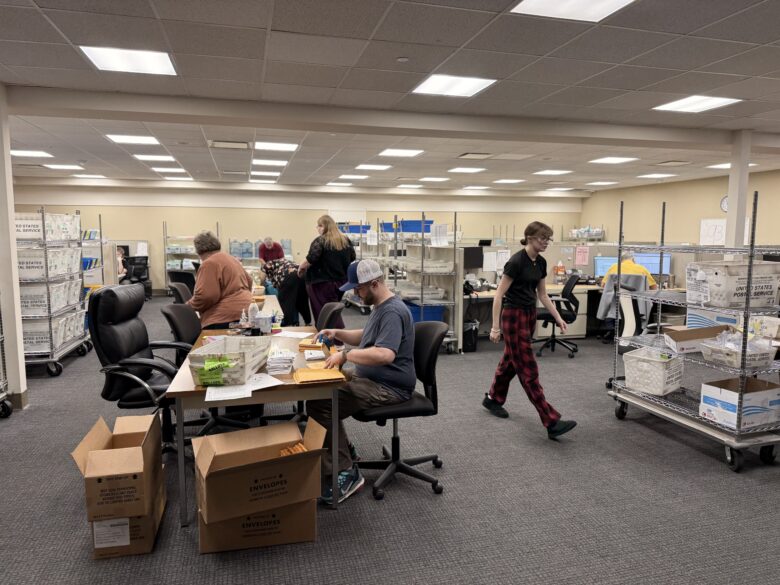
In the weeks leading up to the election, staff at the Douglas County Election Commission’s office were busy preparing and accepting ballots while helping voters along the way. Their work is essential to ensuring election integrity as the national conversation centers around potential election fraud and how to fight it.

But the reason why this office, and the election commissioner position itself, exists at all dates back over 100 years. And it all began with a man named Tom Dennison.
Thomas Neal, executive director of the Douglas County Historical Society, knows Dennison’s name well.
“He was (called) the most powerful private in the army, because everyone else did all of his bidding,” Neal said, referencing Dennison’s behind-the-scenes sway over Omaha and its organized crime.
While Dennison was not literally in the army, he did lead a crime ring in Omaha in the late 19th and early 20th centuries. Dennison’s “machine” was, in part, held together by sympathetic officials whose positions in city government were owed to the man himself, often secured through election fraud. Orville D. Menard, a Nebraska-based historian, wrote extensively about Dennison’s reign.
“Preparing for an election was not a sometime thing, confined to the few weeks prior to actual balloting,” Menard wrote in his book “Political Bossism in Mid-America: Tom Dennison’s Omaha 1900-1933.” “It was a constant preoccupation and carefully calculated everyday machine activities were carried on with an eye to victories.”
Menard and other historians who documented what they could of Dennison’s life frequently referred to him as the “boss,” and his operation as “the machine.”
Who was Dennison?

Before he became a crime-ring leader in Omaha, Dennison grew up in Iowa and Nebraska as the son of an Irish Catholic farming family. He later spent his early years traveling across the West and learning the business of gambling. By the time he moved to Omaha in 1892, the city was booming thanks to agriculture, railroads and meatpacking. But it also had a seedy underbelly that was largely accepted by Omahans and law enforcement alike, earning the city a nickname.
“It definitely was called ‘A dirty little town’,” Neal said. “It was, to gamblers, called an open town, meaning there really was not a whole lot of law. And if there was law, they were looking the other way. There was prostitution. There was gambling. There was thievery. There were drinking establishments.”

Dennison created his own gambling house shortly after arriving in Omaha but relied heavily on networking, according to Neal. Through friendship and favors, Dennison managed to get a hand in many illegal businesses across the city. But his connections were not only with businessmen. Neal said, and Menard wrote in “River City Empire: Tom Dennison’s Omaha,” that Dennison knew the average working man from across different ethnicities would prove vital to his machine.
“Elites were the preserve of white Northern European protestants, while the late nineteenth-century immigrants were largely uneducated peasant Catholics from Ireland or Southern or Eastern Europe,” Menard wrote. “Unwelcome, except as low-level laborers, these new Americans turned to a political boss who was waiting and willing to help them. His price was taken by those called upon to pay as really quite cheap. Nothing more than a vote.”
Good jobs, tax breaks and other favors were offered in exchange for a vote for a Dennison candidate in a city political race. The more officials Dennison knew in city offices, the better favors he could offer. For instance, businesses he was connected with might not be raided by law enforcement, while other gambling houses would be shut down by the police. Neal said even James C. Dahlman, or “Cowboy Jim,” an eight-time mayor of Omaha, was what some historians called a “Dennison Man.”

“‘He says, ‘I’ll make you mayor. But guess what? You’re reporting to me now’,” Neal said. “The police chief, a lot of the police force, all reported to Dennison on a daily basis. They came in first thing, (but) instead of checking into the office, they checked in at Dennison’s office. ‘What would you like me to do today, sir?’”
So long as those officials supported Dennison’s businesses instead of shutting them down, Neal said they continued getting political support from his voters. If anyone stopped supporting him, they often lost their political office and some were even driven out of town.
Most of Dennison’s election influence centered around downtown Omaha, where Neal said he could create enough votes through election fraud to offset any of his opponents who might have done well in other districts.
“He printed the ballots, he had them pre-marked, he counted the ballots, he delivered the ballots,” Neal said.
Dennison had loyalists working as officials at poll sites, and they sometimes would grab random people off the street and bribe them to vote for Dennison’s friends. One Dennison Man, P.J. “Pete” Rooney, opened a boarding house just days before a state. Senate election in 1913 and registered anyone who stayed there to vote before sending them to the polls, whether they actually lived full time in Omaha or not. Each boarder voted in the same order he was registered. That boarding house closed almost immediately after the election, according to Menard. Other times, officials would simply make up a name on a ballot.
“The joke was that the people who helped establish Omaha had been dead years prior to that, but they voted in the first elections (and) they’re still voting today,” Neal said with a laugh.
Neal said Dennison even owned a printing press and would pre-print ballots to be counted on election day in favor of his friends.
“Somebody would find a ballot that was marked the wrong way and pull it out, and then they would be given a ballot to substitute instead,” Secretary of State Bob Evnen said.
The Honest Election Law is born
While Dennison’s loyalists used many strategies to keep the right people in office, Evnen said one of them was eventually caught.
“It resulted in litigation, and the outcome of that litigation was the law that was passed in 1913 that we still have in place today,” Evnen said.

That law was the Honest Election Law, sponsored by Nathan P. Dodge Jr., more commonly known as N.P. Dodge. N.P. Dodge, served in the Nebraska House of Representatives from 1905 to 1909 and then in the Nebraska State Senate from 1913 to 1917. This was before Nebraska established a unicameral legislature in the 1930s. He authored the Honest Election Law, although he wrote in a report that he was inspired by laws from other states.
The law passed after a special committee for the Nebraska State Senate investigated one Omaha election and found that some of the men running the election were, quote, “grossly ignorant, incompetent, and totally indifferent to their duties and to the rights of the candidates.”
For instance, the special committee reported that during the 1912 senate election, one precinct, then referred to as a ward, was staffed entirely by drunk election officials. Menard wrote that a clerk from a local county judge office was called in to help late on election night. The clerk found the drunk officials in “pandemonium” as they were attempting to count ballots, many of which were strewn across the floor. While sober officials stepped in to help count the ballots, they ended up with 10 more ballots than there were registered voters in the poll book.
“An absolutely honest election has not taken place in such precincts within the memory of man,” the special committee reported.
That report stoked a fire within lawmakers to pass the newly proposed law. Dodge suggested creating the office of election commissioner for Douglas County, who would take accountability for honest elections staffed by honest officials. That commissioner would be appointed by the governor, and the office would consolidate the power to staff and oversee election officials to prevent outside interests, such as Dennison, from planting their own staff. The commissioner would ensure that good officials would count the ballots and verify voter registrations so that real, living people would get one vote for the candidates of their choosing.

While the bill made its way through the lawmaking process, the Omaha Bee, a newspaper that Neal said was owned by a family sympathetic to Dennison, covered the “considerable street discussion (that arose) over the merits of this bill.”
Some argued that even if the governor appointed an election commissioner, that commissioner could still engage in election fraud and nothing would change. Concerns were also raised about home rule implications for the city and that whoever took the office would be politically obligated to the governor and whatever party the governor was aligned with.
But proponents argued that the commissioner would carry a great deal of responsibility and could be removed if they did not fulfill their duty. Additionally, the commissioner, under the law, was given the power to draft officials from precincts, or wards, that historically had secure elections to work in historically fraudulent precincts and help clean things up.
Regardless, the bill became law in 1913 and then Gov. John Henry Morehead appointed Harley Moorehead as the first Douglas County Election Commissioner, calling him a good, straight and honest citizen who was perfect for the job.
Today in Douglas County
“When I started my job, I never really thought about how it came to be that the election commissioners of counties over 100,000 (people) were appointed by the governor,” Danielle Jensen, today’s Douglas County election commissioner, said, while poring over history books about Dennison at the Omaha Public Library, Central Branch.
The law originally applied only to Douglas County, which, at the time the Honest Election Law passed, was the only county in the state with more than 100,000 people. Lancaster County got its own office in 1947 and Sarpy County joined in the 1990s.
Today, Jensen and her staff at the commissioner’s office work to ensure nothing like what Dennison accomplished back in the day can happen in today’s elections, whether it’s through ensuring sometimes-drafted poll workers of differing parties are overseeing the voting process, rigid voter registration record-keeping, signature and ID verifications and more. She doesn’t think someone like Dennison could pull off election fraud today.
“We have so many checks and balances, so many procedure checks, so many, so many things in place in law,” Jensen said. “I think it’s something that we’re just going to have to learn about and relive through history books. I think it’s important to learn about it so that it doesn’t happen.”
Jensen said election security is not only of paramount importance, it holds a personal significance for her.
“Not only is it our right, it’s our civic duty as American citizens to participate in the process because we’re making decisions about who makes our laws,” Jensen said. “I think it’s almost your duty, and so when someone comes in and messes with that, that taints the entire process. To me, that taints our country. It taints what our founding fathers fought for.”
Dennison stands out as a particularly interesting character to Jensen and Neal. Dennison continued running illegal operations in Omaha, albeit with less control over local elections, until a federal court case forever tarnished his reputation. Dennison died in 1934, and Neal said his funeral procession was one of the longest in Omaha’s recorded history, spanning blocks. Neal said it was a show of love. Jensen sees Dennison as responsible, at least in part, for Nebraska’s election security procedures today.
“It all came about because of Tom Dennison,” Jensen said. “I kind of have him to thank for my job in a long roundabout way.”