
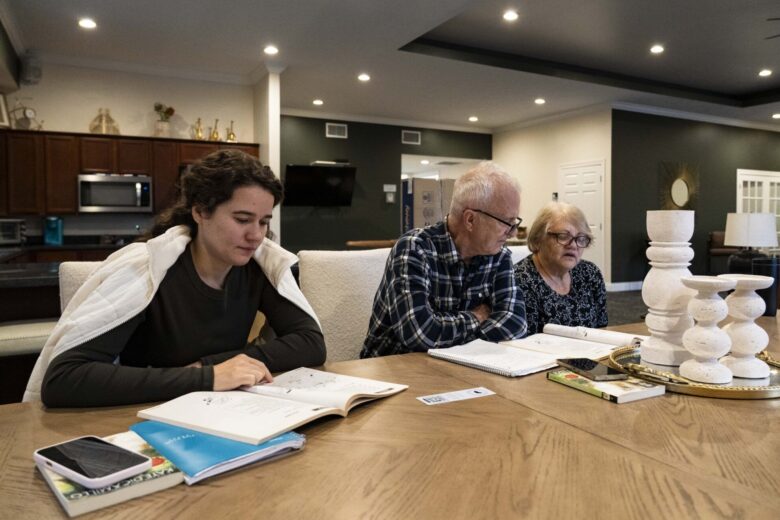
Karolina Ohnivchuk’s fingers traced the words on the page, brow furrowed in concentration.
She listened as her neighbors, Oleksandr and Varvara Babishkevych, slowly recited English sentences from well-loved paperbacks. Paging through the children’s book, they read of the dog who couldn’t stand to be left alone, who pulled cushions off the couch and howled when he was stuck outside, tied up with a rope.
Yes, their teacher praised. Da.
Karolina, soft-spoken but eager, chimed in with the next sentence:
“Getting left behind probably made his heart feel empty.”
The group had just spent 30 minutes practicing English phrases to refill prescriptions or get their test results from the doctor’s office. The story of a girl and her dog offered a welcome break.
Karolina, a Ukrainian mother of three, has spent hours reading “Because of Winn-Dixie.” Outside of class, she reads it with her kids. English has already become a regular facet of their life: They picked up the language quickly in school and chatter with their friends without issue. For children, language is a gift. For adults, it’s a challenge.
The 31-year-old is one of the more than 2,500 Ukrainians resettled in Nebraska since Russia’s invasion in February 2022.
But despite vocal support from Nebraska officials, their future remains shaky. The two paths Ukrainians used to come to the U.S. legally offer no direct path to citizenship and could be ended by the president with little notice. If they’re canceled, Ukrainians could face deportation back to a war zone.
For now, the two Ukrainian families, and 40 others, make their homes inside a cluster of three-story, beige-and-brick apartment buildings that sit a short walk from Elkhorn’s main drag. At Elk Hills, this 216-unit apartment complex, roughly 1 in 5 tenants are Ukrainian.
It’s here that they watch international news with bated breath, praying for an end to the conflict that turned their lives upside down. It’s here they have gained — and lost — government help. It’s where they have found a new sense of community, bolstered by a network of Nebraskans helping them navigate life in the U.S.
Kathy McCormack taught Russian for years, and helped several families resettle in Nebraska. Now, she teaches Karolina and her neighbors English two days a week, gathered inside the complex’s clubhouse.
Varvara is the best cook McCormack has ever met; her golubtsi, cabbage rolls stuffed with ground beef and baked in tomato sauce, have the perfect amount of dill. Karolina juggles taking care of her three children and supporting her husband, who has multiple sclerosis and uses a wheelchair. She’s planning to take English classes at Metropolitan Community College in the spring. She is the strongest woman her tutor knows.
A new resident is set to join the complex in December, bringing a baby with her. Already, the ragtag group coordinated via WhatsApp chats to proffer a travel crib and clothes for the incoming youngest member of their community.
Escaping war was the first challenge McCormack’s Ukrainian students faced. Then came immigration meetings, learning a new language and culture, finding basics like transportation, housing, a job — building a new life from scratch.
“They’re Nebraskans who were born in a different country,” McCormack said, tears welling in her eyes. “You’re not better people than they are. You’re just more fortunate.”

***
Lynnsey Danker didn’t set out to create a Ukrainian safe harbor in the Omaha suburbs.
It was 2013, and the property manager was learning the tools of the trade from her grandfather. They were building what would become Elk Hills. That’s when they met two Ukrainian brothers, hired as subcontractors to install entryway tile.
“I’ll never forget (my grandfather) coming into the office every day and saying, ‘These two brothers are the hardest-working subcontractors that we have on site. They show up before everybody. They’re educated in their trade. They’re very professional, and they just want to talk and tell their story,’” Danker said.
Over the years, Danker lost touch with the men. In February 2022, her grandfather died. A week later, Russia invaded Ukraine. She wondered how the brothers were faring. Two months later, one of them, Nikolay, walked back into her life, this time with a request.
Four Ukrainian families were staying in his basement, he explained. They had fled the war, and while he was eager to help, his basement was full. He’d come back to the same complex he had helped build to ask Danker: Can you help newly arriving Ukrainians find a place to call home?
Yes, Danker said.
“It’s a ‘be kind to your neighbor’ type of situation,” she said. “I’ve got a demographic that needs a place to live, and that’s a service I can offer … The easiest thing to be is a nice human being and a nice person. And if we have something that we can offer, why wouldn’t we?”
At the outset, most Ukrainians settling in Elk Hills knew each other. Nikolay’s parents moved into the complex, as did one of his best friends — Karolina’s husband. As word spread, more Ukrainians began to flock to the apartments.
McCormack recalled helping a woman with immigration paperwork only to realize she had the same last name as another tenant. She connected the two, who discovered they were second cousins. They had never met in Ukraine; it was Elk Hills that brought them together.
At one point, as many as 60 Ukrainian families lived there.
Danker has watched her tenants put down roots. They have started working for Nebraska companies. They have joined churches and enrolled their children in local schools. She has seen those kids grow and thrive, alongside her own, and celebrated their accomplishments, like making varsity soccer.
She has seen Ukrainians meet and fall in love with American citizens, moving out on their own.
Those are the happy departures. She has seen the darker ones, too. Families whose work permits expired, waiting months for a renewal that didn’t come. Families who would rather roll the dice and go to another country, hoping for an end to their legal limbo.

“We see these residents who want to work, who want to pay taxes, who want to contribute to our economy, have this taken away from them,” she said. “They can’t work, can’t pay rent, can’t support their family, can’t shop.”
In early October, the apartment-dwellers anxiously waited as the federal government considered their fate. Many Ukrainians live in the U.S. with Temporary Protected Status, which protects against deportation and allows them to work. The deadline to extend this status for Ukrainians was Oct. 19, and it remained unclear whether U.S. President Donald Trump’s administration had any appetite to do so.
Since being re-elected, Trump has canceled TPS status for 13 countries, affecting about 1 million people. While Ukrainians have for years garnered Republican sympathies and support, the relationship between Trump and Ukrainian President Volodymyr Zelenskyy has deteriorated.
Nebraska lawmakers have tried to help where they can. In 2023, the Legislature passed a law allowing Ukrainians driver’s licenses after advocates noted an inability to drive worsened an already difficult situation for newcomers.
Gov. Jim Pillen has called Ukraine the frontline of freedom in the world. Former state lawmaker Tom Brewer has traveled to the country nine times since the war began. But much of what complicates life for Ukrainians living in Nebraska is out of the state’s control.
Speaking to a conference of advocates in Omaha Oct. 9, outgoing U.S. Rep. Don Bacon promised to push the White House hard to extend Ukrainians’ status. He extended his phone, taking a selfie with attendees to show the federal government just how much support Nebraskans had for extending TPS. But he made it clear he doesn’t believe another extension is enough.
“I really would like to see a plan for green cards and allow people to stay here permanently,” Bacon said to the crowd. “That’s the ultimate answer. It’s creating a lot of uncertainty for people … Do I buy a car? Do I buy a house? Do I put a down payment on a house? Do I have another child? All these questions are hard if you don’t have certainty, and I would sure like to create that certainty.”
Oct. 19 came and went. Instead of making a final decision, the administration posted 31 words on the U.S. Citizenship and Immigration Services website:
ALERT: An announcement on Ukraine’s TPS will be made at the appropriate time. Until such announcement is made, Ukrainian individuals present in the U.S. under TPS retain protection including work authorization.
For now, the Elk Hills residents remain in limbo.
***
Varvara laid out ingredients for the pirozhki, bowls clattering on the counter. She fetched the dough, prepared hours in advance, and got to work.
An untrained Nebraskan eye might mistake her creations for Runzas, or bierocks. But pirozhki are a cousin of the popular German pastry, Varvara, 70, explained. They can be sweet, filled with apples and butter, or savory, with minced meat and cabbage.
Varvara’s daughter and son-in-law are Canadian citizens, though they work and own a home in Omaha. When the war began, Varvara and Oleksandr decided to join the daughter and son-in-law in the U.S. They fled to Poland first, where they stayed with fellow Christians for 10 days. Then they flew to Germany, then Mexico City, where they sheltered with more believers overnight.
They didn’t know the language, where they were going, or what would happen, said the 72-year-old Oleksandr through an interpreter.
“You arrive in Mexico and you’re not sure that they aren’t going to tell you, ‘Get out of here. Go back where you came from,’” he said.
They flew to San Diego, then Omaha. For a year, they lived with their daughter and her family, but with three grandchildren already in the home, it was crowded. Then they heard about Elk Hills.
They have made the space their own. Varvara’s handmade quilted pillows decorate the apartment, and family photos are affixed proudly to their refrigerator. They take walks around the complex with their fellow countrymen in the evening, and share Varvara’s pirozhki — a small taste of home.

Varvara and Oleksandr miss Ukraine. But the small city they lived in has been a target for attacks. Returning would be a death wish.
At the same time, living in the U.S. is becoming tougher for the couple. Oleksandr has circulation issues in his legs that have required multiple surgeries to fix. After a heart surgery in Kyiv in 2020, the retiree is cautious about his health.
This fall he, like thousands of other non-citizens, lost Medicaid when federal eligibility changes went into effect. He has enough of his blood thinner medication to make it to Christmas, but isn’t sure what he’ll do after. Without a green card, they no longer get Medicaid or SNAP benefits.
Karolina’s family feels the same strain. Before his illness, her husband built furniture in Ukraine, and she volunteered helping special needs and disadvantaged kids. The couple would visit homes to spread the gospel, and help intervene if, say, a husband had an alcohol problem.
Lines of scripture decorate their American apartment’s walls. Through love, serve one another.
Now, her husband’s illness keeps him from working. His medical needs are no longer covered by Medicaid.
Her husband, Sasha, asked her: “How can you love me in this condition?” Her reply was simple, he said.
I love Jesus, and I love you.
Sasha sees their presence in the U.S. and the support they have found as a sign of God’s grace. They also desperately miss home. But their kids have built a life here, and any decision to go back to Ukraine would need to take them into account.
In January, Karolina will begin her college English courses. She doesn’t know how long they will be in the U.S., but she knows she wants to be competent, for her children’s sake.
She has dog-eared her copy of “Because of Winn-Dixie,” a reader habit with no direct translation in her native language. She’s starting to learn more advanced phrases in English under McCormack’s patient tutelage.
Descriptive language in this story of a girl and her dog, phrases like “snuffled his nose on her little old-lady feet,” have begun to be more than just words on the page. They have started to make sense.
The class closes the book at the end of Chapter 6. Be ready to read Chapter 7 next week, McCormack says in English, and have a good weekend, she says in Russian. She, like her pupils, doesn’t know what the future holds. But she’s ready to help, for as long as she can.
“There’s a fire out there,” McCormack said. “Do you try to put it out, or do you turn your back?”
The Flatwater Free Press is Nebraska’s first independent, nonprofit newsroom focused on investigations and feature stories that matter.