

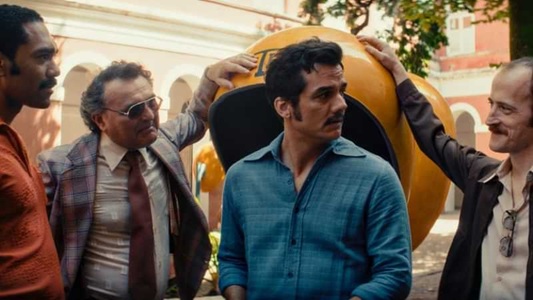
At nearly three hours, and with a deliberate pace that makes you feel most of those minutes, The Secret Agent isn’t a breezy watch. It is a dense cinematic tome, offering universal observations about life under authoritarianism (it’s bad!) and specific critiques of Brazilian political strife (it’s complicated!). Although the idea of a “second-screen movie” is fundamentally repellant, this is whatever the opposite of that kind of movie is. I believe that makes it, you know, a movie.
If you want to know how challenging it is to even synopsize The Secret Agent, I just read two reviews in which the respective headlines called it an “intense political thriller” and “an absurdist satire.” It is, as you likely guessed, somehow both. Anyways, here goes my best attempt at a brief recap.
Marcelo (Wagner Moura), whose name is not really Marcelo, pulls up for gas in front of a dead body being picked at by dogs and fleas during Brazil’s carnival holiday in 1977. He’s on his way to a place filled with refugees fleeing political turmoil after he was ousted from his role as a teacher/researcher who had something to do with electric cars and also a machine that tans animal hides. Meanwhile, police discover a severed human leg in the belly of a shark. That leg will later return as a stop-motion creature that murders people having sex in a park.
Still with me? No? Then you’re getting the full experience.
“Marcelo” is being hunted by two hitmen, who hire a third much more dangerous hitman, while also desperately searching for information about his mother. Unfortunately, the hitmen are making high-quality research quite challenging. This is before the film cuts to present day, when a young woman is also doing research, except it is an investigation into what happened to Armando.
I know that it feels like I didn’t do that right, but I’m pretty satisfied with how that summary came out!
Writer/director Kleber Mendonça Filho did this to us on purpose, in that slow-burn disorientation is both function and form here. Although it may make far more sense to Brazilian audiences intimately familiar with the historical elements at work, they almost certainly would still struggle with the part where the human leg turns into a killer from a slasher horror movie.
Or not?
Because what the film does incredibly well is convey a tone of panic, desperation, and sadness in the wake of fully weird behaviors from authorities. The byproduct of dictatorial government control is crazy-making as much as it is cruelty. “Marcelo” endures it all, and Moura demonstrates the silly suffering perfectly. He is destined to win many international awards and then lose to Timmy Chalamet playing ping-pong. He is so impeccably and impossibly controlled here as to negate the potential for mainstream American award show acclaim.
The Secret Agent demands a close reading and moves slowly enough for audiences to do just that. Filho’s last film was Bacurau, the first new movie I watched after the pandemic started and an absolute banger. That one was far simpler, clearer, and more fun. This one may be better. I say “may” because there is literal research I need to do before I feel like I can fully squeeze allo of its juice out of my mind grapes.
It is truly wild to see the film’s universal acclaim, not because it doesn’t deserve it but because it is so antithetical to the movements of this moment in every way possible. It is an overlong feature in a world beset by frayed attention and a complex takedown of authoritarian culture amid its recurrent rise. It’s so weird. And slow. And great.
If you even think you could like the film after this review, I can promise that you will.
Grade = A-
Other Critical Voices to Consider
Ruben Peralta Rigaud at Cocalecas (full review in Spanish) says “In times when history tends to repeat itself with new faces, films like this are not only courageous, but necessary. Filho doesn’t give us easy answers or cartoonish villains. He gives us a country laid bare, a broken but dignified protagonist, and a carnival that, amidst laughter, reminds us that one can also dance on graves.”
Hoai-Tran Bui at Inverse says “Every frame crackles with warmth and energy, much as every one of its characters pop off the screen. And while it has all the twists and turns of the much more serious genres of noir or political thrillers, The Secret Agent defies those genre trappings to deliver something deeply, beautifully humanist.”
Rania Richardson at Film Forward says “The Secret Agent is the culmination of achievements from Mendonça Filho’s four previous features, all set in his hometown of Recife. Neighboring Sounds (2012) delved into societal behavior; Aquarius (2016) examined the human toll of urban development; Pictures of Ghosts (2023) honored the filmgoing culture of the city; while Bacurau (2019) delved into and toyed with genre tropes.”