

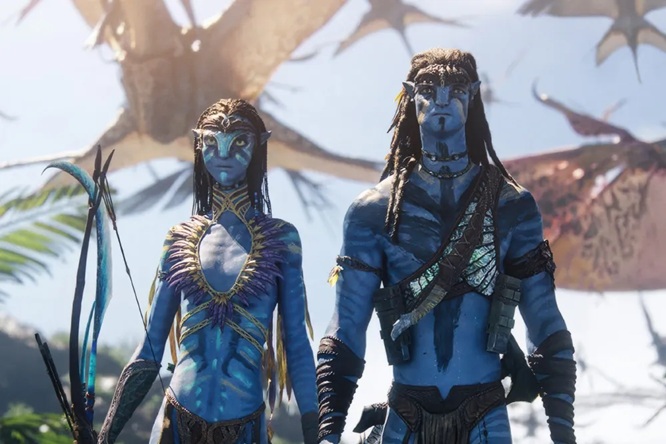
What makes a film epic is the scope and scale, not simply a running time long enough to conceive, gestate, and deliver a baby elephant. Each successive Avatar has been identical to its predecessor in every way but length: each is longer than the one before, like some cinematic witch’s curse. This new one is so long and repetitive, I may still be watching it and simply disassociating to survive.
What’s maddening is that, like both the original film and Way of Water, Avatar: Fire and Ash is objectively well-made in every possible way. Every possible way except story and acting, two things that do largely define whether a movie is “good.”
It is technically impressive (again). It is visually thrilling (again). It has a slew of really, really cool sequences (again). But it is littered with ridiculous performances (again) and literally follows the other movies beat-for-beat. We will keep getting this same thing every few years until James Cameron gets raptured or distracted. Because he is now worth a billion dollars and can make whatever he wants for as long as he wants. Suck on that, Coppola.
Speaking of suck: The story of Fire and Ash is that there are humans who are ruining Pandora, a planet populated by the Na’vi, who all look like Smurfs that have been reverse Shrinky-Dinked, except for the one that looks like Sigourney Weaver. The disparate tribes of aliens must come together to defend their home world. For the third time. Against the same villain. Who has died once already.
That is it, folks. I could give you some character names, but why? I sat through 192 minutes of the last one, which featured the death of a prominent character. At gunpoint I couldn’t tell you that character’s name. I just watched this one last night, and I have maybe two characters’ names still in my head. And that’s only because one is “Spider.” The other is “Jake Sully,” which reminds me of both Monsters, Inc. and Sully Sullenberger.
The point is that this isn’t a franchise that is exactly character-centric. Problematically, it is also not story-centric. The finale is indistinguishable from the climactic battle the last time out. The maddening part: Both of those sequences are, inarguably, very cool. Who could ever hate on aliens riding dragons while firing machine guns at military helicopters and boats as Godzilla-sized whale creatures join the fray? The rest of it? Hate-able. But considering that phenomenal fighting makes up at least 120 of the 197 minutes, it is simply unreasonable to get all-the-way grumpy here.
I don’t have anything original or interesting to say about the Avatar series. That is mostly because it is doggedly determined to say absolutely nothing original or interesting itself. I will watch each film a single time. I will find some of it to be cool and fun. I will immediately forget everything about it. It will make a billion dollars. James Cameron will use some of that money to make a spaceship called the Titanic.
We have bigger fish to fry.
Grade = C-
Other Critical Voices to Consider
Jason Miller at Nerdspin says “for all its sensory splendor, Fire and Ash often feels inert. Where The Way of Water balanced extended spectacle with emotional momentum, this installment is clunkier in its pacing. Scenes of action reset the narrative rather than advance it. The film starts, stops, explodes, and then circles back to where it began. For a three-hour epic, that lack of forward propulsion is frustrating.”
Rachit Gupta at Filmfare says “the Avatar dream was never about fan-building like the Marvel universe. It was about disruption to levels of transcendence. Give the audience an experience in the theatre that they have never even imagined. Sadly, Avatar: Fire and Ash, trades in that inherent fervor of its franchise to settle for something more business friendly.”
Stephanie Zacharek at TIME Magazine says “Avatar: Fire and Ash never lets you forget you’re looking at a screen, especially as hour three starts ticking by. Cameron’s vision is no longer the future, but a nostalgia trip, a very expensive form of deja vu. Movie magic can take many forms, but rarely is it as calculated as this, confusing awe with stupor.”