

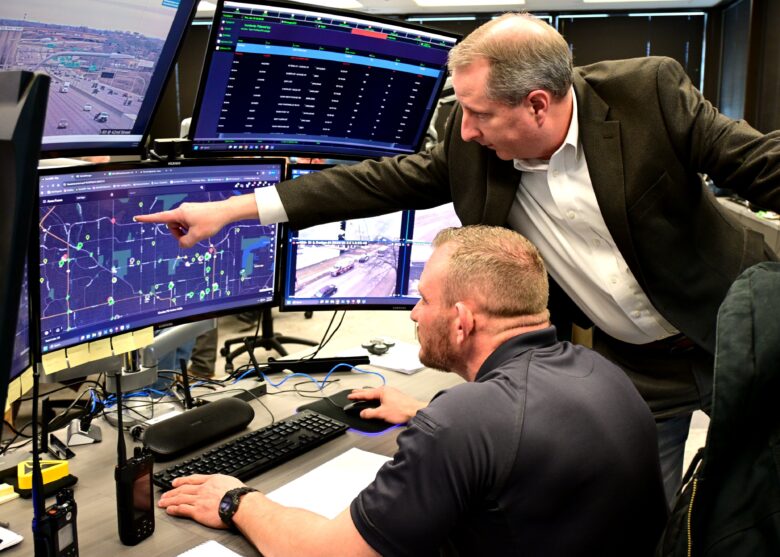
Omaha Police Lt. Allen Straub can see much of the city from his desk.
With the help of more than a thousand cameras, he and other specially trained officers can monitor traffic hazards, assist emergency responders and track suspects — all without leaving the police department’s central headquarters in downtown Omaha.
Straub oversees the Real-time Operations Center, also known as the ROC. With the click of a button, officers can view live footage from across the metro by accessing traffic cameras and cameras registered with the Omaha Police Department by businesses or public entities.
“We help officers on the street,” Straub said. “They may be going to a crime in progress, they may be going to a hazard, maybe going to a huge accident, a house fire, building fire. It’s not just focused on crime but encompasses public safety.”
The ROC is one example of new technology introduced in recent years that has drastically changed how the department operates. From high-tech drones to data storage, tools once thought of as futuristic fantasy are shaping the current reality of policing. The Omaha Police Department hopes to stay ahead of the curve.
Efficiency of information
Down the hall from the ROC is David VanDyke’s office. The former research psychologist serves as deputy director of the department’s Technology and Reporting Bureau. When he talks about technology in policing, he focuses on information: how it’s gathered, how it’s used and how it’s stored.
Major changes have occurred since VanDyke joined the police department in 2013. Reports are now processed electronically, so rather than searching through a filing cabinet, officers and investigators can go digital, utilizing a central repository of more than 6.7 million records.
The result of a centralized record management system is efficiency, VanDyke said. Time that would be spent on clerical tasks is spent instead on investigations.
Beyond record keeping, new initiatives like the ROC and the department’s drone program allow for information to be processed on a real-time basis.
“The advances that we’ve seen in the last several years in our ability to process data quickly and to make it available to at the fingertips of the officers who are doing the investigation, has made huge strides in our ability to address the objectives we have and responsibility we have to the citizens of Omaha,” VanDyke said.
The department points to those technological advances as a major factor in successful homicide investigations. In 2025, for the third year in a row, Omaha’s police department cleared all 26 homicides. The ROC has been fully operational for about two years.
A map of Omaha can be seen on several large monitors in the Real-time Operations Center. Camera icons crisscross the metro, designating an available live feed. Street cameras owned by the city’s Public Works Department can monitor live road conditions, and businesses and organizations can integrate their cameras into the ROC, adding hundreds of potential feeds to the operations center.
The Metropolitan Entertainment & Convention Authority (MECA) was among the first local organizations to integrate its downtown cameras. The group oversees Omaha’s riverfront parks and venues.
In 2024, those cameras were used to track and arrest a sexual assault suspect, Straub said. Officers have helped track robbery suspects, assess shooting scenes and locate serious crashes, all in real time.
There’s also a registry that allows the public to partner with the police department. Contact information is shared and home surveillance devices like ring cameras are noted by the department. Those cameras can’t be live streamed, Straub said. An officer would have to reach out to the camera’s owner who would then have to share their footage with police.
All that watching can stir anxiety among the public. Straub maintains that the ROC isn’t surveillance but is used only to locate a suspect, a victim or assess a crime scene.
“There are a million people traveling within and around Omaha every day,” Straub said. “I’m not watching them. We’re not watching intersections. I’ve gotten asked, ‘well, you’re just watching us run red lights.’ I’m not, but if you’re running a red light, please don’t.”
In 2025, the ROC assisted with nearly 4,000 calls for service and was able to cancel patrol officer responses more than 450 times, freeing officers to focus on higher-priority and emergency calls. Ninety-one of those ROC-assisted calls ended in an arrest.
The Real-time Operations Center is among the most impactful resources added to the Omaha Police Department’s daily operations in the past decade. Late last year, another asset was added to the department’s high-tech toolbox.
Drones as first responders
A few miles north of Omaha, a hangar at the Blair Executive Airport holds the police department’s three helicopters, the Omaha Police Air Support Unit, and the software needed to launch drones from rooftops across the city.
Omaha Police Chief Todd Schmaderer and Mayor John Ewing announced the launch of the unmanned aerial vehicles in November as key equipment in the city’s new “Drones as First Responders” program. The public safety initiative uses high-tech drones to assess emergency scenes ahead of police arrival.
The program is the first of its kind in Nebraska and is overseen by Chief Pilot Frank Peck. Like the ROC, the drones can be used to assess scenes and potentially clear calls before an officer arrives.
“Our main goal is to support the men and women that are doing the hard job on the ground,” Peck said, “and that’s the purpose of this program.”
By spring, six drones will be located in various locations. Two are currently on the roof of Omaha police central headquarters downtown, housed within climate controlled launch pads. The drones immediately begin recording when deployed, sending live footage to the ROC and to the pilot monitoring the flight.
The new technology comes with evolving guardrails. The Omaha Police Department holds a Beyond Visual Line of Sight permit, meaning the department has special permissions from the FAA to operate a drone without needing to keep eyes on it from the ground.
The permits are becoming more common, and in 2023 Jay Stanley, senior policy analyst with the American Civil Liberties Union, advocated for strict guidelines and specific laws governing their use, including usage limits, transparency and specific recording policies.
Stanley has followed the progression of domestic surveillance drones for more than 20 years. He said in the early 2000s they were mostly regarded as a topic of “futuristic science fiction,” but their usage among law enforcement grew in the 2010s. In 2019, he watched the first “Drones as First Responders Program” launch in Chula Vista, California.
“I think it behooves us to look ahead and start to think about what we want and we don’t want in terms of law enforcement and police usage,” Stanley said.
Every flight through the Omaha Police Department is documented, Peck said, and under the department’s policy, the drones are only launched in response to a 911 call. It’s a point Mayor Ewing emphasized when announcing the program.
“This will not be utilized for general surveillance, or patrols and neighborhoods, or any of those types of things that sometimes people get worried about when they think about technology,” Ewing said. “This is 911 generated responding to someone’s call for help, and that is the most important thing that the police department does.”
Within the next several years, Peck expects drone usage will become increasingly common for police and emergency responders nationwide.
“I think years down the road, we’re going to look back, this is going to be one of those times in policing where the technology came to fruition,” Peck said, “and it’s just going to almost become kind of an expectation.”
