

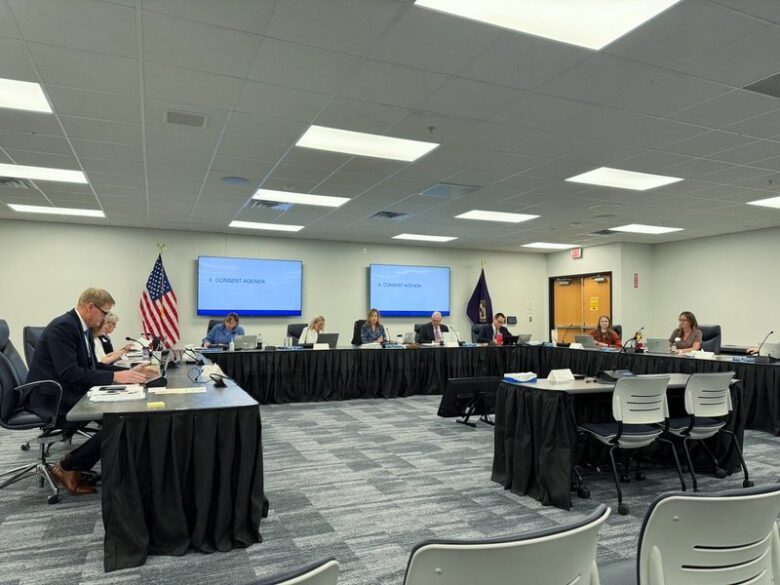
The State Board of Education ultimately rejected a learning community plan for Omaha-area schools in a 4-4 vote on Tuesday after postponing the vote for two months.
The community achievement plan is a collaboration with the Learning Community of Douglas and Sarpy Counties and 11 Omaha-area school districts, including Omaha, Ralston, Millard and Papillion La Vista. Those four superintendents defended the plan ahead of Tuesday’s vote, along with Gerald Kuhn, chief executive officer of the learning community.
About $10 million in state aid is tied to the community achievement plan. That money goes to the school districts involved in the plan.
The four registered Republicans on the officially non-partisan board – Kirk Penner, Sherry Jones, Lisa Schonhoff and Elizabeth Tegtmeier –voted against the plan. Three of the four said they had concerns with one of the partners involved in the plan, OneWorld Community Health Centers. The organization provides transgender health care outside of its work with the learning community.
The learning community added a clarification to the plan ahead of Tuesday’s vote outlining that “no learning community resources — including state funding or levy funds — may be used to provide, support, subsidize, or reimburse gender-affirming medical care, reproductive health care services, prescription medications, or any clinical medical procedures.”
Board member Sherry Jones said while she was grateful for the clarifications, it was not enough to sway her vote.
“However, they do not address the influence of the OneWorld Health partnership, and I have previously shared my specific concerns regarding its practices and scope of influence,” Jones said.
Gerald Kuhn, chief executive officer of the learning community, said the learning center in South Omaha partnered with OneWorld because it already had roots in the community.
In an interview with Nebraska Public Media News before the meeting, he said that OneWorld only helps with educational programs at the center, like financial literacy, parenting classes and English as a second language.
“They were a leader in the community. They had a lot of credibility with the community in South Omaha,” Kuhn said. “We, the learning community, needed that at that time to be able to gain the trust of the community.”
Papillon La Vista superintendent Andrew Rikli said the heart of the discussion seems to be about trust in educational professionals.
“We don’t indoctrinate kids,” Rickli said. “If we did, we’d be indoctrinating them on how to be more respectful and how to get their homework done on time, and how to leave their cell phone at the front door rather than other things.”
Another member, Tegtmeier, was concerned about the whole plan, saying she didn’t see improvements in student achievement since the last time the plan came to the board. She specifically pointed to English language arts and math scores with Omaha Public Schools. In the 2022-23 school year, they were at 37% and 32% proficiency respectively, according to Tegtmeier. The most recent 2024-25 school year data shows those at 40% and 30%.
Tegtmeier asked OPS superintendent Matthew Ray what the expected timeline for measurable impact on student improvement was.
Ray said it’s hard to put a timeline because students don’t work that way. He added that OPS is looking at ways to shift resources to better help students and teachers with reading instruction.
“I can’t speak to and I don’t want to speak to what those before me did in 2009 or 2006. I can speak to what I’m in charge of as the superintendent now,” Ray said. “I can tell you that we’re making progress, and that we’ll own our data that we have now. We will continue to do what we can for the kids that we serve.”
Ray, along with the other superintendents, highlighted several areas of the plan that have been helpful, including the School as Hub program that connects families with their child’s school starting as early as possible, even before they start kindergarten. The four also dove into literacy efforts with each of their school districts.
Ray shared that the roughly $8 million in state aid OPS gets from this plan goes toward staffing programs and classrooms. Omaha Public Schools is also currently facing a $50.6 million shortfall in state aid due to an overpayment that was found in November, which the district is looking to raise its levy to address.
The four registered Democrats on the board voted for the plan. Board member Maggie Douglas said the plan aligns with statewide goals to improve literacy proficiency for third graders to at least 75% by 2030.
“To achieve those goals, students must have equitable access before they enter formal schooling and families must be engaged as partners, exactly what the (community achievement plan) is designed to support,” Douglas said.
Douglas added that the plan aligns with the state board’s strategic plan to collaborate to tackle challenges in early childhood education and literacy.
Board member Liz Renner shared concerns that the board was stepping outside of its scope. State statute lays out what the board needs to approve the plan, including commitment from the participating school districts and a high likelihood of improving student achievement.
“I would just caution us to be very mindful of what is our state statutory obligation versus our own preferences if we were running a district or making decisions on vendors,” Renner said. “They’re very different things.”
According to state statute, the board must provide its reasons for rejecting the plan and give the learning community and superintendents a chance to revise.
The next regular State Board of Education meeting is scheduled for March 6.