

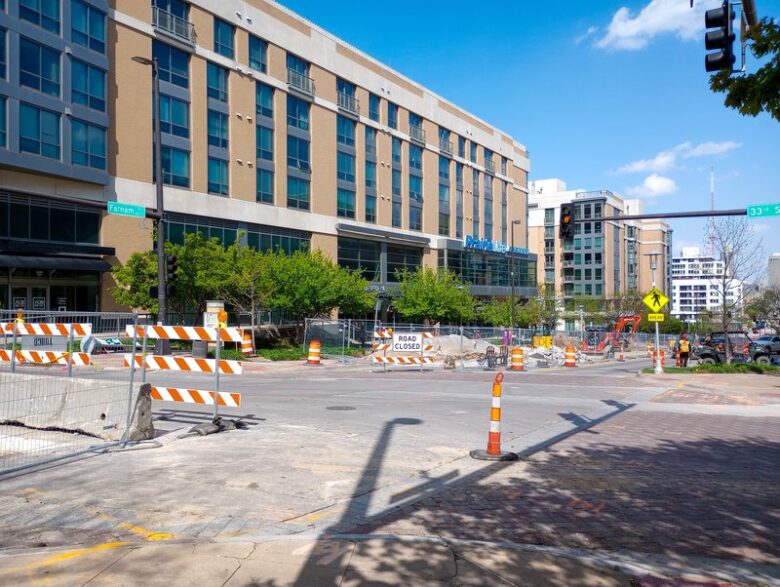
Omaha Mayor John Ewing announced an upcoming parking program Wednesday that’s meant to bring more patrons to downtown businesses hit hard by streetcar construction.
The program, set to begin in a few weeks, will offer $1 parking sessions in two downtown garages. Ewing and his staff also met with Omaha business owners at City Hall on Wednesday to discuss the impacts of the city’s streetcar project.
As of mid-March, 91% of businesses in the construction zone report that sales have plummeted, according to the Streetcar Alliance, a coalition made up of small-business owners and residents along the streetcar construction route.
Clark Ross is co-chair of the Streetcar Alliance and the owner of Mercury, a downtown bar. He spoke to members of the press following an afternoon meeting with Ewing and his staff.
“We’re gonna chalk this up as a win for sure, because they did answer at least one of our requests,” Clark said.
Here’s how the parking program will work: Garage signage will guide employees how to sign up through their employer to validate a parking session. Employees will work with their employers for validated $1 parking sessions at the following times:
- 1516 Douglas St.: 5 p.m. to 5 a.m. on weekdays and all day on weekends for validated businesses that sign up for the program. Corridor employers must validate their employees.
- 899 Farnam St.: 8 a.m. to 5 p.m. on weekdays only for validated businesses that sign up for the program. Corridor employers must validate their employees.
A third garage will run a similar program for the general public. Customers will pre-pay the $1 at the garage gate. Event rates are $3 for the event pre-pay or $5 at the door.
- 1215 Capitol Ave.: 5 p.m. to 5 a.m. on weekdays and all day on weekends, when there are no events.
More information can be found online.
There’s a lot riding on the $421 million streetcar project. City leaders are optimistic the fixed rail system will revitalize a stagnant urban core, bringing new development, jobs and housing to the heart of the metro. Small-business owners along the route worry their store fronts and restaurants won’t be around to see the streetcar start rolling.
The alliance called on the city to “present a comprehensive, actionable plan to provide immediate financial and logistical aid to the corridor.” Clark said the group’s next step will include meeting with Gov. Jim Pillen.
“So our next stop is going to be to talk to Gov. Pillen, and see if we can get some state intervention to help keep these 100 businesses afloat during this construction,” Clark said.
Ewing encouraged Omahans to visit businesses within the streetcar corridor.
“We will get through this together,” Ewing said, “but we do need the help of the people of Omaha in patronizing these establishments so they can survive this construction and be able to thrive once the streetcar is done.”
Within the next year, the city will transition from utility-related work into mainline construction, meaning lane and street closures should become more predictable.
Up to this point, the project has required significant construction work by the Metropolitan Utilities District to replace or relocate gas and water lines along the 3.2-mile route. The price tag of that work has more than doubled beyond early cost estimates and has added to the project timeline.
Work is expected to be completed in 2028.
