

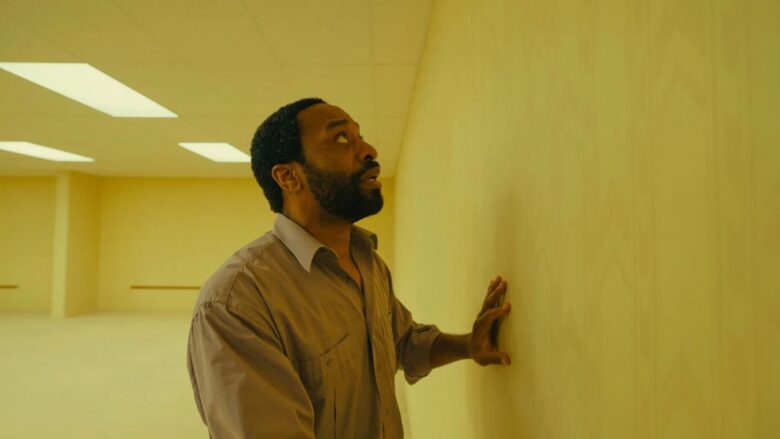
The past is objectively terrifying. Our memories are nothing but warped unreality. If you could really zoom in, nothing would look right. Every place we “vividly remember” would be horribly malformed. The people wouldn’t even really look like people.
More than its ballyhooed liminal spaces, the monster of memory is the nightmare fuel behind Backrooms. Although its Gen Z creepypasta DNA puts folks like me squarely outside its target demographic, the core of what makes it so interestingly upsetting is universal. There is no boogeyman quite like toxically-mutated nostalgia.
The fascination over 20-year-old director Kane Parsons’ age has eclipsed the meritocracy of his rise. Unless I have been wildly misled, dude isn’t a nepo baby. He just started a web series when he was 16 that went viral and has now morphed into an A24 movie. Speaking of twisted versions of things, that’s as close to the American Dream as is legally allowed these days.
The leap from YouTube to cineplexes required a passing effort at a plot. Barely passing is still passing, right? In the 1990s, Clark (Chiwetel Ejiofor) sells furniture at a pirate-themed outlet store. After his wife kicked him out, the sparse retail location is also his new makeshift home. His therapist, Mary (Renate Reinsve), is hoping to help Clark confront his demons and turn over a new leaf.
Then Clark steps through an invisible door in his store’s basement and finds a series of endless rooms, filled with the half-remembered detritus of life and at least a few half-living creatures.
The early 90s setting is central. It was time when everything first started being recorded. Parents would find any excuse to whip out the video camera. Our closets are filled with VHS tapes marked “recital” but also ones that just have dates. Nothing happened on that day. Just somebody busted out a recording device, and now it is commemorated forever.
The youth of today understands curated aesthetics. Nobody from that previous era did. It is hideous. Nobody operated as if their lives would be captured and rewatched. All the colors and patterns on everything were barely suited for eyes and are wholly unsuitable for viewing decades later. It is ugly in the way that everything dated is ugly, but it was all catalogued in a way that has become commonplace.
Add to this the fact that at some point around this time, the idea of leaving a better world for the next generation started to wither. Of course young people find liminal spaces terrifying. They are tangible proof that the world is built wrong. Backrooms is about the indescribable feeling of knowing that everything around is incorrect and dangerous without knowing how or why. That seems…pretty understandable for Parsons’ generation to feel.
The film gently asks the question “Are people willing to fix this?” Because if so, the first step is fixing ourselves. It would mean admitting uncomfortable truths. It would mean taking responsibility for “the way things are.” It would mean apologizing. Doesn’t seem likely, does it?
It is fun to play with the other questions that Backrooms asks. Where boundaries of reality start and stop in the movie is fodder for great debate. And there is lots of room for that debate, mostly because this isn’t slow-burn so much as “barely smoldering.” It will be dismissed as silly and boring by many viewers, and that is not an indefensible position.
But unlike Skinamarink, which was liminal creepypasta that was fascinating but mild torture to watch, Backrooms goes down easy. A lot of that is Ejiofor and Reinsve, but a not insignificant amount of it is Parsons. I felt borderline bored, then looked down to see the movie was almost over. At my non-gen-z age, I have learned that one of the highest compliments you can give is to describe a film as legitimately unique. What a singular, oddly thought-provoking experience this one was.
Grade = A-
Other Critical Voices to Consider
Luis Pomales-Diaz at Horror Press says “for every person who absolutely loves the ambiguous and fatalistic closer, there will be someone raging about the pacing and lack of follow through. People will demand more answers, and demand a more aggressive and bombastic ending. A crowd pleaser, Backrooms is not, though many will be leaving the theater pleasantly surprised this opening weekend.”
Meagan Navarro at Bloody Disgusting says “Backrooms is at once complex and sparse, but never repetitive. It might be set in 1990, but it effectively captures modern anxieties and isolation in a way that frequently makes your skin crawl. While the journey ultimately loses steam by its cryptic end, Parsons’ visual representation of the human psyche disturbs like no other.”
Amy Nicholson at the LA Times says “Describing Backrooms as a horror film doesn’t feel exactly right. It’s a surrealist painting in motion, the equivalent of staring at Salvador Dali’s wasteland of melting clocks until it makes gut-sense. Dali made that famous masterpiece, ‘The Persistence of Memory,’ in 1931, a breath-holding moment between wars when daily life looked normal enough but vibrated with the dread that no, things were definitely not OK. Kids don’t know that, but they vibe with Dali anyway because he keys into their suspicion that the world doesn’t really obey the rules.”