

Fitting for a movie entirely about a wedding, my solemn vow to you—for every review, until death do us part—is always “no spoilers.” That makes this one particularly challenging. Not quite as challenging as the one that the marketing team had when promoting writer/director Kristoffer Borgli’s The Drama, but a challenge nonetheless.
It is a challenge because this satirical, salient dramedy hinges literally entirely upon one revelation made very early in the film…that is understandably being kept behind a cinematic paywall. You must buy a ticket for The Drama to learn Zendaya’s premarital confession to Robert Pattinson. Honestly? It heightens the tension. After deciding to watch the film, it is impossible for audiences not to make internal guesses as to what it is she will reveal. Whether it is “worse” or “better” than you thought is a wonderful internal litmus test of human decency. Have fun!
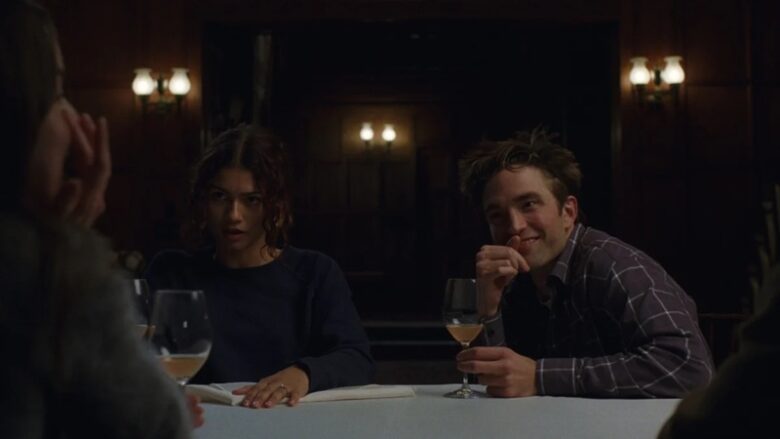
The promos tell you that the information given causes Charlie (Pattinson) to rethink all that he knows about his bride-to-be, Emma (Zendaya). They were previously rapturously happy. But just before their nuptials, their couple friends, Rachel (Alana Haim) and Mike (Mamoudou Athie), convince each member of the quartet to share “the worst thing they’ve ever done.” This is an exceptionally terrible “game” that could only be proposed by a lunatic likely narcissistic troublemaker, which is a pretty good description for Rachel.
After the cascade of proverbial beans flow from Emma’s mouth, Charlie goes through various stages of “coming to grips” with how he now perceives his wife-in-waiting. He tries to build a narrative of excuses for her. Then he attempts to minimize the significance. Then, he buckles beneath his increasing anxiety. All the while, the couple proceeds through the genuinely ludicrous steps of a ritual marital ceremony.
The Drama is remarkably, surprisingly funny. And not in the over-the-top ways that the poster or adverts suggest. There is a tremendously awkward exchange with a photographer, a quietly hilarious (but sincerely kind) DJ, and Bobby Pats being a total little weirdo throughout. Zendaya turns in a challengingly quiet and nuanced performance, remaining endearing in a role that actively invites the audience to turn on her. And Rachel is one of the most easily hateable supporting characters in ages, with kudos to Haim for relishing in our collective judgment.
How we judge each other is the whole point. Is it worse to have almost done something very, very, very bad but stopped just short or to have actually done something significantly less evil but still quite clearly wrong? Is redemption a myth? Are we doomed to always be that which we were? How can we ever really, truly judge the people closest to us? And on a bigger level, why are we so loathe to reflect on the collective monstrosity that we have made out of the modern world, specifically here in America?
The Drama gets very, very deep into a host of massive questions that it can’t possibly hope to answer and never tries. It is also remarkably deft at asking them. There are visual and narrative flights of fancy that stop just short of gimmicks. There are simple, subtle, but absolutely explicit keys about the nature of everyone involved that given right upfront and then repeated throughout.
And then there are massive societal questions of the ugliest sort.
Those are almost certain to understandably be far too much for some people. An upsetting number of folks will have an even-more-upsetting direct connection to The Drama. If those people are revulsed and condemn the whole thing, it is beyond justifiable. But those of us for whom that spoilery issue remains more abstract really should be grappling with the questions that come with it more than we do.
All art is subjective. Art that strikes at the deepest, darkest questions surrounding our relationships (both intimate and more broadly) is inherently uncomfortable. The comedy may help The Drama go down, but it remains a decidedly upsetting endeavor. But in a way that, to someone admittedly removed from the central revelation, seemed thoughtful and not callous or flippant. If someone were to tell me “I hated that movie and found it vile,” I would immediately understand. But that isn’t how it read to me, which is fascinating.
That’s really the way I will be forever forced to describe The Drama. It is fascinating to me. It defied my expectations not only in terms of events and tone but in terms of the introspection and reflection that it allows. It goes far beyond encouraging audiences to consider how they would react to a similar specific occurrence and begs them to think broader and bigger, as uncomfortable as that may be. How rare to find a mainstream work so knotty and challenging. Fascinating…
Grade = A
A postscript (which I never do): I read the first review below after writing this review. It revealed a few things about the filmmaker that definitely change how I would have thought about what’s being conveyed in the movie. I stand by the above as my legitimate “first reaction” in isolation. But this is why I am thankful for the insights and work of so many smart, thoughtful writers out there. This is all to say, please take the above with a grain of salt and read the first review below when you can.
Other Critical Voices to Consider
NOTE: This is a “whoops, all spoilers” roundup. Just a caution before you go clicking below!
Brooke Obie at Black Girl Watching says “In The Drama, we see the emotional violence of white women, the terror of self-pitying, petulant white men, real-life tragedy reduced to wild hypotheticals and insensitive to actual victims, and the erasure of Black woman- and girlhood. How quintessentially American.”
Justin Chang at the New Yorker says “What is it about Zendaya that compels certain filmmakers—and, there’s no way around it, certain white male filmmakers—to pelt her with gobs of unexplored trauma? Do they think suffering looks good on her? Does her air of youthful innocence provide just the touch of sugar they need to make the hard-core medicine go down?”
Angelo Muredda at FilmFreakCentral says “Borgli invests these characters with no aesthetics whatsoever, no tastes outside of the knick-knacks in their A24-core home, and no opinions outside of whatever might provoke the next drama.”