

Editor’s note: This story is part of a collaboration between Flatwater Free Press and The Reader examining Omaha’s future streetcar.
Ernest Wintroub ushered his 7-year-old son Frank out the door of their Dundee home on a brisk spring evening in 1955. They stood on the street corner and listened for the familiar rumbling.
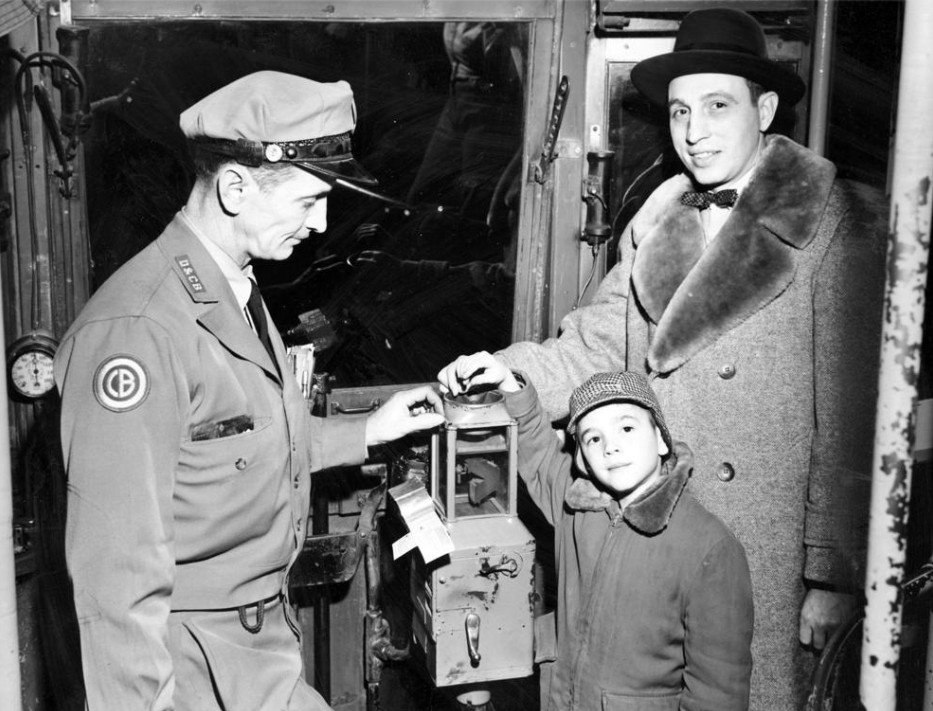
For 86 years, streetcars had crisscrossed Omaha. That night was the final public ride for the city’s last operating trolley, a relic of the transit system that was once one of the most robust in the country. As the father and son hopped aboard, an Omaha World-Herald photographer snapped their photo. It was published in the paper the following morning with the caption: “… remember this, it’s the last.”
“Dad really got a kick out of it,” Frank Wintroub, now 78, said with a laugh. “He was all excited about riding the last streetcar.”
Seventy-one years have passed since the Wintroubs witnessed the end of Omaha’s streetcar era — a move that represented residents’ growing dependence on cars to navigate the ever-sprawling city.
Now, Omaha is poised to bring streetcar transportation back: a 3-mile loop connecting midtown to downtown. Elected officials, developers and business leaders hope the new — and controversial — streetcar will bring new housing and business to the city’s stagnant urban core.
“It’s the right time for Omaha to support a streetcar,” then-Mayor Jean Stothert said when announcing the project in 2022. “The momentum we have to change our urban core forever is undeniable.”
The rails that moved Omaha
In the early 20th century, trolleys ruled the streets of a young Omaha.
The settlement just west of the Missouri River was a struggling railroad town of about 10,000 people when, in 1867, the Omaha Horse Railway Company was granted a 50-year franchise to build and operate trolley tracks.
Omaha’s first streetcar opened for passengers in 1868 with wagonlike trolleys that ran on rails and were pulled by horses through muddy streets. The first track was laid on Farnam between Ninth and 15th streets.
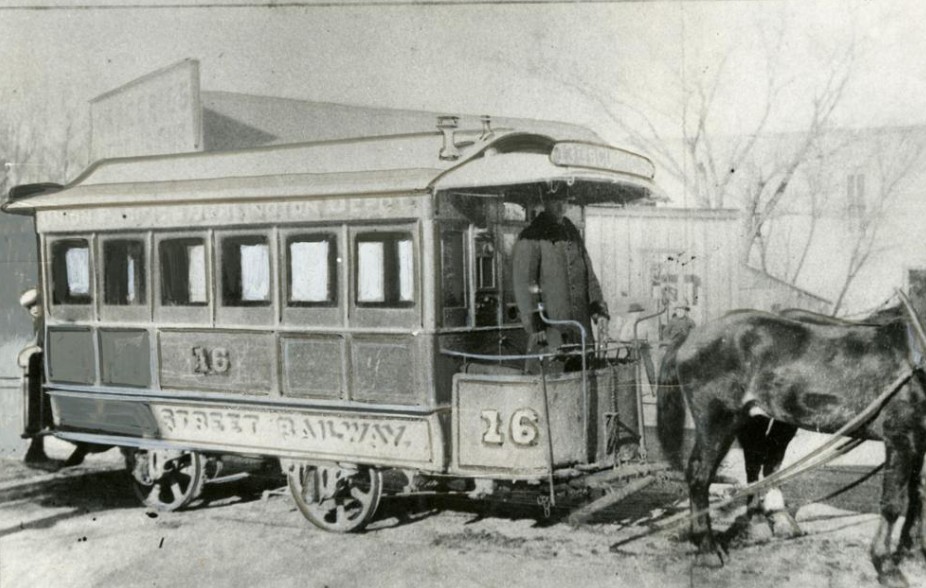
The wooden trolleys could hold about 14 people and were steered by a conductor, who was instructed to keep the horse galloping under 5 mph, as detailed by the late historian Richard Orr in his book on Omaha’s streetcar past.
As the city grew, so did demand for new routes. Dirt roads became brick streets, Omaha’s successful stockyards and meatpacking industry brought new residents and electric streetcars started to become the norm. Land speculators began to carve out new neighborhoods.
In the winter of 1887, the banker and real estate developer Erastus Benson purchased a sizable chunk of land a few miles northwest of the city — a new neighborhood known as “Benson.”
To connect his new village to Omaha’s urban center, Benson built and maintained his own streetcar line. This was a typical move of developers, said Marty Shukert, a longtime urban planner based in Omaha, but it also created a chaotic network of rails.
Omaha and Council Bluffs had 90 miles of tracks by 1890, more than any city in the country except Boston.
“You couldn’t have an uncoordinated system of streetcar lines owned by six different people, all of whom are real estate developers,” Shukert said. “So they were all coordinated and consolidated into one operating company.”
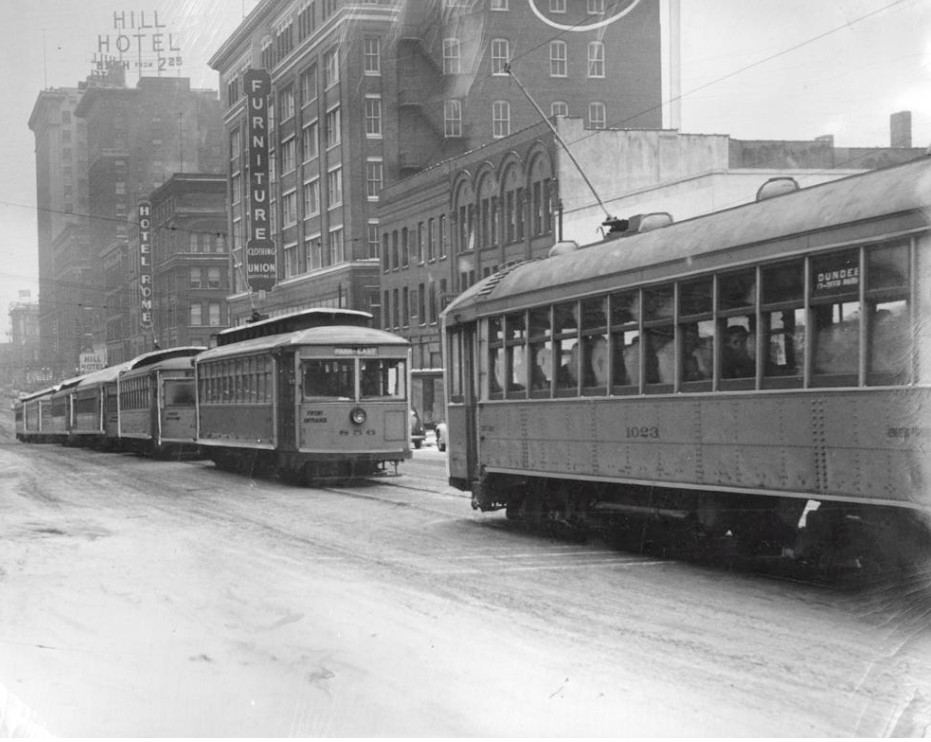
The Omaha & Council Bluffs Street Railway was founded just before Christmas in 1902, consolidating all the electric railways in the Omaha metro. By 1907, 24-foot trolleys powered by electrical lines overhead carried thousands of passengers to and from the suburbs of Florence, Benson, Dundee and South Omaha. Downtown was still the center of economic activity and the convergence point for many of the lines.
Former Omaha Mayor Hal Daub remembers riding the streetcar as a young teen in the 1950s. He’d hop aboard near his North Omaha home and hand out political pamphlets for Congressman Roman Hruska to commuters heading downtown. His mother would use the line to commute to her job at a downtown department store.
“It was a very viable way of transportation,” Daub said. “It was quite intensively ridden. It was full all the time. It was a connection from downtown Omaha, and the very vibrant commercial business and jobs core.”
The city’s streetcar lines made Omaha’s westward and southward expansion possible. Suburbs like South Omaha and Benson offered housing and land ownership options without stagnating the city’s downtown economic center. Streetcars became a necessity, an affordable public transportation option for residents needing to navigate a growing city.
But by 1930, there was a new tool of transportation to compete with.
When automobiles and public buses hit Omaha streets, public opinion on trolleys shifted. They started to be seen as slow-moving, street-clogging relics.
Omaha & Council Bluffs Street Railway Co. announced an increase in fares in the late 1920s, citing a sharp decrease in ridership, increase in wages for workers and a rapidly expanding bus system, according to Orr’s book.
The city’s urban sprawl eventually stretched beyond the streetcar lines still in operation, and developers weren’t willing to financially support new tracks.
The antiquated public transportation tool had outlived its useful life as cars took the wheel of Omaha’s westward expansion.
An editorial published by The World-Herald a month before the final trolley run in 1955 offered an apathetic eulogy:
“San Francisco may cling to its obsolete cable cars, but we surmise there will be few lamentations when the last of Omaha’s streetcars goes out of service,” the editorial said. “With buses on Farnam, Dodge, North Fortieth, etc., the moving roadblocks-on-rails will be eliminated, and street capacity will be substantially increased.”
There were only two streetcar lines still running in 1955. Most of the trolleys were sold for parts or scrapped.
“We knew (the end of streetcars) was inevitable,” Orr told a World-Herald reporter in 1995. “And we knew it was the end of an era.”
Last stop, new beginnings
Daub carried a love for streetcars into his four terms in the United States House of Representatives and time as mayor of Omaha from 1995 to 2001.
He imagined Omaha having a light rail, like the one in Denver, that could connect multiple neighborhoods. Or an elevated looped rail, like Chicago’s “L” train, snaking through downtown Omaha.
In his first year as mayor, Daub’s administration applied for and received a $1 million federal transportation improvement grant. The money went toward a transportation feasibility study that eventually became a blueprint for the route and financing mechanism of the city’s current streetcar project.
“There’s an old saying that, you know, good things take time,” Daub said. “Be patient. Good things will come to pass. And it’s been 20 some years I’ve been waiting for that first streetcar or that first trolley.”
In 2022, Stothert announced plans to make a modern streetcar in downtown Omaha a reality. The city’s downtown library would be demolished, making way for new development. Mutual of Omaha announced plans for a new central headquarters on the site.
And the streetcar — which would run past Mutual’s former Midtown campus and its new downtown tower — was an essential piece of making that happen. Mutual’s decision to relocate was dependent on the city’s commitment to building a streetcar, Mutual CEO James Blackledge has said.
The streetcar system increases the value of any redevelopment to Mutual’s current campus and offers assurance that the midtown area will succeed even without Mutual’s robust workforce, Blackledge said.
The roughly 3-mile modern streetcar route is a fraction of what once crossed Omaha’s core, but the project’s proponents expect a big impact. They point to the streetcar as a means to solve a festering problem for a growing Omaha metro. The city is running out of room to expand.

Omaha for decades avoided the stagnation and declining tax base of other older U.S. cities thanks to the annexation powers it has under state law. The city’s population could shift into the booming suburbs as families and businesses left the urban core.
But Omaha is running out of land to annex. A report from the Greater Omaha Chamber warns that physical and legal barriers will leave Omaha “land-locked” as early as 2040.
City officials and developers are betting on the streetcar bringing density and new development back to Omaha’s core.
Not all Omahans are on board with the project. Area business owners say the ongoing construction threatens to kill their businesses well before the first car rolls down the tracks. Others have criticized the streetcar as a tool for developers rather than a meaningful public transportation option.
Shukert describes himself as a “supporter with his eyes open” of the modern streetcar. He recalls riding Omaha’s streetcars as a child. The last trolley rolled to a stop when he was 5 years old.
“These particular streetcars, as I remember them, were noisy and bumpy, but I loved them,” Shukert said. “It was really a huge adventure to be on one.”
An Omaha World-Herald reporter was there to witness the final public trolley ride on March 4, 1955. More than 50 passengers climbed aboard, including the Wintroubs. Many scavenged for souvenirs like signs, posters, pieces of wood — even the rearview mirror.
A 7-year-old Frank Wintroub helped his father pry a metal pamphlet holder from the trolley’s interior. His parents kept it in their home for years. Frank’s not sure where it ended up.
Omaha’s new streetcar line is scheduled to open in 2028. Frank Wintroub now lives in Fairfield, Iowa.
“You know, I was delighted that my father was excited enough to take us out on that cold night and ride,” he said. “I was thinking that I should probably come back and ride the first streetcar that gets recommissioned. I think it’d be a lot of fun, actually.”