

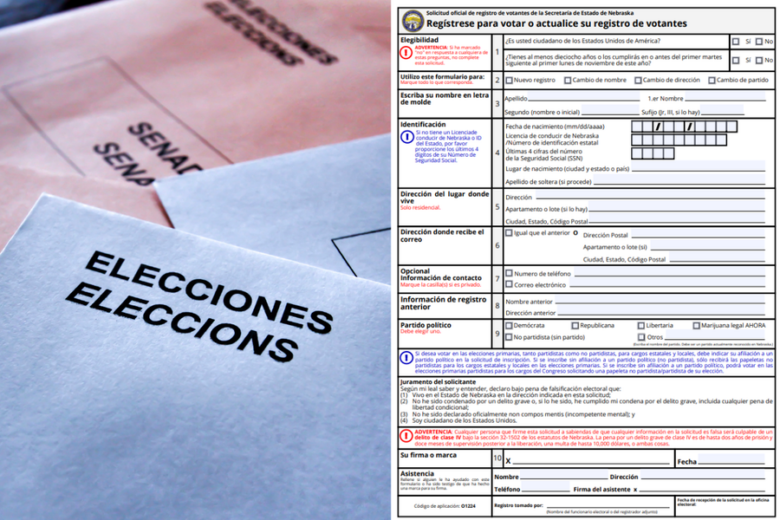
Immigration crackdowns and job losses have shaken Nebraska’s Latino community this year. Some – even citizens with full voter rights – are afraid to speak up amid the fear caused by these events. Others see the turmoil as an opportunity to show the Latino community how much their voices matter.
The Nebraska Democratic Party’s Latino Caucus started a new program in March. Over six weeks, the group bused about 70 people from Omaha to the State Capitol in Lincoln to teach people about civic engagement. The group partnered with the NDP’s Black Caucus as well.
Chair of the Latino Caucus Jennifer Reyna said the program has helped people learn about Nebraska’s legislative process and meet their senators.
“We want to be able to give everyone an opportunity to just learn and grow alongside us but also feel like they have that sense of empowerment to stand up and speak up, especially with their representatives here,” said Reyna.
Anyone was welcome, Reyna said, but it was especially important for Latino Nebraskans to come out this year and make their voices heard.
“Especially when it’s concerns impacting them every day,” Reyna said. “Like Omaha – what happened last year at the Glen Valley Foods ICE raid. Lexington – when Tyson had shut down and laid off thousands of workers. Families have lost their one source of income to protect the family.”
Since President Trump took office for his second term, ICE arrests increased 329% in Nebraska alone. Reyna says the fear caused by intensified immigration enforcement has made some Latino Nebraskans scared to engage politically.
“When immigration does cause fear, it impacts them every day,” Reyna said. “So, my job is to make sure we speak up more often, that we start challenging those that are constantly putting us down with their fear and intimidation tactics.”
Between chatting with senators and watching the final days of the session’s floor debates, the visitors are taking a break in the lunch room. Over sandwiches, they’re discussing how their communities have been affected by immigration enforcement.
Almarosa Infante said people in her Omaha neighborhood have been scared to go out and live their lives as normal. Her sister was concerned, too.
“I have a sister that said when all this started to happen, ‘I’m scared to go out there, Rosa, because of what’s happening.’ No, no, no, no, sister,” Infante said. “This is when we must come together as one and become strong together and realize that we won’t be intimidated and that we will come forth and we will put that vote in.”

As a first-generation Mexican-American and organizer for the NDP in central Nebraska, Infante said she believes coming together is the key to overcoming that fear.
“Our word of mouth is very powerful in the Latino community. It’s mostly just talking to everybody and letting them know the importance of voting and that their vote counts,” Infante said. “It’s just a matter of talking to everybody and having one person say, ‘Hey, let’s get some Latino moms together,’ because these moms are powerful in our culture.”
Infante said a personal connection can be the best way to share information on civic engagement and politics.
“I think when they can identify with you, because you are them, and they are you, then that’s power,” she said. “Because we’re all in it together for the better of our people.”
An uphill battle
In Nebraska and across the country, voter turnout is low among Hispanic and Latino households. Nonpartisan civic education and voting rights nonprofit Civic Nebraska tracks voter turnout data across the state.
Most census tracts in Nebraska see 60% to 100% total voter turnout. But among Hispanic and Latino households, voter turnout rarely rose above 20% of eligible voters in the 2024 general election. In most areas, the turnout rate didn’t exceed 5%.
“Voter turnout rates typically tend to be lower in underserved communities,” said Clara Wilson, director of voting rights initiatives at Civic Nebraska. “And underserved communities are often communities of color or new Americans.”

Recently naturalized citizens may not know how the voting process works, or people facing poverty may be unable to take off work, Wilson said. Other barriers like childcare and transportation can also affect a person’s ability to get out and vote.
That has led Civic Nebraska to focus its voter outreach projects on those communities to help them understand their rights and options on how to vote. They’ve identified Lincoln and Omaha neighborhoods that could benefit from resources to connect with before the 2026 elections.
“We are making sure that we’re focused on those communities that may not have the education of how our election process works – because we know it’s very complicated – and that they have access to the resources that they need,” Wilson said.
Education, Wilson said, can take many forms. For example, Civic Nebraska has created canvassing materials in Spanish. Their Ballot Builder tool – which shows who and what is on the ballot in a given area – is also available in Spanish.
Through the Get Out The Vote coalition of multiple nonprofits and Nebraska community groups, Civic Nebraska is partnering with groups already working with Latino communities to build consistency and trust.
“We want to make sure that in a system that feels really tricky – sometimes really scary or inaccessible – that they do have resources that they can rely on throughout that process,” Wilson said.
As Latino and immigrant communities face new challenges this year, Wilson added some new partners are reaching out to the organization to ask how they can help.
“Businesses or other kinds of initiatives or efforts that aren’t typically partners of ours are reaching out and wanting to be a part of instilling that trust and confidence in the process this year,” Wilson said.
Connection and conversation
Guadalupe Esquivel is the communications director for Nebraska Table – a nonpartisan group of nonprofits focused on issues like civic engagement and voter rights. She said building community is key to encouraging Latino Nebraskans to vote.
“We really try to make sure that we’re part of the landscape for folks, and that these things are pretty commonplace – that they’re able to access these resources and look back at it and normalize a culture of civic engagement,” Esquivel said.
And sometimes, Esquivel said that promoting that culture starts by making a connection. She recalled one story from when she was a canvasser where speaking Spanish helped her break the ice with some potential voters.
“At first they were kind of responding a little haltingly – a little hesitantly. And when I switched over to Spanish, they instantly opened up, and they shared a lot of the concerns that they had with their community, with their neighborhood, with their representatives,” Esquivel said.
She said they called their family members over to listen.
“They were all citizens. They all had the right to vote,” Esquivel said. “They just didn’t really know if it was worth it for them or if it would make a difference.”
Those connections allowed her to share resources and educational materials about voting and civic engagement.
“I had so many conversations with people who, frankly, just felt like they hadn’t been listened to,” Esquivel said. “It was really lovely to be able to make that connection with people and follow up with them and show them different avenues so that they could make their voices heard.”
This year, Nebraska Table has voting how-to guides in English, Spanish and five other languages.
Language accessibility can be a challenge for some voters. Only three counties in Nebraska – Colfax, Dakota and Dawson – have ballots available in Spanish as required under a 1975 amendment to the Voting Rights Act. It requires certain jurisdictions to provide voting materials in an applicable language when over 10,000 (or over 5%) of voting age citizens are part of a language minority group.
Counties who do not meet the population threshold for the ballot translation requirement can choose to offer language assistance, but they are not required by law to do so. Voting term glossaries, bilingual poll workers, phonetic translations of names and voter education pamphlets are examples of materials some counties in the U.S. provide.
Esquivel wants to make it “second nature” to civically engage.
“Our Unicameral Legislature and our split electoral vote shows that we have so much power that people don’t realize,” Esquivel said. “Nebraskans know best. They know their communities best and their needs best. It’s just a matter of making sure that they have access to the resources that make those voices heard.”
But regardless of that education, this year, Esquivel said many citizens who have the right to vote may still feel intimidated by efforts to curb immigration or prevent non-citizens from voting.
“It is the fear that they feel first. They are not looking at whether something is legal or constitutional. It discourages them just hearing that news,” Esquivel said.
She said that fear creates a “chilling effect” where people may be afraid to publicly express political opinions or engage in civic processes.
“And we see that combined with the frankly inaccurate message that our voice isn’t valued,” Esquivel said. “This leads to feelings of overwhelm, exhaustion and apathy.”
Combating the apathy
Local organizers and civic engagement groups are trying to curb that fear and apathy.
In Grand Island, the Multicultural Coalition helps people find employment, gain job skills, develop businesses and apply for work permits.
About 36% of Grand Island’s population identifies as Hispanic or Latino. Executive Director Raúl Arcos Hawkins said the organization’s presence in the community made the jump from community development to civic engagement easier.
“As people are moving through the immigration legal process and then becoming residents and citizens, they’re becoming more invested into the community,” Arcos Hawkins said. “Part of our job as an organization is to also provide resources and tools – such as the Get Out The Vote initiative – for individuals to learn about voting and how to access their polls and what they need in order to go and vote.”
Arcos Hawkins said that community relationships make it easier to talk to people about voting. At the front of its office, the Multicultural Coalition has materials on voting available in different languages along with guides on voter registration deadlines, mail-in voting information and voter ID rules.
But education on voting isn’t just about how to vote, Arcos Hawkins said. It’s also about why someone should vote.
“A lot of the time we do ask what their top issues are,” Arcos Hawkins said. “That’s when we start talking to them about why it’s important to have their voice heard, because it’s the issues that are impacting them.”
Arcos Hawkins said policy changes have also affected the legal immigration system, which is delaying green card, work authorization and citizenship processes. That has an impact on economic security for immigrants, but also on who can make their voice heard at the ballot box.
“All of that is impacting the way that the community is able to participate,” he said.
Even if noncitizens are unable to vote, Arcos Hawkins said they can help influence some policy decisions in their communities.
“I do believe the individuals can still support the Get Out The Vote campaign by encouraging others and educating others on voting,” Arcos Hawkins said.
Weyler Flores of Bellevue joined the Nebraska Democratic Party’s Latino Caucus on Capitol trips this year. He said the policies of the second Trump administration inspired him to get involved in politics.
“I’m trying to give more voices to the Latino community, especially for other people – immigrants and such – who cannot really be a voice themselves,” Flores said. “I have some family members who are going through the immigration processes right now, and so I’m trying to advocate for them. I’m trying to advocate for my family, and this is the means to do so.”

He said the visits helped him understand the legislative process and dispel myths about public officials.
“They seem like regular people,” Flores said. “We might disagree, probably on most things, but nevertheless, it is a regular person that you can talk to and try to find things that you agree on and see if there is a way that you can persuade them to see your point of view.”
Flores is a naturalized citizen who moved from Venezuela to the U.S. in 1998. He’s so inspired by the Capitol trips that he said he’s considering a future run for public office in Bellevue, where he now lives.
“I’m really, extremely fired up,” Flores said. “This has been a transformative experience, at least for me.”