

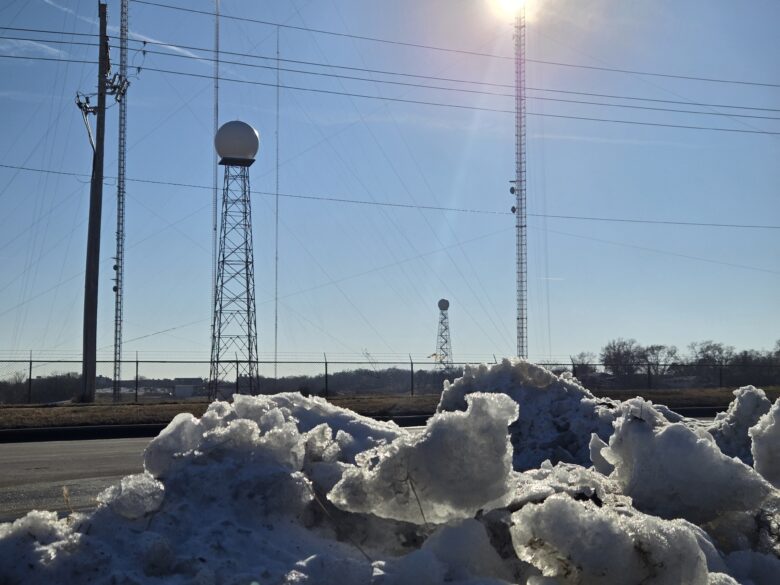
As bad weather approaches Omaha, sometimes radar maps will show a safe zone surrounding the city. When the rest of the state gets blanketed in snow or drenched by a downpour, Omaha commonly emerges fairly unscathed. This has led some residents to believe in something called the “Oma-dome” – a mythical barrier that protects the city from storms.
This social media conspiracy theory – or meme, rather – has been circulating for nearly a decade.
“Those who do not believe are those who are not enlightened,” commented one Reddit user with the badge “OmaDome Deacon” on their profile.
Some comments imply the dome protects critical military infrastructure at Offutt Air Force Base. Others believe the Desert Dome at the Henry Doorly Zoo is connected.
“On occasion, the OmaDome is shut down for maintenance and re-fueling. Such maintenance windows allowed the April 26th Elkhorn tornadoes to pass through as well as the July 31st wind storm which knocked out power for over 200k customers,” one commenter theorized.
Others say the Oma-dome siphons power from Omaha drivers high-centering their cars on rocks. This element of the Oma-dome lore became popular when a 2019 news story of a vehicle doing just that at a West Maple Road shopping center went viral.
“I once totaled a minivan on a landscaping rock in Omaha and ever since I have craved pictures of other vehicles in contact with large rocks to reassure me that I am not the worst driver in the city,” one Reddit comment reads. “More cars on rocks = increased OmaDome shield density.”
Social media accounts claiming to represent the Oma-dome often post when precipitation shows up on radar.

“I must say I look Beautiful tonight!” reads a May 18 post from Facebook account “The Omadome” as heavy rain was predicted in surrounding areas.
Bill Randby has reported on the weather in Omaha since 1992 for KETV Newswatch 7. He said there could be some truth to the Oma-dome, but not as much as the internet would have you believe.
“People batted it around probably back in the ‘90s and around 2000, but just as sort of an observation that seemed like a storm was missing Omaha,” Randby said. “But it really wasn’t talked about very much until the Internet era. Social media is the thing that made it spread more than anything.”
Most of the theories are harmless and lighthearted, but Randby said there are two meteorological explanations behind the so-called Oma-dome observations.
Debunking the dome
Sometimes, a radar map will show a hole in impending rain or snow that wraps around the Omaha metro area. But as Randby tells it, that’s a simple function of radar technology called the “cone of silence.”
“The radar beam can’t see straight up, and it doesn’t see as much close to it as it does at a distance,” Randby said.
The radar towers in Omaha are in the center of the city, which can make it look like storms weaken as they approach on a radar map alone.

But occasionally, severe weather does miss Omaha, even if it hits other surrounding areas. Randby said that could be explained by the “urban heat island effect.”
Urban areas tend to be warmer than surrounding areas because of infrastructure, higher populations and more vehicles. All that activity and warmth coming from Omaha’s urban center can change the atmospheric temperature by a couple of degrees – just enough to have an effect on weather.
“We’ve had a couple of freezing drizzle, freezing rain events where it stayed just 33 in the middle of Omaha and Eppley Airfield because of the warmth of the city relative to the outside area, and it was 31, 32 in Fremont and in Blair, and it was bad icing there and not as bad in the city,” Randby said. “And again, people would say, ‘See? There’s the Oma-dome!’”
Randby said “every metropolitan area with a radar looks just like that” when precipitation is coming. The same phenomenon occasionally happens in Lincoln. Kansas City calls its weather dome theory the Tonganoxie Split.
He said it’s also quite rare for Omaha to get large snowstorms.
“Ninety percent of our snows in Omaha are less than four inches,” Randby said. “It’s really hard to get a big blizzard. It just doesn’t happen very often. But sometimes computer models show that.”
Those differing radar models, which Randby said people have greater access to with computers and phones, can also affect how they perceive the weather.
“With the advent of the iPhone and smartphones and people having a radar app, people became more familiar with looking at precipitation on the radar and how it changed as it moved into a metropolitan area,” Randby said.

“I truly, though, am humbled by people that watch and pay attention to the weather on a daily basis, and I think there’s value in it,” Randby said. “People are interested in the weather here – and I would say more than in many other parts of the country. It makes it great for meteorologists to work in an area where people are interested and pay attention.”
If the Oma-dome is real, it hasn’t stopped Omaha from facing icy snowstorms, high winds and damaging tornadoes.
“If you looked at a chart over the last 5,000 years – and of course, people haven’t been here that long to track that – I’m sure there have been tornadoes that have tracked over almost every square inch of the city of Omaha,” Randby said.
This year, Omaha had a mild, dry winter – as did most of Nebraska – but heavy snow still hit in late February. Last March, the worst blizzard in years knocked out power for over 100,000 people. Two years ago, tornadoes destroyed homes and other buildings in west Omaha.
“They happened right in the city, but people’s memories are short,” Randby said. “They tend to forget about storms that happened in the past.”
All in all, Randby is an unabashed Oma-dome denier.
“We never know everything about everything, Randby said. “So, who knows? Maybe there is, you know, some unknown conspiracy behind it, but I choose to believe that the simplest explanation is usually the right explanation.”