
On a hot afternoon in early July, handlers at Omaha’s Eppley Airfield lowered a flag-draped box from the hold of an Alaska Airlines jet.
Police officers and military veterans saluted. Passengers, alerted to the flight’s special cargo, peered through the windows.
The box held the remains of a soldier who died July 5, 1942, in the crash of an Army transport plane off Alaska’s southwestern coast.
In the early days of World War II, the twin-motor C-53B was ferrying troops to the Aleutian islands to counter a Japanese invasion of the archipelago. All 16 crew and passengers were killed. Six bodies washed ashore. Five were identified and returned to their families. The sixth, labeled “X-3 Fort Randall,” has been buried in Alaska for the past eight decades, undisturbed and mostly forgotten.
Now X-3 had been exhumed from that grave in Sitka National Cemetery by a recovery team from the Defense POW/MIA Accounting Agency and flown to Omaha for identification. An Air Force honor guard, clad in dress blues, carried X-3’s casket to a hearse waiting on the tarmac for a ride to the agency’s laboratory at Offutt Air Force Base.
DPAA anthropologists there will compare the remains to what is known about the missing men, and compare DNA with that of living relatives.
“At this point, the science will run its course,” said Josh Fennell, a DPAA historian who researched X-3 Fort Randall and the missing plane. “Then we will finally know (who it is), after all this time.”

One of the missing soldiers is a Nebraskan: 2nd Lt. Eugene Christensen, 21, of Fremont, the co-pilot of the C-53B. Without pressure from Christensen’s relatives, X-3 might never have had a chance to be identified.
No one pushed harder than Chris Pfeiffer, 72, Christensen’s grandnephew, who grew up in Scribner and is a veteran of the Air Force and the Nebraska National Guard.
Pfeiffer kept pressing for the disinterment, even through a yearslong dispute between DPAA and officials at the VA’s National Cemetery Administration (NCA).
The NCA operates Sitka National Cemetery, in southeast Alaska, where X-3 has been buried since 1948. It had initially resisted DPAA’s efforts because of fears about geological instability in the hillside burial ground.
Pfeiffer said he was convinced the case would go nowhere unless he got involved.
“They told me, ‘Chris, the squeaky wheel gets the grease,’” Pfeiffer said. “I never let up on them.”
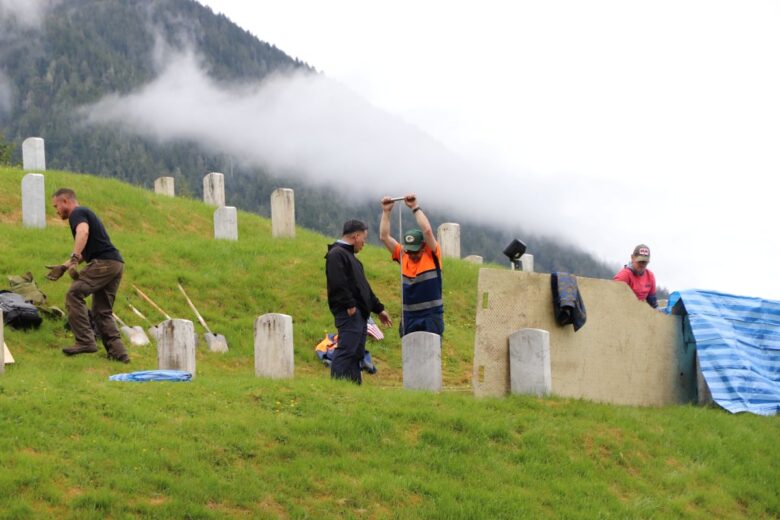
Last month he traveled to Sitka from his home in Texas to watch the disinterment. Aaron Cummings, a DPAA planner who coordinated the Sitka disinterment, said the recovery team made special provisions for him to watch, even though the cemetery was officially closed.
“We welcome family members to be present, but we simultaneously have to be sure we’re protecting the sanctity of the site,” Cummings said. “It was wonderful to have him onsite to observe from a safe distance.”
Christensen’s living relatives only know him through a few handed-down stories. His parents and four siblings all died years ago. No one now living remembers him.
“I’m the senior family member now,” said Joe James, 77, of Lincoln, who is Eugene’s nephew. “I wish I had asked more questions about him when I was younger.”
Surviving relatives have heard he was athletic, popular and good-looking. He raised racing pigeons in the loft of his family’s barn and enjoyed hunting.
After high school, he attended Midland College. He took up flying and planned to become a doctor, according to a 1943 obituary in the Fremont Tribune.
In September 1941 – three months before Pearl Harbor – Eugene joined the Army and was sent to flight school. He completed training in April 1942 and was sent to Elmendorf Field, Alaska, to join the 42nd Troop Carrier Squadron.
Records of Christensen’s last flight, and the search efforts that followed, are fragmentary and contradictory, Fennell said.

The C-53B is known to have taken off from Elmendorf around noon for a scheduled four-hour flight to Fort Randall, near the village of Cold Bay. There’s no record of a distress call.
It’s not clear whether searchers found any wreckage, though the Army apparently concluded that the plane crashed about 25 miles northeast of Cold Bay.
Six bodies were recovered along the shore over the coming months by a fur trapper. The next spring, he reported his findings to the Army and drew a map showing where he had buried them. The Army brought all six to Fort Randall.
Five were identified. All but X-3, who was reburied at Fort Randall.
After the war, in 1948, the Army made another attempt to identify X-3 but could not. The missing men were declared unrecoverable the following year.
In the Christensen family, the airman’s loss left a wound that never quite healed. Though Eugene’s mother displayed Gold Star emblems and the folded flag from his memorial service, he was rarely talked about.
For the Army, and for the Christensen family, the case of the missing C-53B and its soldiers went quiet for more than 65 years.
Then, in 2015, the Defense Department reversed a decades-old policy and began allowing the newly formed DPAA to reopen graves of the “unknown” dead from past wars. Fennell and other DPAA historians began combing through missing person files, looking for “unknowns” who might easily be identified.
“This one jumped out because there’s such a strong circumstantial connection between previously identified remains and this ‘unknown,’” he said.
Fennell said the agency had little difficulty coordinating disinterments at other military cemeteries in Hawaii and overseas. But the NCA balked at allowing any digging in Sitka because there had been so much underground movement of ice, water and soil in the cemetery. No one knew if the remains might have shifted. And NCA didn’t want to risk causing a landslide.
Pfeiffer’s nagging made the difference, Cummings acknowledged.
“He had a massive impact in breaking the logjam,” Cummings said.
The NCA dropped its opposition after DPAA agreed to dig by hand, and to stay within individual gravesites.

The recovery team learned the perils of digging in Sitka while excavating another unknown from an unrelated case. They dug down 10 feet but found the grave empty.
The team had much better luck with X-3. Only three feet below the surface, they struck the casket’s wooden lid.
“Usually caskets collapse, or they are about to,” Cummings said. “When that happens, you have no barrier between the soil and your soldier.”
But it turned out the wooden coffin was lined with metal. Inside was another metal casket protecting X-3.
“The remains were in very good shape. That is very good, scientifically,” Cummings said.
Word of X-3’s disinterment had circulated in Sitka. Ten police cars and two fire vehicles escorted the casket to the airport as up to 3,000 residents lined the streets to pay respects. An honor guard loaded the casket into an Alaska Airlines jet bearing a special “Fallen Soldiers” paint scheme.
“It was impressive. The whole town came out,” Cummings said.
Forensic anthropologists will work with the Armed Forces DNA Identification Laboratory in Delaware to match X-3’s DNA with reference samples obtained from relatives of 10 of the 11 missing soldiers.
Christensen’s relatives would love to find out it matches the uncle they never knew.
But Pfeiffer said he will be fine if it doesn’t. He has also become familiar with the stories of the other missing soldiers, who all came from all over the country. He’ll be glad for the closure an identification would give one of their families, too.
“A long time ago, I came into the mental position that I’m going to be part of that (funeral) ceremony, whether it’s Oklahoma, or Arkansas, Wisconsin, California,” he said. “And I’m glad we take these unknowns, and put a name on them.”