

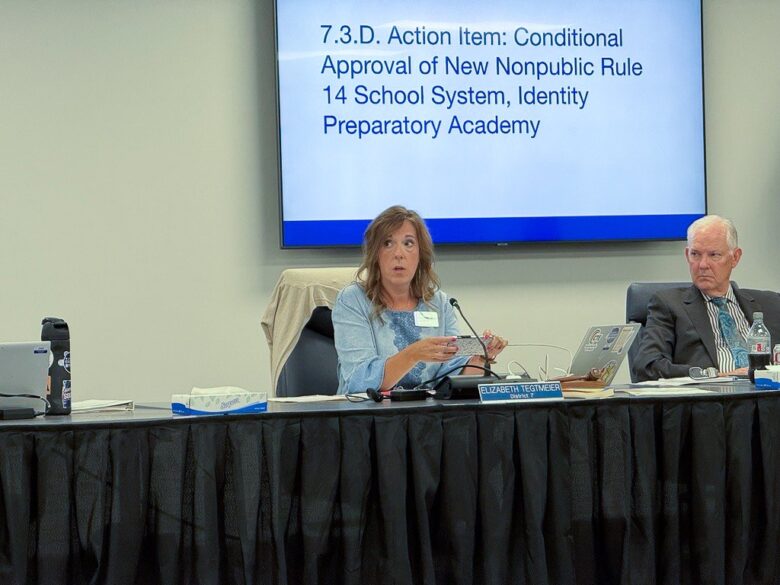
The State Board of Education on a 6-2 vote postponed the conditional approval of Identity Preparatory Academy, an all-girls middle school in North Omaha set to open later this month.
The school was seeking conditional approval under Rule 14, which outlines the requirements a school needs to be recognized by the department. It would be a temporary go-ahead for the school to open its doors for the year. Nebraska Department of Education staff would then visit the school during the year to ensure requirements are being met. As long as the school meets those certain specifications, the school would be recommended for approval again for the next school year.
If the school doesn’t receive approval, leaders could look into operating under an exempt status, which is what homeschools usually operate under.
DérNecia Phillips, founder and chief executive of Identity Preparatory Academy, spoke during public comment ahead of the vote to clarify the school’s educational framework.
“In our initial design phase, our website utilized exploratory language like ‘liberatory’ and ‘abolitionist’ to express our desire to build joyful, secure learning spaces that practically interrupted those negative pipelines,” Phillips said. “However, through our ongoing collaborative journey alongside North Omaha families that structure evolved and changed.”
Kirk Penner, a Republican on the officially nonpartisan board, said he wanted to postpone the vote to learn more about the school’s curriculum. He, along with the other three Republicans on the board, shared concerns that the school would use an “abolitionist framework,” which the members defined as abolishing the American government.
“I want to go up there, and I want to talk to Dr. Phillips and staff and everybody, and I want to see the whole program because what we were seeing is totally different than what Dr. Phillips was saying today,” Penner said. “We need a little bit more time to vet the whole process.”
Sherry Jones, also a Republican, said she was concerned the curriculum wasn’t lining up with state statute. She specifically pointed to the state statute on civics education and the one on character education, which includes honesty, respect for the national flag and obedience to law.
“When you read this, it talks about obedience to law, desirable citizenry, etc.” Jones said. “If you do your homework on this [abolitionist] framework, it is not supportive of that. I want to hear from Dr. Phillips about the things that I’ve read about the abolitionist framework, educational framework.”
Liz Renner, a Democrat who ended up supporting the postponement, said she believed the board would see that Identity Prep is actually the perfect civics lesson.
“The founder and a board collaborated with their community, with parents, with students, with caretakers for potential students to form an educational environment that serves their needs,” Renner said. “They have proceeded to engage in the process in every way that we’ve laid out. There’s nothing more American than what they’re doing.”

Both Deborah Neary and Kristin Christensen, who are Democrats on the board and the two no votes for postponement, said they believe the school passed all the requirements laid out for approval in Rule 14 and should have been approved at the meeting. Christensen said the school has outlined its guidelines for the core curriculum areas, and it’s not up to the board to approve or not approve the certain materials they use to teach that framework.
“From my standpoint, for with those three pieces — the application, the statute, and the Rule 14 — they have met the criteria to be an approved, conditionally approved Rule 14 school, because the actual materials that they’re using, the curriculum that they might purchase or give to students or use as teaching guides for their teachers is beyond our purview,” Christensen said.
Neary also brought up concerns that the discussion was being brought up late in the process, when the board was meant to vote on approval. She shared concerns that the postponement had nothing to do with policy or what is legal, especially because the school serves predominantly African-American families.
“You can still go next week and visit the school, and give your input to the staff who will continually be evaluating this because that’s their job over the next year,” Neary said. “But it’s disrespectful. I think it might be illegal. I believe that we have a responsibility not to increase chaos, but to support schools that are trying to do the right thing for the students of Nebraska.”
Elizabeth Tegtmeier, who is board president and a Republican, denied race had anything to do with anyone’s votes.
“I’m disappointed that the race factor came into this because nobody else raised that,” Tegtmeier said. “There was concern with statute, and I don’t believe that this is racially motivated in any way.”
The two Democrats to vote for the postponement were Renner and Maggie Douglas, and both support approving the school. Renner asked for board members to be open-minded in conversations with Identity Prep staff.
The board will hold a special meeting on Aug. 11 at 1 p.m. to vote on the approval of the school. Identity Preparatory Academy is set to open Aug. 19.
Phillips said after the meeting that she will be hosting the board members on Monday to share more about the school and the framework. She said interest in the school has been high, with more than 300 girls applying to the school’s wait list. There will be 30 girls going to the school in its first year.
“I’m excited to share with them more about what the community has created together with Identity Preparatory Academy,” Phillips said.
Vote on social studies standards set for September
Board members will be voting on updated social studies standards at their September meeting. Updates for standards come up for review every seven years.
Those standards were a discussion item for Friday’s meeting. Neary said she was concerned that several references to examples of figures like Harriet Tubman, Crazy Horse and Martin Luther King Jr. were removed from the standards, even if they were left in some spots.
“I was told by teachers that live in smaller rural communities that they need those examples in the standards, or they’re going to be maybe called on the carpet, like ‘Why are you teaching about these ideas and this,’” Neary said. “If it’s not listed there as an example, then it makes it harder for them to be able to teach these subjects.”
Tegtmeier pushed back on the idea that teachers would be questioned for teaching historical figures.
“I did see a few looks of alarm from staff who have taught in small rural schools that they would never call teachers on the carpet for bringing up historical figures. There was a little look of alarm,” Tegtmeier said. “I’m in rural schools, that’s all I have in my district, and the idea that administrators in rural areas are narrow-minded and bigoted is abhorrent, and that’s why I got some looks from rural teachers and administrators.”
Brooke Crumb, the communications and outreach specialist for the non-profit Stand for Schools, said during public comment that her organization opposes the proposed standards. She said the current standards highlight the importance of differing views.
“The proposed changes would effectively undo those implemented in 2019, which is not only regressive but endangers high-quality education or instruction and risks students’ academic achievement,” Crumb said.

Hope Hibler, an educator for 20 years with 15 years teaching social studies, said she was initially concerned about these standards. She urged the board to ensure that there would be proper implementation through filling the open social studies education specialist position, providing teachers access to high-quality guides and resources, and offering professional learning.
“Communities from Omaha to McPherson County Schools, they should have equal access to training that moves beyond what to teach, but how to teach complex histories in a way that provide a safe environment for open and valued civil discourse,” Hibler said.
The board’s next regularly scheduled meeting is set for Sept. 4.