

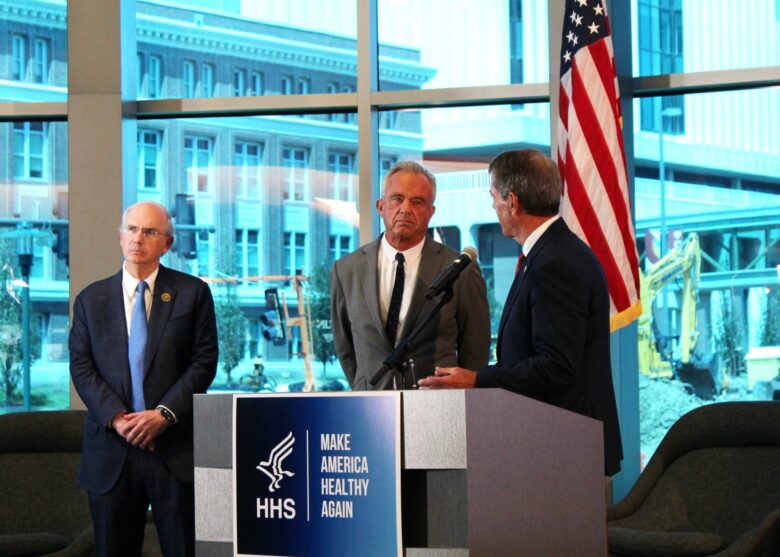
The nation’s top health official was in Omaha Thursday.
U.S. Department of Health and Human Services Secretary Robert F. Kennedy Jr. met with members of the press following a tour of the National Quarantine Unit housed within the University of Nebraska Medical Center campus.
Kennedy’s visit came roughly two months after UNMC ended its hantavirus quarantine operation. Eighteen people were sent to the Omaha-based quarantine unit for monitoring following an outbreak of the disease on a cruise ship.
Their stay at UNMC made national headlines. A New York Times article reported complaints from a woman who alleged she was forced to stay in quarantine despite an opinion from the Centers for Disease Control that she could safely return to Florida while continuing to be monitored.
Kennedy signed an order requiring her to remain in Nebraska. Asked about that decision Thursday, Kennedy said it was based upon two things.
“One is President Trump’s perception that his job is to protect the health of the American people,” Kennedy said. “And the other is science that the incubation for this virus was 42 days, and that it made sense to quarantine the people who were exposed to the virus rather than take a chance it would spread across the country.”
With hantavirus operations over, Kennedy said UNMC professionals will help train public health service officers deployed to an upcoming biocontainment unit in Kenya. That facility is planned to hold U.S. citizens exposed to an ongoing Ebola outbreak.
In his position, Kennedy has drastically reshaped public health in the U.S. Some of those decisions brought criticism from longtime public health experts, including UNMC’s dean of public health, Dr. Ali Khan.
Khan has spoken out against cuts to the Centers for Disease Control and vaccine research, as well as U.S. withdrawal from the World Health Organization.
University of Nebraska President Jeffrey Gold welcomed Kennedy alongside Nebraska Gov. Jim Pillen. Asked whether he agreed with recent changes to the U.S. childhood vaccine schedule, Gold said individual decisions about vaccines often come from trusted health professionals.
“At the end of the day, my advice to parents, and I get asked this all the time, is to speak to your trusted healthcare professional about what they think is best for their child,” Gold said.