
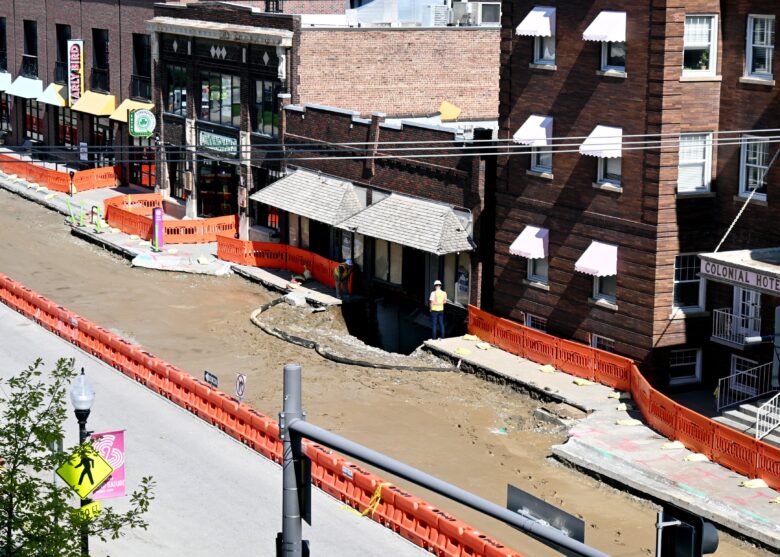
Omaha made national headlines this year after a sinkhole swallowed two vehicles earlier this year. More collapses followed. Nebraska State Geologist Matt Joeckel sat down with Nebraska Public Media’s Grant Winterer to talk about what’s going on under the streets of Omaha.
Grant Winterer: What is it about Omaha’s geology and soil that is making these collapses possible?
Matt Joeckel: Omaha is almost entirely underlain by late Ice Age, or late Pleistocene-era loess. Nebraska should be known as the “loess state” in my opinion, because it’s so widespread.
What’s special about loess is that it makes great agricultural soil because it holds onto enough water and drains effectively. It has a lot of calcium for plants to use.
It’s also problematic, because it’s highly erodible, especially when exposed to a sudden burst of water, either from storm drains, or perhaps related to failing infrastructure.
Winterer: It seems like we’ve seen a relatively large number of these sinkholes crop up in a short amount of time. Are we actually seeing more of them, or are they just more visible based on the huge ongoing construction projects?
Joeckel: I think you’re spot on in relating this to construction that’s going on. But some of it happens regardless.
Say a water main bursts, that creates internal erosion that creates a void under the surface. And if there’s a road over the top of that void, it’ll bridge the opening for a while, but only as long as the strength of the road can sustain the pull of gravity, and then you have a collapse.
Winterer: There’s a lot of big projects, ongoing construction projects in Omaha. When a sinkhole emerges, it seems as though people tend to assume that something related to construction caused it. How do we know if that work is a culprit?
Joeckel: I’m not a construction expert, but I think if active construction is going on, and something like a washout occurs, then you can be fairly sure that there is some kind of relationship.
There have been plenty of road collapses, though, where there was no construction going on. That usually indicates an infrastructure failure: a break in a water main, a sudden release of water, something like that.
Winterer: What are some of the biggest misconceptions people might have when seeing footage of, or even hearing the word “sinkhole” either in the news or on social media?
Joeckel: The one that concerns me is that people might think of these as “sinkholes” in the strictest sense; that is, “the collapse of the land surface related to the dissolution of bedrock.”
That’s not what we’re talking about here. We’re talking about internal erosion that leads to the collapse of a manmade structure, like the previously mentioned road over the void.
Winterer: Is Omaha unique for this in regional cities, or are we seeing it elsewhere? Kansas City, Des Moines, Sioux City, places like that?
Joeckel: I think these collapses occur in other places, these washouts under roads. You could find multiple accounts just through an internet search.
Here’s the problem: it’s tough to make statistically valid comparisons. In other cities, you might be talking about a huge difference in soil makeup and geology.
Winterer: It sounds like there may be more in the future. What should people keep in mind going forward?
Joeckel: I don’t think there’s an imminent catastrophe, but I do think people should report anything unusual: sinking of the ground surface, open holes.
Any sort of strange collapse at the land’s surface could be suspicious, and probably should be investigated.