

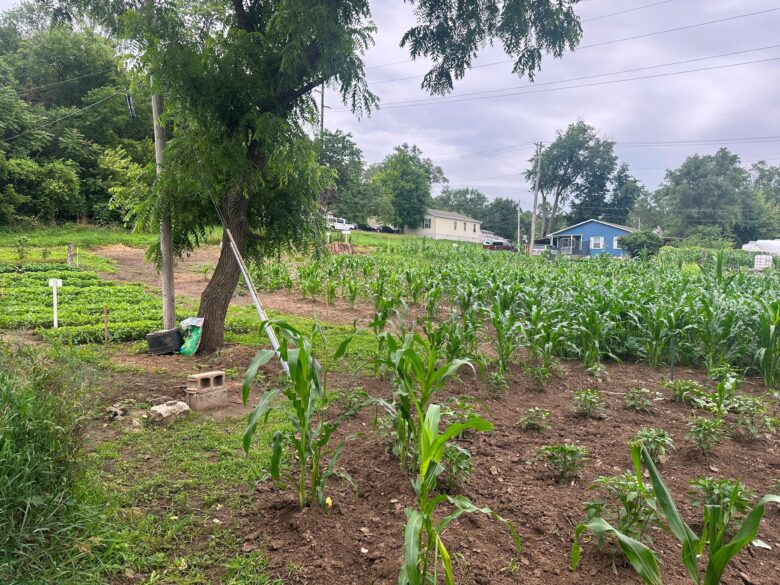
A Maya community is using a national grant to create a climate resilience plan for a North Omaha neighborhood.
Comunidad Maya Pixan Ixim will use the $96,440 to plan out how its roughly 8-acre property along the Beltline Trail can help improve neighborhood resilience to climate impacts.
The funding is part of $3.1 million distributed nationwide by the Climate Smart Communities Initiative, a public-private organization that supports local communities in preparing for extreme weather and other results of climate change.
Among the goals for the North Omaha project are managing stormwater, growing green spaces and reducing the effects of extremely high temperatures. The grant was announced last week amid a heat advisory for feels-like temperatures over 105 Fahrenheit that included the North Omaha neighborhood.
The discovery phase of CMPI’s North Omaha Resilience Plan starts this weekend, where a survey will be rolled out at the 2026 Indigenous Peoples Summit asking residents how climate change is already impacting the neighborhood, and the climate adaptations they want to see in the area.
“The survey is meant for just the community that lives around that area, but also partnering organizations that also have projects and interests in that area,” said Luis Marcos, executive director and co-founder of CMPI. “What are they seeing? What are they observing?”
The discovery phase is expected to last until December, when organizers plan to launch a series of workshops with residents and local non-profit organizations to explore the possibilities for CMPI’s Grant Street property.
Verdis Group — an Omaha-based climate consulting firm — is working on the resilience plan along with CMPI, the Nature Conservancy Nebraska and the Papio-Missouri River Natural Resources District. Grace Thomas, the group’s manager of sustainability services, said the final result will be a document detailing the plan and “written in plain English.” Beyond those pages, however, she sees a broader impact.
“An important outcome is the process itself,” Thomas said. “It’s the act of having conversations about how climate change is going to show up in North Omaha and is already showing up in North Omaha. It’s the relationships that CMPI is going to build with neighbors in that 68111 ZIP code.”
Another key part of the process is bringing in members of the Q’anjobal Maya community, many of whom live near CMPI’s Grant Street property and face language and literacy barriers. Marcos said the process needs to be intentional, and include face-to-face conversations.
“The Maya writing system, for example, is completely different from the alphabet that we use here,” Marcos said. “So if people don’t know how to read, then you can write it in English, Spanish, or Q’anjobal. It will not be readable to people. So we have to be one-on-one. We have to do focus groups to really, really just capture exactly the vision of people for the different properties.”
CMPI’s North Omaha Resilience Plan will cover communities in the 68111 ZIP Code, which stretches from 24th Street in the east to 45th Street in the west, and Redick Avenue in the north to Charles Street in the south. The area includes the home where Malcom X was born.
The ZIP Code has faced decades of redlining — where lenders illegally deny financial services based on racial or ethnic bias — which has left at least a quarter of residents below the poverty line and incomes well short of the city’s median, according to the Verdis Group.
The community also faces environmental concerns; few trees, aging infrastructure and lots of paved surfaces exacerbate heat and flooding, while more than 10% of residents live with asthma amid poor air quality, the Verdis Group wrote in a recent press release. The firm cited research from the University of Nebraska Medical Center that found historically redlined areas are some of the hottest places in Omaha, swinging up to 10 degrees warmer than other parts of the city.
Currently, more than a dozen Maya families are already using a portion of the Grant Street property to grow crops using traditional agricultural practices. Under the resilience plan, CMPI wants to push back invasive species on the land — including the Siberian elm.
“The idea is to replace that with more useful trees,” Marcos said. “For example, cottonwood is a sacred tree for the native nations here in the area. But we are also thinking about fruit trees and hazelnuts and just really maximizing the use of that property, and we want to keep it a green space.”
Thomas said that adding housing to the property is a goal for the resilience plan — though what such housing would look like is dependent on the needs of the neighborhood.
“The proactiveness of having these conversations at this point in CMPI’s planning process and development of this land is, I think, really powerful.” Thomas said. “I think a lot of resilience plans happen after infrastructure has already been in place for a long time and we’re having these conversations and doing this work on the front end of a really exciting community, setting up hopefully this property to really be able to thrive despite a lot of the climate impacts that are projected and that have already been well-documented and established.”
She expects the planning process to take about nine months, and wrap up by May or June of 2027.