
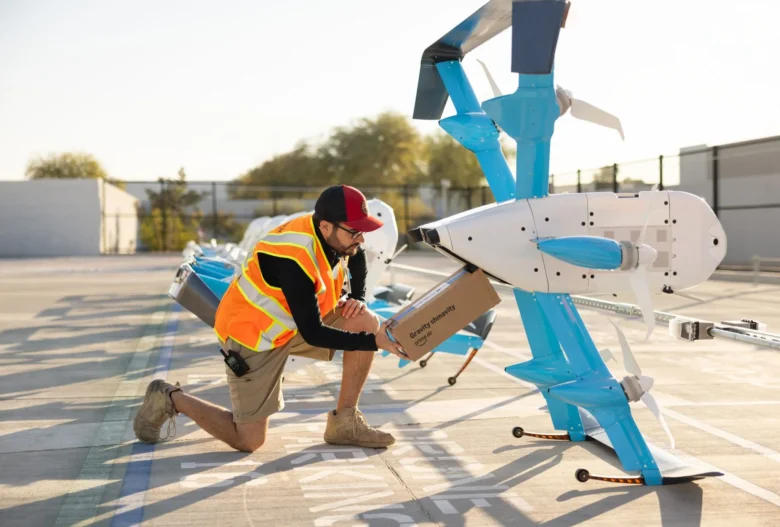
Robert Thayer looked up from his computer as a churning weedwacker-like sound interrupted the silence of his west Omaha home. As he noticed his grass swaying, he thought: That must be the drone.
The tech worker walked out his front door to find a blue-and-white robot hovering above his yard.
He watched with amusement as the drone dropped a brown box containing the allergy medicine he had ordered 90 minutes earlier. Then, the machine’s powerful propellers blew the box from his lawn into the street.
“Only the best from Amazon,” Thayer wrote in a Reddit post alongside a video of the delivery.
This summer, suburban Omahans have caught a glimpse into the future of online shopping.
Twelve drones made 6,000 trips from Amazon’s hulking Papillion warehouse in July and August to deliver packages up to 7.5 miles away. The facility is one of 11 U.S. locations launching the autonomous robots. By year’s end, Amazon anticipates delivering to 500 cities and towns.
Some living in the new drone zone see the technology as a novel solution to speed up package delivery and reduce traffic on local roads.
Others say noise from the drones disrupts neighborhoods and wildlife habitats while providing little benefit. The tech will eventually cost people jobs, said Bryan Patel, vice president of Teamsters Local 554 and a representative for United Postal Service members.

“It makes me want to throw up a little bit,” Patel said. “I don’t like it at all. I view it as corporate greed. Amazon makes billions of dollars every year, and it’s never enough.”
Amazon doesn’t believe that will happen, said Erik Robertson, the regional operations manager for Prime Air. For Amazon, these drones — autonomous robots that are 78 lbs., more than 5 feet tall and capable of traveling faster than 70 mph — offer a solution to emergency necessities like Tylenol for a sick child or last-minute purchases like art supplies to finish a school project.
“To finally bring this technology that our teams have designed into fruition, it’s amazing,” Robertson said.
As one of Prime Air’s early customers, Thayer feels conflicted about the new drone service.
Robert Thayer took a video of an Amazon drone dropping a package onto his west Omaha lawn. The box was then blown into the street by the machine’s powerful propellers. Video courtesy of Robert Thayer
“I’ve been in the technology industry for most of my career, so that side of me is like, ‘This is really cool,’” Thayer said. “But the idea of just driving around and seeing drones flying all over delivering stuff is kind of dystopian.”
Not science fiction
In late 2013, Jeff Bezos promised CBS’ “60 Minutes” he had a big surprise to unveil. The Amazon CEO led the camera crew down a white, windowless hallway and opened the door to an office simply titled “AV Room.”
“Oh, my God!” Charlie Rose exclaimed when he saw two helicopter-like robots sitting on a table. Bezos showed a video of conveyor belts, packages and drones lifting off into the sky.
“I know this looks like science fiction,” Bezos said. “It’s not.”

CBS reported Bezos wanted his drones airborne in as little as four years. But federal regulation had to catch up.
Congress first ordered the Federal Aviation Administration to integrate drones into air regulations in 2012. After years of lobbying by Amazon, the agency allowed the company to launch pilot projects on the West Coast and in Texas.
In the meantime, the company honed the technology, improving the batteries and AI-backed “computer vision” systems that allow the drones to fly safely and deliver packages with accuracy, said Paul Armstrong, a London-based tech adviser who writes a weekly newsletter about Amazon.
Recently, Amazon applied to deliver up to 1,000 packages a day in several U.S. metros, including Omaha, Kansas City, Detroit and Dallas.
Papillion made the early cut because of Amazon’s great relationship with the city, which includes the company donating money to local schools, Robertson said. In 2023, the company also built an automated warehouse that uses robots to move items.
Strategically, Papillion is more of a testing ground than a “showcase city” for the company, Armstrong said.
“If Prime Air can operate reliably through wind, snow, storms and temperature swings, Amazon learns far more than it would from another carefully controlled launch in a warm, easy market,” Armstrong said.
The main approval Amazon required came from the FAA. Its June application to operate here mostly concerns potential environmental effects, which the company says would be largely insignificant. The FAA did not respond to emails and calls requesting comment.

The flights didn’t require any action from the Papillion City Council or the Sarpy County Board, officials said.
Don Kelly, who represents Papillion on the County Board, said Amazon has been a good partner. He still has questions about the potential for accidents and how many drones will be buzzing around suburban Omaha airspace, but there’s no use fighting the future, he said.
“Welcome to the 21st century,” Kelly said. “It’s tech. It’s here. America innovates, and we’re lucky to be living in America.”
Sharing the skies
Simon Hoey was puzzled when he noticed Amazon drones flying over Chalco Hills Recreation Area. The park’s rules say drones are “strictly prohibited,” but Hoey counted five in the sky during a walk around the lake a few weeks ago.
A self-described “bird nerd,” Hoey worried the drones would disturb the bald eagles that nest seasonally in the park, which lies roughly a mile from the Papillion warehouse.

“It’s posted all around the lake saying, ‘No drones,’” Hoey said. “You just see the drones flying through willy-nilly with no concern.”
Bald eagles, a federally protected species, could feel threatened by drones that get too close and may eventually abandon their nests, said Kristal Stoner, vice president of the National Audubon Society.
Amazon agreed with federal officials last month to alter flight paths so the drones don’t fly within 1,000 feet of the nests, said Amanda Grint, assistant general manager of the Papio-Missouri River Natural Resources District, which manages the park.
The NRD’s rules specifically bar the launching of drones in the park, so Amazon’s drones are allowed to fly over, Grint said.
Hoey called that a “really weird loophole.”
Dave Zajac, the assistant chief flight instructor for Oracle Aviation, is less concerned about drones flying near the Millard Airport. Zajac said his understanding is that Amazon’s drones don’t fly within a mile of the runway and two miles from where planes take off and land. The drones also fly at a maximum altitude of 400 feet. Planes using Millard’s airport fly at a minimum of 1,000 feet, Zajac said.
“As long as they stay in their world (and) we stay in ours, everything is fine,” he said.
The noise created by the drones has divided people on the ground.

Hoey said the mechanical sound from above has affected his enjoyment of the Chalco Hills park.
“We go for walks to get away from technology and to see nature,” Hoey said. “Hearing and seeing drones carrying Amazon packages going above kind of ruins it.”
Retired Air Force pilot Skip Bailey said he doesn’t mind the noise and enjoys watching the drones drop packages around his Papillion neighborhood.
“In my experience, the drones are quieter than lawnmowers, motorcycles and even the traffic on busy streets,” said Bailey, now an aviation instructor.
Tech of the future
Drone technology will be essential to deliveries — what kind of deliveries remains to be seen, said Alice Smith, a University of Alabama engineering and computer science professor and drone researcher.
Smith has engineered robots to deliver medicine and other essentials to people living in isolated rural communities in Alabama. She also has delivered replacement parts to Norwegian oil rigs in the middle of the ocean.

Drones excel in niche uses like this, Smith said. Outside of that, things get complicated.
Smith wonders if drones are visually advanced enough to navigate a crowded, noisy city. And while these drones are very safe, it takes only one accident — a robot the height and weight of the average fifth grader falling onto a person or into traffic — to sway public opinion, she said.
“There are going to be applications that make total sense and will improve people’s lives and be efficient,” Smith said. “And then there’s other applications, probably some of the ones we’re doing now, that will be like, ‘Yeah, that just wasn’t the best idea.’”
The idea of delivery drones flying around the country at any level raises privacy and cybersecurity concerns, said Hosam Alamleh, an unmanned vehicle expert at the University of North Carolina Wilmington.
Drones can be disabled or hacked by individuals or even foreign adversaries, potentially putting people at risk, Alamleh said.
“If you’re having your drones just flying around in cities and mapping everything, this is very, very valuable data,” Alameh said. “So the question is, who’s gonna have access to it?”
Amazon spokesperson Andy DiOrio said Amazon’s drones do not use facial recognition technology, read license plates or record audio, and cannot identify individuals. Imagery is stored on encrypted drives, accessible only to authorized personnel and is not disclosed in response to government demands unless the company is legally required to do so, he said.
Workers also are worried for their future, said Patel, the local UPS Teamsters representative. State data shows about 2,350 people in the Omaha metro area currently drive delivery trucks. It seems obvious other companies will follow Amazon’s lead, and many of those jobs will be at risk, Patel said.
“You’re going to get boxed out,” he said.

Sky Rotert doesn’t foresee drones becoming the dominant delivery method of the future. The west Omahan got some office supplies dropped in his backyard a few weeks ago but doesn’t plan to regularly use the drone service.
He questions whether he needs anything so badly that the slight convenience of a drone delivery outweighs the noise and disruption it causes.
“At this point, it feels more frivolous than, like, revolutionary,” Rotert said.
The Flatwater Free Press is Nebraska’s first independent, nonprofit newsroom focused on investigations and feature stories that matter.