
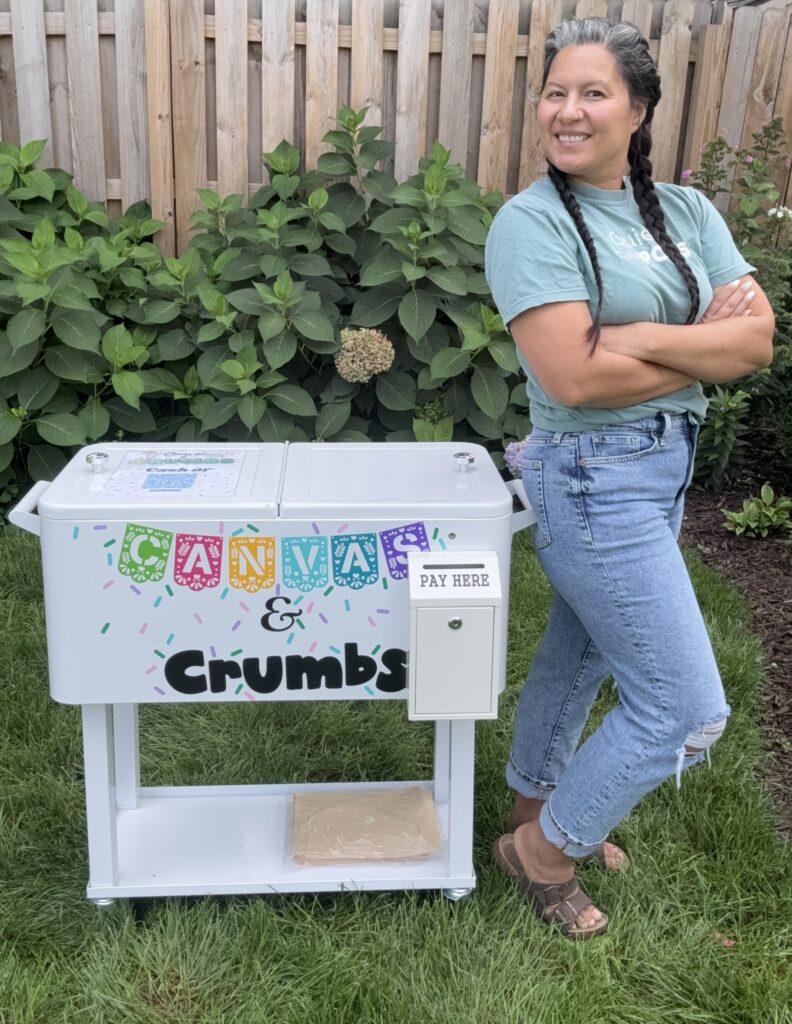
In 2018, Audelia Orellana decided to leave her corporate career to focus on raising her four sons. But Orellana has always described herself as a workaholic. So six months after leaving her job, she decided to create her cake pop business —Canvas & Crumbs.
“I’ve always loved working, and since I wanted to be home as well, I thought this was a really good balance,” Orellana said.
The mother of four reached out to the Nebraska Department of Agriculture to learn more about the state’s cottage kitchen laws and regulations. In 2020, she got her ServSafe certification and registered her business with the Nebraska Cottage Food Registry.
The stay-at-home mom turned business owner decided to shut down operations to focus on her son’s health and recover from donating an organ in 2022. Three years later, after her son’s health got better, she decided to reopen the business.
“I was able to jump right back into kind of where I left off because I’ve had such a loyal clientele,” Orellana said.
With her cooler that serves as her “storefront” she carries her cake pop to public events. For regular operations, she leaves the cooler out with her cake pops on her porch with a QR code for payment and a box for cash payment. This is the common model for cottage bakers but especially cake pop stands. Omaha content creator, Wickydubs did a series testing out cakepop stands in Omaha and compiled a list of 30 different stands.
Orellana believes the increase in cake pop stands specifically comes from the online discourse surrounding ‘Sweet Treats by Ashley.’ Where the content creator and baker was accused of stealing another cake pop baker’s fruity pebble cake pop recipe. The video of Ashley explaining the accusations garnered 27 million views on Tik Tok.
“It’s been really really fun watching the progression of cake pops here in Omaha now. I think there’s like a lot of them, and it’s really great to see that there is a lot of options now,” Orellana said.
Despite Orellana’s success, she wants to stay as a cottage kitchen and has no desire to open a storefront. She wishes to have control over her personal life. With a storefront, she would have more set hours and lose flexibility in her schedule. She also notes that the cost of running a retail store is more expensive.
Not all cottage bakers want to continue working from home. In the study conducted by Nebraska Extension, 37% of registered cottage kitchens saw themselves scaling up production in five years. But only 8% were using their cottage kitchen as a means to start a brick-and-mortar business.
The industry does seem to be growing, though.
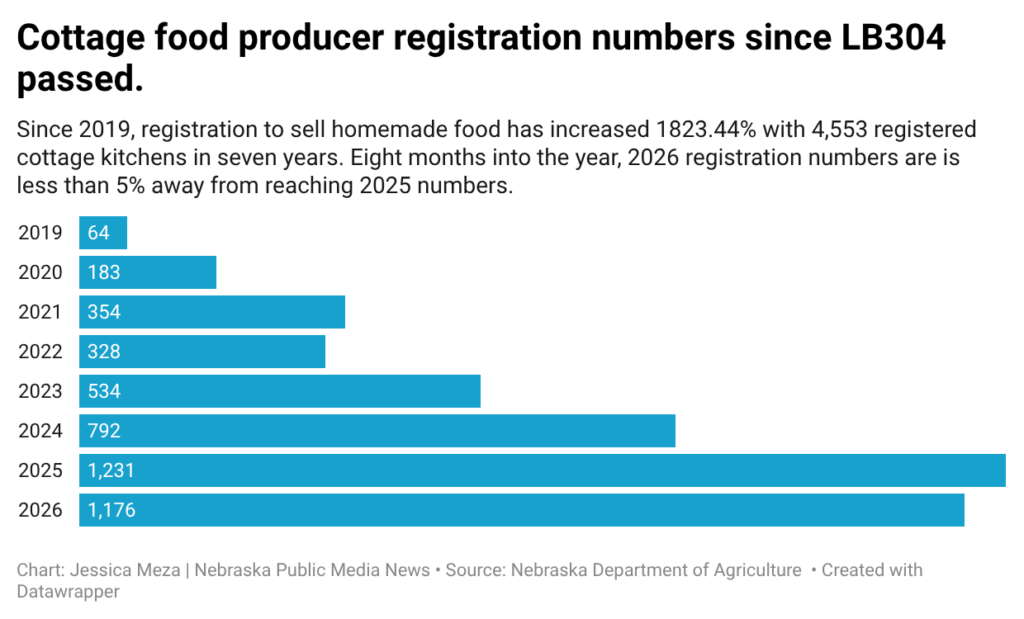
There are currently 4,553 cottage kitchens licensed to sell in the state of Nebraska, and 25% of the kitchens have registered this year. For some cottage kitchen producers, this model is the entire structure of their business. And for others this is a stepping stone to a storefront business.
In 2019, LB304 expanded the places home bakers could sell their products. This included farmers’ markets, fairs, festivals, producers’ homes and more. Five years later, cottage food laws were updated with LB262 by expanding the types of food being sold, including foods that require time and temperature control (TCS) for safety, such as cheesecake, cut fruit, cooked egg dishes, desserts with buttercream, ice cream, pudding, cheese and butter.
“Selling food is very personal, and you can appreciate that whether you’re a permitted business or a cottage food vendor,” said Caitlyn Andrews with the Nebraska Department of Agriculture. “It’s one of the ways that people feel like they can share their own personal love and culture, and just joy in life. So I understand why that would continue to grow.”
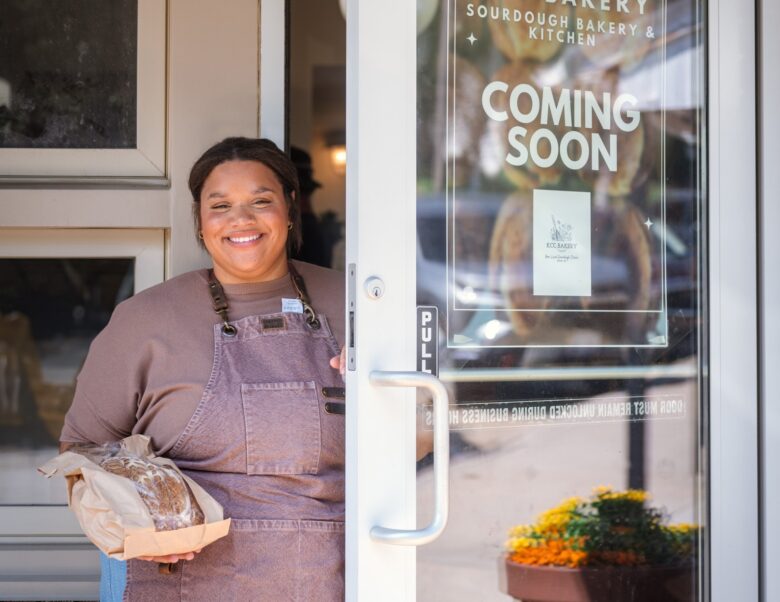
Kelsay Cosgrove has been cooking and selling baked goods from her home bakery, KCC Bakery, since 2017. After a high school cake decorating class, she realized her love of baking. But as her life got busy with college, her career and her children, she slowly stopped baking as often.
During the pandemic, she began baking more and started baking sourdough, which is now the business’ staple baked good. In 2026, she decided to quit her corporate job as a business broker. She was tired of selling other people’s businesses and wanted to start her own.
“I was just sick of working a corporate job, and you know my family relying on others for a paycheck, and also I just found way more joy in this than what else I was doing,” Cosgrove said.
Using her marketing degree, she began strategic marketing and networking to grow her business. Cosgrove sold from her home and at local farmer markets. During this time she says she welcomed half of Omaha to her front porch. But she wanted to venture more with her business.
When she first started her business, she never thought it would lead to having a storefront bakery. Though she loved working from home, she felt she was never able to escape it. With dirty dishes and unwarranted guests, Cosgrove was ready to expand outside her home. The demand for her baked goods was also there, which allowed her to open her store front and hire staff.
“As much as I loved welcoming half of Omaha to my front porch, it also is nice to just have your home be your home,’ Cosgrove said.
Cosgrove feels ready for the change and is excited to try new recipes now that she is no longer limited by cottage kitchen laws. One item she would love to sell now without the limitation is bacon cheddar bagels. Two years after taking the risk of quitting her job, Cosgrove is now set to open her storefront bakery soon.
How to get started
The process to become a cottage food provider is quite simple. It includes completing an accredited food safety course, following food safety guidelines by local area, getting well water tested and registering online. The Department of Agriculture then reviews menu items to ensure that the food items are permitted.
While there are multiple accredited food safety courses that would qualify you as a cottage kitchen, there is only one course specifically for cottage foods. Cindy Brison at Nebraska Extension created the cottage food law course and certification, which offers an in-depth look at cottage food and laws. Brison still recommends that cottage food producers take a ServSafe course, which is a nationally recognized food and beverage safety training and certification program administered by the National Restaurant Association. Not only does the course give the proper guidelines on permissible food and proper kitchen set up, it also provides additional training and education surrounding cottage kitchens.
Nearly 99% of cottage kitchens registered in Nebraska are based in the state. The location demographic shows that half of all the registered cottage kitchens are in Douglas, Lancaster, and Sarpy counties. Omaha alone has 971 registered cottage bakeries.
Angelyn Wang, a project associate at the Center for Rural Affairs, said cottage food laws have increased food production in rural communities. Many of the vendors that Wang works with are using their cottage kitchens as a side hustle rather than a full-time job, helping to fill in gaps when it comes to basic everyday goods.
Brison said rural cottage food producers can help in areas considered “food deserts,” meaning they lack grocery stores.. An instance Brison recalled was when a rural Nebraskan needed a gluten-free wedding cake, but nobody in a 50-mile radius was able to provide one. So she spoke to a cottage food producer, who was able to make a gluten-free cake.
“Our cottage food producers fill a need that’s there. Whether it be allergens like peanut-free or gluten-free, or maybe it’s just something that’s not available at your local grocery store or within 50 miles,” Brison said.
But rural cottage kitchens face hurdles. The biggest is getting capital and buying the goods needed to start the business. These materials to begin their cottage kitchens are often expensive. Other issues are land access and proper marketing skills. Many cottage food producers do not have the land to grow produce, and renting land in rural areas is expensive. Some producers are unable to reach the proper customer base due to a lack of marketing.
Nebraska Extension, which works alongside organizations and cottage producers to meet these needs and educate cottage food producers, conducted a survey that found that marketing and building brand awareness were the topics producers most wanted to learn about. Its cottage food law course is updated as new circumstances and law changes occur to keep producers up to date on the latest regulations.