

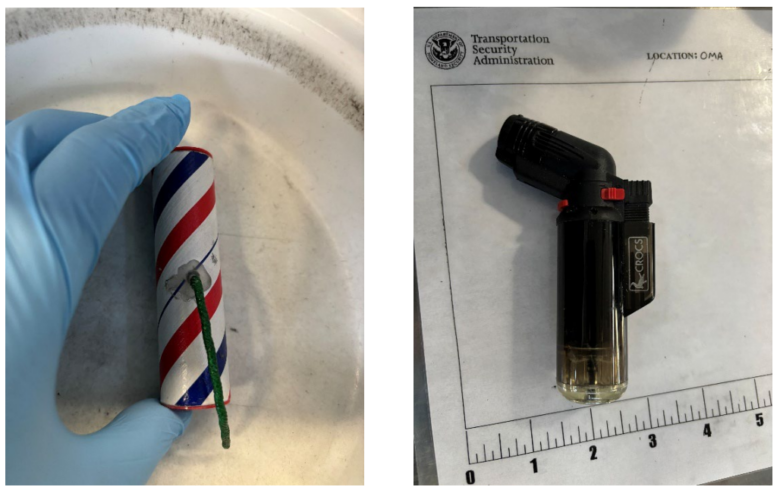
Federal prosecutors dismissed the case against a man accused of bringing a firecracker through security at Omaha’s Eppley Airfield.
The government’s motion to dismiss the case was granted by a judge on Tuesday. Che Salpas, an Oregon resident who was in Nebraska to visit family, was previously charged with one felony count of carrying an explosive device into an airport.
Salpas was initially arrested on Sept. 5 after TSA officers flagged a possible explosive device in his carry-on luggage. When officers inspected his luggage, they found a firecracker inside of a prescription pill bottle and multiple lighters.
Assistant Federal Public Defender Richard McWilliams did not dispute that Salpas carried the firecracker into the airport. But he said in court that Salpas had no knowledge that the firecracker, which was a gift from his father, had been packed into his luggage. To convict, prosecutors would have been required to prove that Salpas knowingly possessed the explosive device.
At a preliminary hearing on Sept. 10, U.S. Magistrate Judge Ryan Carson appeared to express some doubt about the strength of the government’s case after hearing testimony from an agent with the Bureau of Alcohol, Tobacco, Firearms and Explosives, or ATF, who interviewed Salpas’ family members.
“It is not the court’s job or place to dictate what charges the government wishes to assert against you,” Carson told Salpas at the hearing. “I do question, though, where this may be going, because it seems to me that there’s sufficient evidence to show that [Salpas’ father] acknowledged that he gave it to you as a gift, and that he very may well have put it in your bag, whether you knew he did it or not.”
“We’ll see if the government can prove its case,” he said.
More information about how the firecracker ended up in Salpas’ bag came out at the preliminary and detention hearing. ATF Agent Colton Graham said he and other agents interviewed Salpas’ parents, who live in Lincoln.
Salpas’ father told Graham that he purchased five firecrackers from an unknown man outside of a firework stand in a grocery store parking lot. He set four of them off and saved the fifth one to give to Salpas as part of a gift bag. The father said he was the person who placed the firecracker inside of the pill bottle to keep it safe.
While Salpas was visiting his parents in Lincoln, his father gave him the gift bag. Graham said both of Salpas’ parents recalled him finding the firework in the bag and remarking that he would not be able to take it on the plane. In his interview with Graham, Salpas’ father said he was “sure” he was the one who repacked the firecracker into the bag that ended up in his son’s luggage.
McWilliams, Salpas’ attorney, argued at the preliminary hearing that the evidence presented didn’t meet even the low bar of probable cause.
“We got a situation here that the government chose to charge first and investigate the case later,” McWilliams said. “That investigation has borne out that my client had no intention of possessing that device.”
Prosecutors defended the charges and investigation. The government also sought to place Salpas in pretrial detention, a request that was denied by the magistrate judge and by a district judge who reviewed the magistrate’s decision.
Carson, the judge, allowed the case to progress after the lengthy hearing. The motion to dismiss was filed by prosecutors about two weeks later.