

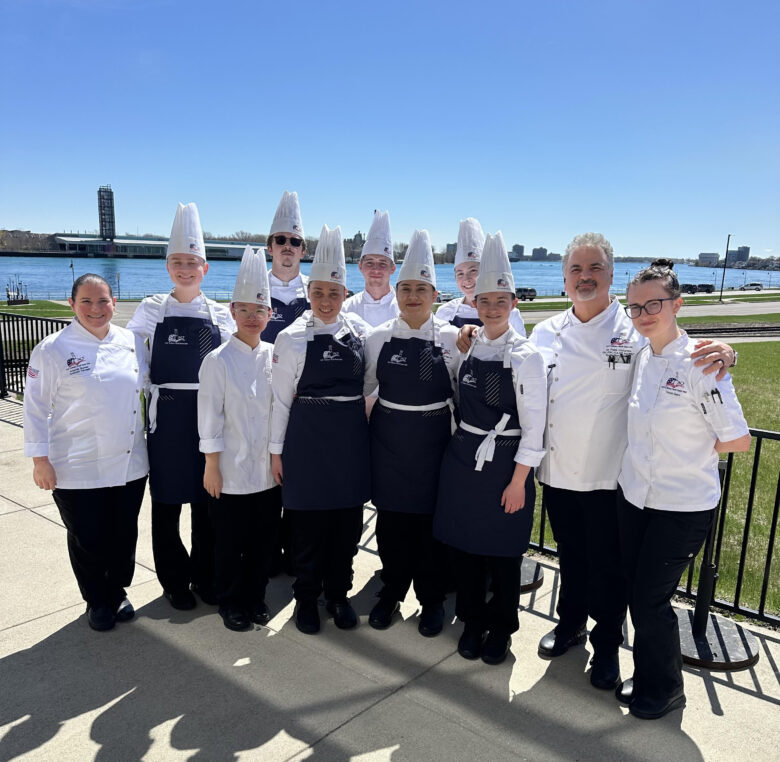
For Amanda Sheeler-Gurciullo, the road to the Culinary World Cup in Luxembourg is more than an opportunity to compete on a world stage. It’s a chance to thank the team who educated and raised her.
Today, Sheeler-Gurciullo is executive chef of Metropolitan Community College’s Sage Student Bistro and a culinary instructor. She is also assistant coach for Culinary Team Nebraska and assistant manager of its Youth Olympic Team.
In November, she’ll travel to Luxembourg with the U.S. team for the RAK Porcelain Culinary World Cup, taking with her years of experience on both sides of the kitchen.
While cooking, serving and culinary creativity run deep in her blood, Sheeler-Gurciullo still made room for other considerations.
“I would say there was a faint glimmer in high school when I thought I wanted to be a journalist and put effort into that,” she said. “I had worked at my family’s restaurant, Lo Sole Mio, as a hostess and bussing tables. Then I did some pro-start competition team through my high school and got a small scholarship. With that, I did culinary school for a while, which led to working in the kitchen at my family’s restaurant. After that I took a position working with Ben Maides (at VMertz). Then I got an internship interview and was hired on at Avoli about two months before it opened.”
Eventually, Sheeler-Gurciullo found herself drawn toward another part of the culinary profession: teaching.
“When I was working at VMertz I found myself doing more mentoring, teaching the ins and outs of what we were doing, and I felt like that was where I excelled,” she said. “It was complementary of my ability to instruct clearly, to communicate.”
When the opportunity to teach at Metro arose, she reached out to Cathy Curtis, the college’s culinary arts coordinator, who encouraged her to pursue it.
Sheeler-Gurciullo is now in her third year of teaching at MCC.
As a Metro student, Sheeler-Gurciullo followed the culinary arts and management track, learning the foundational skills her students now learn: knife skills, soups and sauces, baking and the fundamentals of professional cookery. Internships and volunteer opportunities introduced her to people and experiences that would shape her career.
“That led me down so many roads since then, it’s what I’ve built my career on,” she said.
She now teaches Restaurant Cookery II and Restaurant Desserts in the Sage Student Bistro, Metro’s student-run restaurant.
The bistro gives students an opportunity to experience the restaurant business in real time. They cook, serve, manage the front of house and make decisions about the food they create.
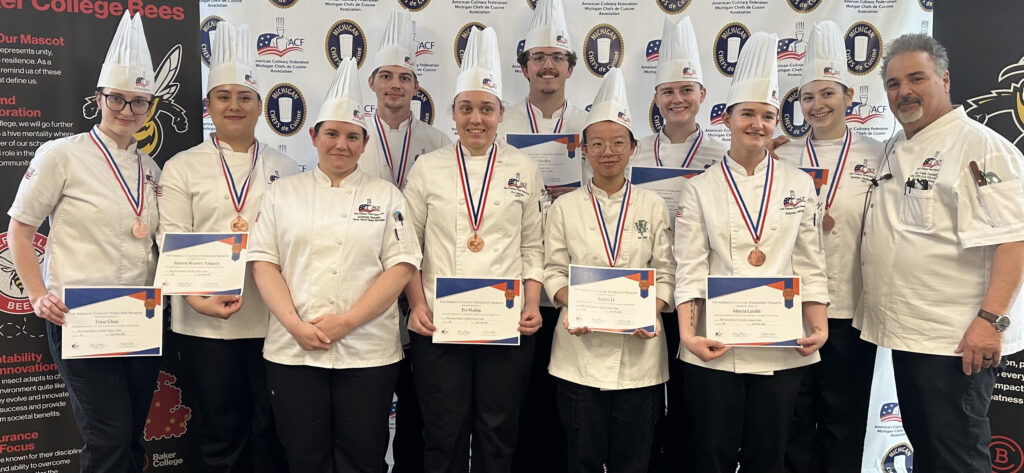
Her courses are centered on fine dining and regional cuisine. Students who have previously created individual specials now have the opportunity to develop an entire menu and define the style of food they want to prepare and serve.
For Sheeler-Gurciullo, teaching is only one part of her work with the next generation of culinary professionals.
She also serves as assistant manager of the youth Olympic team, which includes three Metro students. The competitors, all between 20 and 22 years old, must remain students through the 2028 competition.
The team began training in March 2025, meeting monthly for intensive practice sessions. Sheeler-Gurciullo oversees much of the logistical work — timelines, requisitions and organization — while helping the young chefs refine their cooking techniques and build confidence.
“It’s tedious and tiring, but it’s very rewarding,” she said.
The work has demanded plenty from everyone involved. Practice weekends can begin with a 3-4 a.m. departure from Omaha. Sometimes the team arrives and heads straight to the host kitchen. Cooking programs can run eight or nine hours, followed by another early morning.
At the most recent practice, the team completed four nine-hour cooking runs.
“It was tough on them and myself in the beginning to find that within yourself,” Sheeler-Gurciullo said. “As they’ve gotten closer and our goals have become more aligned, we’ve found ways to mentally, physically, emotionally prepare, we understand what it takes.”
Nutrition and exercise have become part of the preparation. So has a shared commitment to the people beside them.
“Sharing that common goal and not wanting to let each other down is sometimes enough to get us through,” she said. “And caffeine. A lot of coffee.”
Now the team is in the home stretch.
One final practice is scheduled for Oct. 22-25 before the Culinary World Cup. For Sheeler-Gurciullo, Luxembourg represents a halfway point on the road to the 2028 Culinary Olympics, but it is also a chance to experience what all that preparation has been building toward.
“There are times where it’s so exciting,” she said. “When you have the moments when you realize what you’re preparing for. You see what an honor it is. That makes it kind of feel like a bigger purpose. A chance to represent in a positive way.”
The experience has also changed the way Sheeler-Gurciullo sees the place she calls home.
Training with culinary professionals from other schools has given her the opportunity to see programs across the country. The more she travels, she said, the more she appreciates what Metro has built.
“I see just how incredibly lucky we are. We have a heck of a team,” she said. “I think each of them plays to their strengths. We’re blessed with a beautiful facility. Amazing equipment other schools don’t have.”
But for Sheeler-Gurciullo, the most important part of Metro isn’t the equipment. It is the people and the values behind the program.
“It comes from the values he’s instilled in us. In the students,” she said of Brian O’Malley, who has played a significant role in her own development and in Metro’s culinary program.
Sheeler-Gurciullo credits O’Malley with helping her develop the leadership skills she carries into her work today.
“I honestly probably wouldn’t have finished college if it wasn’t for him,” she said. “I wouldn’t have the leadership skills I developed without him.”
Now she gets to pass some of those lessons forward.
“I will say the values that make you stand out are really instilled from day one,” she said. “I don’t know that they recognize that it’s happening, at least not until they realize it retrospectively.”
For Sheeler-Gurciullo, one of the most rewarding parts of teaching is watching students discover what they are capable of before they fully recognize it themselves.
The Culinary World Cup will give the students a chance to show what they can do. But for Sheeler-Gurciullo, the journey to Luxembourg represents something larger — the continuation of a culture built by teachers, mentors, chefs and students who understand that hospitality is never an individual pursuit.
And sometimes, the most meaningful part of being on that team is realizing, years later, who helped teach you how to play.