

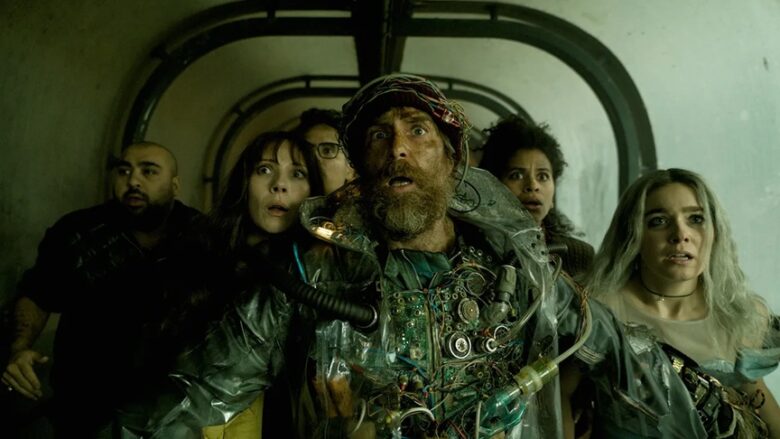
“Send Sam Rockwell back in time to stop AI from becoming evil” is both the setup for Good Luck, Have Fun, Don’t Die and a more robust tech policy than any political party has put forth this decade. Writer Matthew Robinson and director Gore Verbinski deliver the cinematic equivalent of shotgunning a beer made out of Black Mirror. The thesis doesn’t get much deeper than “sometimes computers are bad.” But what the movie lacks in nuance and subtlety it makes up for with cheeky visual overindulgence and a genuinely well-delivered finale.
Too few sci-fi filmmakers lash themselves to the mast and resist the siren song that compels them to start their movie with boatloads of exposition. Good Luck, Have Fun, Don’t Die starts with Rockwell simply vomiting plot contrivances. His opening screed against social media, shortened attention spans, smartphone addiction, and AI is clunky, on-the-nose and underwhelming. Somewhat shockingly, the movie only gets progressively more ambitious and clever, which is the inverse of most flicks that can’t pay off a promising premise.
The Man From the Future busts in and tells patrons at a diner that if the right combination of them joins him in his fight to stop a Godlike AI from taking over the world, they can save humanity. Except, he doesn’t know what that right combination is. And he has tried more than 100 times so far. This time, he pulls in Susan (Juno Temple), Mark (Michael Peña) and Janet (Zazie Beetz), Scott (Asim Chaudhry), Marie (Georgia Goodman), and Ingrid (Haley Lu Richardson).
The squad’s attempt at stopping the apocalypse is intercut with flashes to their backstories, each of which plays like an aforementioned episode of Netflix’s somehow-less-progressive Twilight Zone. RIP Rod Serling, the realest of the real ones. The movie’s big reveals are painfully obvious, but the descent into surreal nihilism is a delight. It helps immensely that Rockwell and Richardson are wildly charismatic, that the visuals are irresistibly captivating, and that watching AI get whacked feels therapeutic right now.
Good Luck, Have Fun, Don’t Die doesn’t proselytize about technology. It falsely assumes everyone watching realizes that it has a limitless capacity for evil. If anything, it pities those who are enraptured by the promises of artificial intelligence, which has a name that blatantly advertises its hollowness. The movie also concedes the inevitability of AI. This isn’t John Connor working with a Terminator to take down Skynet. This is more like if that duo worked together to beg Skynet “not in the face.”
That’s not super inspiring. If our bonkers madcap sci-fi escapism can, at best, muster “please be somewhat nicer Mr. AI,” the future feels grim. And honestly, the climax and resolution here lean into that pessimism to a pretty significant degree. It is hard to call a movie with such a bummer outlook a good time, but Good Luck, Have Fun, Don’t Die is objectively a good time. It is a refreshing non-remake/sequel/IP adaptation that picks the right enemy for the current zeitgeist. Eat it, Grok.
Grade = A-
Other Critical Voices to Consider
Rain Jokinen at Mulling Movies says “Where the story ends up is very chaotic, not entirely understandable (it involves A.I., because of course), and pretty predictable if you’ve ever seen a movie involving time travel. But the first third or so of the film is so strong I can narrowly recommend it solely on that. Good luck, have fun, tamper your expectations.”
Travis Hopson at Punch Drunk Movies says “We’re all probably a little bit sick of movies about AI, but Good Luck, Have Fun, Don’t Die is a truly inventive piece of work that isn’t afraid to go to some crazy places to entertain and enlighten. Is it perfect? No, but I’ll take intention over perfection any day.”
Amy Nicholson at the L.A. Times says “Matthew Robinson’s funny, savage and surprising script doesn’t downplay its inspirations. (He even lets Rockwell rip off Indiana Jones’ line about snakes.) But the screenplay gets so intricate and angry — and so shamelessly ambitious — you can’t believe someone in today’s Hollywood was willing to put up the money to get it made.”