

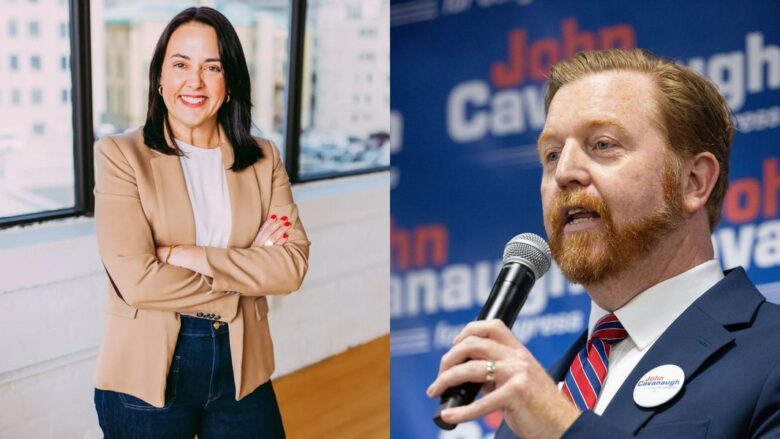
Democratic congressional candidate John Cavanaugh will begin running negative TV and digital ads against opponent Denise Powell Sunday, escalating an already messy primary race.
The new approach from Cavanaugh comes after a recent deluge of mailers, digital ads and TV spots from a Powell-aligned SuperPAC opposing his candidacy. Media pages on campaign websites for both Cavanaugh and Powell now highlight attacks on the other as a key messaging priority.
Nebraska’s second congressional district – sometimes called the “Blue Dot” – is seen as a key pickup for Democrats as they look to take control of Congress in November. Powell and Cavanaugh are amongst five Democrats running to face off against Omaha City Councilman Brinker Harding, who is the sole Republican in the race. The Cook Political Report moved the race rating from toss-up to lean Democratic last year after incumbent Rep. Don Bacon announced his retirement.
The new Cavanaugh ad, which refers to Powell as “dark money Denise” and accuses her of having “orchestrated secret donations for billionaires” signals a heightened focus on negative advertising in the final weeks before the May 12 primary.
The ad references Powell’s previous consulting work for nonprofits Sixteen Thirty Fund and New Ventures Fund, which are named in a recent lawsuit from Nebraska Attorney General Mike Hilgers over alleged foreign funding of ballot measures. Hilgers alleged that those groups funneled money from a foreign national through an “elaborate network of nonprofit organizations” in violation of state and federal laws. The nonprofits named in the lawsuit, including the Sixteen Thirty Fund and New Ventures Fund, have denied wrongdoing and called the lawsuit politically motivated.
Powell’s campaign said she had no involvement in fundraising for either nonprofit and only worked in outreach and communications. Her consulting work for the Sixteen Thirty Fund and New Ventures Fund was related to her work on the Support Our Schools and Protect Our Rights ballot initiatives in 2024, the campaign said.
In a statement on Saturday, Powell’s campaign manager Ryan Longenecker said Cavanaugh was “falsely attacking Denise’s work to protect the Blue Dot, stop a total abortion ban, and protect public school funding.”
“This is a dishonest and desperate attempt to distract from the fact that if Cavanaugh leaves his legislative seat, Gov. Pillen will replace him with a MAGA Republican, giving Pillen the votes to swing our next presidential election by eliminating the Blue Dot, and the votes to ban abortion entirely,” Longenecker said in the statement.
Cavanaugh has disputed that his candidacy jeopardizes the Blue Dot. His campaign shared the ad with Nebraska Public Media one day before it was released publicly.
Outside groups spend big on advertising
Many of the anti-Cavanaugh ads that landed in Omaha mailboxes and on television in recent weeks were paid for by Fight for Nebraska PAC, which was formed in March and has raised more than $1.2 million in just over a month. Fight For Nebraska PAC has spent $610,307 on ads opposing Cavanaugh and $605,804 on ads supporting Powell, according to data from the Federal Election Commission, or FEC.
Just last week, two other PACs – Women Vote and Elect Democratic Women (EDW) Action Fund – also reported independent expenditures for TV ads opposing Cavanaugh and supporting Powell. Both PACs are focused on supporting female candidates.
Cavanaugh’s advertising has largely come from his own campaign funds – not from outside PACs. But last week, the Congressional Progressive Caucus PAC reported an ad buy to support Cavanaugh.
Ads opposing Cavanaugh largely center around Democratic fears that Cavanaugh leaving the Nebraska Legislature could give conservatives the upper hand.

If Cavanaugh, who represents part of central Omaha in the Legislature, is elected to Congress, Nebraska Gov. Jim Pillen will be able to appoint a replacement to complete Cavanaugh’s term, which ends in 2028. Pillen would be expected to appoint a conservative representative in the reliably Democratic district. And if no other seats in the Legislature flip from Republican to Democrat in November, that would solidify a filibuster-proof supermajority for Republicans.
Mailers and ads from Fight For Nebraska PAC argue that would give Pillen and the Legislature the power to enact a stricter abortion ban, roll back voting rights and eliminate the so-called “Blue Dot” by shifting Nebraska to a winner-take-all electoral system, or by redrawing electoral maps.
Democrats, along with a left-leaning independent, currently hold 16 seats in the Legislature. Seventeen votes are needed to overcome a filibuster. A handful of conservative lawmakers have sometimes joined Democrats in opposing controversial legislation in recent years.
Cavanaugh and some of his fellow progressive state senators have pushed back on that claim. On his website, Cavanaugh said “elected Democrats in Nebraska are confident that they will pick up more than enough seats in November to offset John’s vote.” Twenty-five of the 49 seats in the Legislature are up for election in November.
Still, some progressives are uneasy about the prospect of losing Cavanaugh’s seat. In a widely-shared post, State Sen. Megan Hunt of Omaha criticized the “refusal to be honest about the stakes in the Legislature.”
“You can support a candidate for Congress—that is, my colleague and friend Senator John Cavanaugh—and still acknowledge that there is a real tradeoff if he leaves the Unicameral,” she said.
Very limited polling has been shared publicly in the primary race. Two polls commissioned by Cavanaugh, one conducted last summer and the other earlier this year, showed Cavanaugh as the clear frontrunner, with Douglas County District Court Clerk Crystal Rhoades a distant second. Powell has significantly ramped up advertising since those polls were conducted.
Is Fight for Nebraska PAC ‘dark money’?
As is often the case with SuperPACs, the top donors to Fight for Nebraska are other PACs – namely a $500,000 contribution from The Way Back PAC, a Wyoming-based Hybrid PAC focused on electing Democratic candidates in the “Mountain West,” and $600,000 from The Bench, a Hybrid PAC that has endorsed Powell.
The Way Back PAC is largely funded by the Western Futures Fund, a 501(c)(4) nonprofit that is not required to disclose its donors. According to Powell’s personal financial disclosure, she previously received at least $5,000 from Western Futures Fund for consulting. The Western Futures Fund has also donated directly to Fight for Nebraska PAC.
Other major contributors to the Way Back PAC include Toolbox, a Virginia-based 527 organization largely funded by heirs to the Rockefeller fortune and others associated with various Rockefeller companies; and Michael Novagratz, an investment banker focused on cryptocurrency. 527 Organizations are a type of tax-exempt group focused on political advocacy.
Major individual donors to The Bench PAC in the 2025-2026 election cycle include prominent businesspeople and philanthropists: Hedge fund manager Stephen Mandel ($2 million), investor and philanthropist Mark Heising ($1 million) and Netflix co-founder Reed Hastings ($395,000). The Bench also received significant contributions from other PACs.
Gavin Geis, the state director of Common Cause’s Nebraska chapter, said SuperPACs aren’t inherently dark money. But when contributions get funneled between PACs and 527 organizations and nonprofit groups, it can become difficult to discern where the money originated from.
“It just all kind of gets obfuscated,” Geis said. “By the time you’ve given to even the second PAC, it’s hard to say – where did the money originate from? Maybe you can go to the first PAC and look at the donors. But by the time they give another amount to a second PAC, now how much of that original donors’ money is getting into that second contribution, and the third one?”
“It gets even hazier to the point where I think, yes, even though there’s a certain amount of reporting for PACs, I think it’s still fair to say they play a role in the dark money game,” he said.