

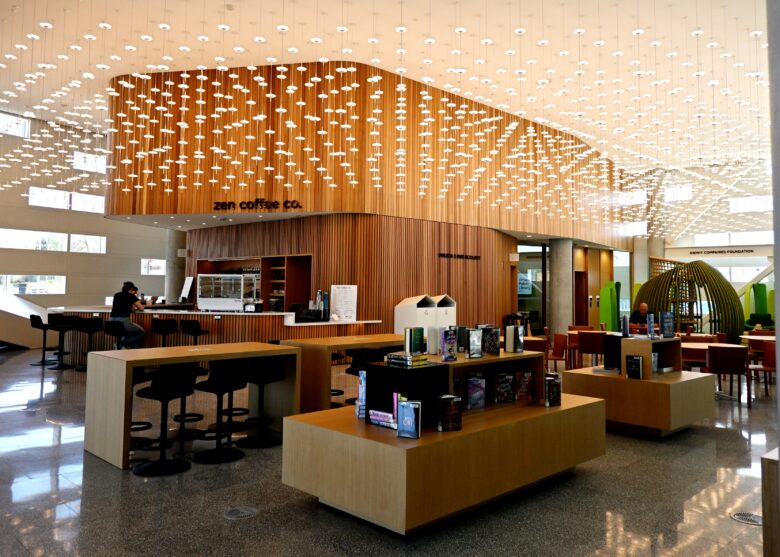
On Wednesday, the Omaha Public Library’s new central branch was buzzing with activity as contractors and library staff worked through the final touches ahead of this weekend’s grand opening.
The 96,000-square-foot, $158 million dollar building goes beyond books. There is a coffee shop and a courtyard with a garden. Art pieces from local artists hang on the walls and from the ceilings. Do Space, a technology library that stood at the new library site from 2015 until 2023, has been integrated into the library system and offers access to technology like 3D printers, a podcasting and TV studio, and tech classes for kids and adults.
It is the only public library in the U.S. to have an automated storage and retrieval system, or ASRS – a massive collections hub that can hold more than 600,000 books and other materials. It will be used to store some of the library system’s lesser-requested titles. If a central branch patron requests a book stored in the ASRS, it will be delivered to the front desk on a conveyor belt. Librarygoers can watch the machine at work through glass panes near the front desk and in upper-level meeting rooms.

The interior and exterior design of the library was done by native Omaha firms: Alley Poyner Macchietto Architecture managed the interior design, and HDR took the lead on designing the innovative building. Molly Ashford spoke with Nancy Novak, an interior designer at Alley Poyner Macchietto, and Tom Trenolone, an architect with HDR, about the design process and the inspiration behind it.
The following conversation has been lightly edited for clarity.
As you’ve had people come through so far, is there anything that’s really stood out to visitors?
Nancy: I brought somebody through the other day that literally said, I cannot believe this is a public library in Nebraska – like I cannot believe the level of design and programming and services.
Tom: There were a lot of people that kind of wondered what it would be like, and I think it’s exceeding expectations right now. And I think that it’s intuitive. I give a lot of kudos to the team and the fact that it is a very intuitive space. We had the slogan of “find your place.” And I think it carried through from a design standpoint… That became kind of a guiding mantra.
Thinking back to the conceptual stages, were there any kind of big wants or needs that you wanted to make sure were incorporated into the space?
Nancy: One of our drivers was to make sure that when we created the new library that it really represented all Omahans, so that everyone could walk into the building and feel like it was theirs. So it goes back to kind of finding your place, but really making sure that you have a sense of identity here.

Tom: And there’s the idea that the library itself is not downtown. It’s literally right next door to Crossroads. 72nd and Dodge has kind of a weird aura to it. In the city of Omaha, a lot of people come here to make their point. And the idea that the new central library wouldn’t necessarily be the downtown library is a unifying element. It doesn’t matter if you’re from South Omaha or North Omaha or downtown or West. Everybody can come together at this point. It’s also a transit-oriented development, so that’s there when it comes to the bus routes. It’s right on the crossroads of all those methods of transportation. It’s near the Keystone trail, so you can literally ride your bike here from just about any part of the city.
Walk me through some of the features and spaces in this new library.
Nancy: One thing that’s unique to the library, and really specific to Omaha Central, is we have this storage system that allows us to take more traditional shelving that would be on the floor and put it in the ASRS. That’s for collections that aren’t as popular, so they aren’t checked out as frequently. You’re still able to pull those materials out of the ASRS in less than five minutes and have them delivered at the front desk, so it’s still very accessible to the public. But when we relieve that kind of pressure to the floor, it allows us to display the collection in a variety of ways. We still have traditional shelves and storage on the floor, but we also have these very vibrant displays. They’re almost like large, kind of undulating cubes. It has more of a retail vibe.

Tom: Nancy talks about retail displays – it’s not lost on us that there’s an irony here that the Central Library in Omaha, Nebraska, sits on the site of a former Borders Bookstore. When you think about it, back in the day, there was a moment where we were all having the conversation: Would Barnes and Noble and Borders destroy the library? I think it’s a story of great resiliency that Borders is gone, but the Central Library is now here.
Nancy: We have 16 conference rooms, a variety of size and scale. They all have wonderful technology in them to support a variety of different social or meeting spaces. We have a large community room that will seat up to 250-plus people, even more if we’re having a children’s summer reading program or something that has a larger audience with smaller bodies. We’ve got a cafe – Zen Coffee is going to be housed here. Architecturally, the building does such a beautiful job of opening up floor plates so you really get this strong sense of community action and celebration. You can stand at nearly any corner on the first floor and look up and through – not only see your neighbors and community, but also get a better understanding of everything the library has to offer.
Tom: [The client] was pretty daring in that they really wanted something very dynamic and different than what you had seen in the past. The other aspect that was pretty exciting was that Nancy and I had the opportunity to actually sit on a selection committee for Omaha artists that have been able to populate the building with original works. I had high expectations, but I think they really blew it away.

Nancy: And we wanted our interiors to feel very warm and welcoming. A lot of the unitized [curtain wall] system is white metal panel, which is really beautiful and lets the windows be the showcase. But in complement to that, we created these warm wood walls with western red cedar. It wraps around our main ASRS, staff and meeting room spaces. And in the evening you get this almost like a draw… You just want to know what’s going on in there. The way the windows tip up on the corners is so invitational.
How does the furniture you chose play into the design?
Nancy: We had high aspirations for furniture. I think libraries are one of our most challenging furniture types. The furniture gets used and abused by the public, which is great! It means they like it, and they’re using it. And we need a variety, because not everybody sits the same or likes to meet the same. So just the nuts and bolts alone were a higher challenge than typical. We reached internationally to find pieces that were unique to our region – not just Omaha, but that Great Plains region, so when the public came in, it was really like a treat to come and experience things a little differently than they might in other buildings. When you really look at the true bones of the building, it’s with materials that have a long lifespan and that kind of have a unique beauty of their own that we expect to age with beauty and a kind of timeless classicism to it.
Are you guys excited for it to finally come to fruition and open to the public?
Nancy: Oh, super excited. One of my kids was asking me, ‘What time are you going to go to the opening on Sunday?’ And I said, well, I’m getting there early enough so I can be inside and watch people’s faces as they come in. Then we’ll really know if we did it right.
Tom: Yeah. I hope that the reactions we’re seeking, like on Tiktok and Instagram, are the same ones from the general public. This week we’ve been in the building, and people have been walking by, and you can tell that they’re anxious to be able to come in. It has been heartbreaking to tell them that it’s not quite open yet.
Almost!
Tom: Almost.