

The cost of living, making health care more affordable and other economic issues are top of mind for voters likely to participate in Nebraska’s midterm elections, showing up in polling and at voter’s doors.
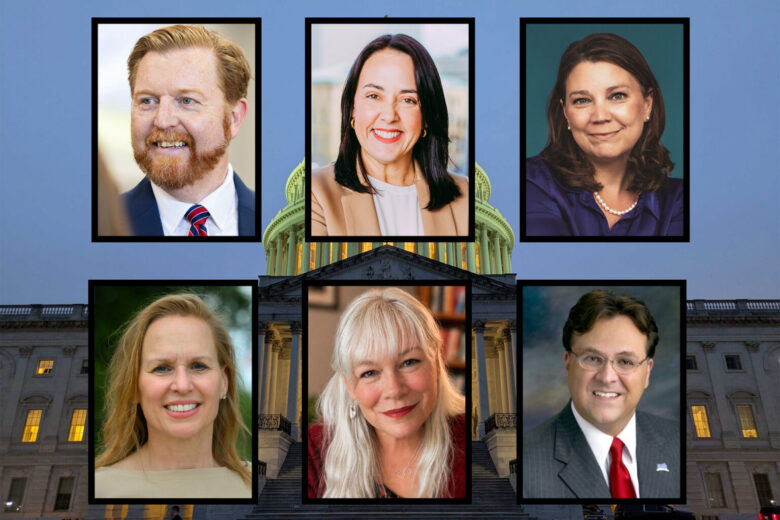
Six Democratic candidates in the state’s most politically divided and diverse congressional district in the Omaha area are fighting to persuade voters they can help address those issues as the primary season pushes toward its end.
Operatives on many sides of the political spectrum have highlighted the economic woes of the past few years. Voters still deciding are asking candidates and campaigns about fixes.
Four of Nebraska’s 2nd Congressional District primary’s top-polling candidates talked to the Examiner in recent weeks about how they would distinguish themselves on the kitchen-table issues. All six are competing to face presumptive Republican nominee Brinker Harding.
Affordability
Political action committee co-founder Denise Powell said affordability needs to be addressed in the long term and will take “a lot of work,” but in the short term, Congress “is asleep at the wheel” and could take actions that help Americans.
She said she would work to push back against President Donald Trump’s approach to tariffs and to rein in the U.S. war with Iran or “any other foreign conflicts without serious congressional oversight.” She says his actions contribute to rising gas prices, grocery prices, fertilizer prices and other goods, including soccer cleats and cell phones. She also emphasized pushing for federal action on childcare if “we’re serious about addressing the affordability crisis.”

“[The Iran war] is just making everybody’s lives infinitely harder,” Powell said.
Nebraska has seen gas prices rise above $4 per gallon, and some farmers have expressed concerns about fertilizer and diesel fuel prices.
Douglas County District Court Clerk Crystal Rhoades said she would focus on creating “an environment where we have policies that are going to fuel economic growth and development and opportunities for living-wage jobs.”
“At the end of the day, that is where the affordability crisis begins and ends,” Rhoades said. “Once prices go up, they rarely come down. That’s just not how it works most of the time. What you have to do is wages have to catch up.”
Rhoades also added the need to make structural changes to the way wealth is distributed, as “too much is going to the top 1% and not enough to the remaining 99%. That is something that only Congress can address.”
The race’s frontrunner, State Sen. John Cavanaugh, said he likes multiple proposals in Congress that could address affordability. He pointed to a proposal to cap prescription drug prices, another to help first-time homebuyers with a down payment and a proposal to tax the profits of large oil companies, based on the difference between the current price of a barrel of oil and the average price per barrel last year. He said that money would be sent to Americans as relief rebates.
“Obviously, the very first one is extending the ACA [Affordable Care Act] premium tax credits so that people can buy insurance and actually afford to buy insurance on the marketplace, but we need to make sure that when people buy that insurance, it actually covers healthcare,” Cavanaugh said.
The pandemic-era expansion of ACA premium tax credits expired late last year after Congress failed to pass any proposal to extend them. Those credits were aimed at making health insurance more affordable for people earning lower incomes.
The U.S. House passed a bill in January that aimed to extend the tax credits. The bill is currently in the Senate.
Retired U.S. Navy veteran Kishla Askins, a former deputy assistant secretary of Veterans Affairs under former President Joe Biden, said she would introduce legislation called SHIELD, Security, Health, Infrastructure, Energy, and Land Defense.
Askins’ policy framework seeks to align existing assets, authorities and investment streams into a coordinated economic and national security platform, according to Askins’ policy framework on her campaign website.
“I have listened to Nebraskans who need jobs, healthcare, higher wages, and are tired of failed promises. This is what drove me to write my … policies,” Askins said in a statement.
Healthcare
The three top-polling contenders — Cavanaugh, Rhoades and Powell — each said, in their own way, that they would support a public option for health insurance over Medicare for All. Askins said she wants to “build health and prevent chronic disease” with her “Whole Health America” plan.
Medicare for All, a policy that would replace all private health insurance with a universal coverage system funded and run solely by the federal government, has seen a resurgence of popularity among some Democratic candidates nationally, as CNN reported.
The issue has a local history, too. Second District Democrats chose former nonprofit consultant and executive Kara Eastman over former U.S. Rep. Brad Ashford in the 2018 Democratic primary, partly because Eastman emphasized her support for Medicare for all in her 2018 and 2020 bids. Republicans attacked her on the issue in the general election that retiring U.S. Rep. Don Bacon, R-Neb., won.
Former Omaha state lawmaker Tony Vargas didn’t run on Medicare for all but on supporting a public option. He also lost to Bacon in 2022 and 2024 in the largely urban, suburban and exurban swing district that leans slightly to the right, by just under 2 percentage points.
Cavanaugh said he wants to make sure everyone has healthcare and said he would work in Congress to increase access. He used the example of generic drugs to lower costs, allowing Medicare and Medicaid to negotiate all prescription drug prices and to keep providers accountable for charging “wildly different costs for services.”
The U.S. Secretary of Health and Human Services can currently negotiate prices with drug companies for certain high-cost drugs covered under Medicare, according to the Kaiser Family Foundation.
On a public option or Medicare for all, Cavanaugh said he is a pragmatic person who favors whatever would increase people’s access to healthcare.
“We get to … talking too much about making sure everybody has health insurance,” Cavanaugh said. “People should have health insurance, but we need to make sure everybody has access to healthcare.”
Rhoades said she doesn’t care what voters call the next step in healthcare coverage but said she wants “the average American to be able to buy into or pay for their healthcare through the federal government.” She said she is not suggesting getting rid of private health insurance.
“People who want to keep their private health insurance certainly should do that, but we need to have an option available for every American, whether their employer is offering health insurance or not,” Rhoades said.
She added that the healthcare cost is a burden for everyone and that something should be done soon to “quit playing games with people’s lives.”
Powell said the first thing is “recognizing that the system is flawed” and that Trump’s tax and spending bill makes the health system “even less stable.”
Trump’s tax and spending law, passed by Congress last year, added new work requirements for Medicaid and food stamps to offset the law’s cost. The law also caps medicaid reimbursement rates, which some healthcare advocates say make it harder for rural hospitals to stay afloat. Congress passed the one-time $50 billion Rural Health Transformation Program in the tax-and-spending law to help rural hospitals and clinics, but some say it isn’t enough to offset structural changes to the Medicaid program.
The law made the tax cuts from the first Trump administration permanent, cementing most of their benefits for high earners. It also introduced new temporary tax breaks for low-income workers.
Powell said mending what Trump cut would “stabilize” the healthcare system, but there is also a need to rebuild it in a “way that works better for people.” She hopes Congress will streamline the healthcare bureaucracy through technology and said she wants to extend the Affordable Care Act premium tax credits.
“I do think a piece of this is that the government should be going to bat against these big health insurance companies who are making these decisions on who and what gets coverage, who gets their care paid for,” Powell said.
Powell said she has talked to voters who like their private insurance and labor groups with members who like what they have negotiated in health insurance, but she said people should have “real choices” in a public option, one that includes dental and vision coverage. Askins said both Medicare for all and a public option don’t go far enough because they only answer “the question of who pays the bill without addressing the health needs of patients.”
“Whole Health America is finally a system that HEALS: Health first, Early access, Aligned care, Lower costs, and a Sustainable system,” Askins said in a statement. Askins said her plan would “redefine primary care” to include dental, vision, and mental health care, as well as other care, as “essential services.”
What makes them different from each other?
When asked about how she might differ on policy on affordability and healthcare from her opponents, Rhoades pointed to her experience of dealing with policy.
“Having been in government and having [an] understanding about how important it is to look at things holistically and use data and instead of just crazy, wild seat-of-our-pants ideas … I know that the road to hell is paved with good intentions, and I’ve seen that mess have to get cleaned up,” Rhoades said.
Cavanaugh, who represents a central Omaha district in the Legislature, said the Examiner would have to ask other candidates for differences.
“I talked a lot about affordability and specifically about specific things that I have done and want to do in Congress to address those issues,” Cavanaugh said.
Askins said “experience and effectiveness” is what sets her apart.

“The reality is that many new members spend years learning how to navigate Washington before they can effectively deliver results,” Askins said.
Powell said the other Democrats in the race will see the same “challenges” and know that they need to be addressed, but what she brings to the table is “listening to our communities.”
“It’s really easy to come down from on high with [a] policy that maybe makes sense for other parts of this country or even other parts of the state. … It’s not about reinventing the wheel. It’s making sure that we are plugged in enough to those communities to bring back the kind of investments that they need to advocate and advance their work,” Powell said.
Early voting for Nebraska’s May 12 primary election is underway. The general election is Nov. 3.