

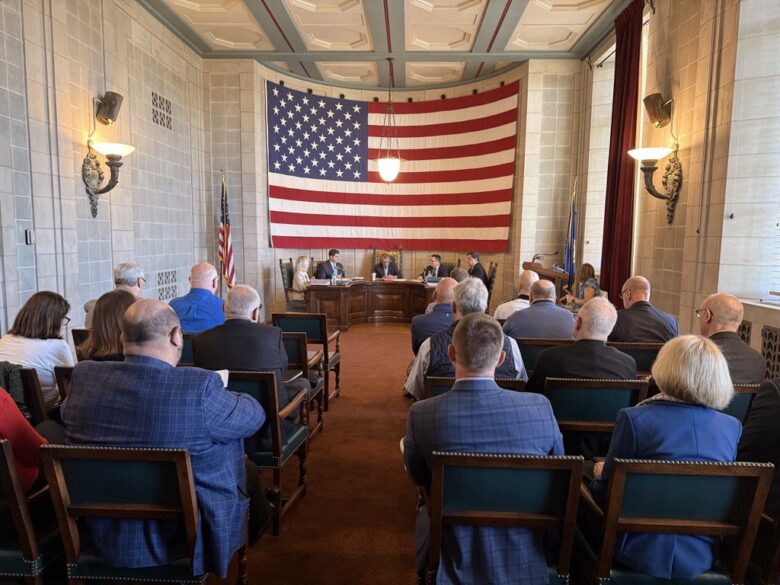
The Sports Arena Facility Financing Assistance Act Board approved two and rejected nine applications for financial assistance for sports facilities on Thursday morning. The only approved projects are in Nebraska’s two largest cities.
The board rejected applicants from Gretna to Valentine, which sought tax incentives, capped at $1.25 million, for sports facilities in their cities. The only approved applicants for turn-back taxes, which bring revenue back to the city for a project from state sales taxes in a specific district, were from Lincoln and Omaha.
Gov. Jim Pillen, who sits on the sports facility board, noted ahead of voting that he has consistently been trying to shrink Nebraska’s government.
“Somebody’s gotta worry about balancing the checkbook,” Pillen said.
Applicants sought tax incentives under the Sports Arena Facility Financing Assistance Act, which allows up to 70% of new state sales taxes, generated within 600 yards of the proposed facilities, to be sent back to the city for funding the projects. Smaller communities can take up to 25% of all state sales taxes for up to five years.
Lincoln, in partnership with Nebraska for Volleyball, hopes to build a youth volleyball facility, expected to cost around $16 million. Omaha’s tax incentives will help finance a 6,500-seat open-air soccer stadium and entertainment facility with a $114 million price tag.
The votes came after the legislature passed a law that attempted to curtail Pillen’s ability to stall tax incentives for sports facilities. Prior to the law’s passage, Pillen held veto power over the five-member board. He now votes alongside its other members. The law also requires board members to make a determination on a project within 30 days of a public hearing. Otherwise, the project will automatically be approved.
The bill was drafted after the sports financing board failed to vote on several different projects for more than a year. Pillen’s office said last year that he did not plan to vote on any projects until June of this year. Pillen wanted to eliminate sales tax loopholes in order to fund property tax relief.
Other board members said during the vote Thursday that while many of the applicants included information on the millions of dollars they anticipated their projects would generate in economic value, they expressed concerns about the state’s free cash and long-term financial stability. Board member Gail Werner-Robertson summarized.
“We need to be careful,” Werner-Robertson said. “When you spend a rainy day fund, you can only do it once.”