

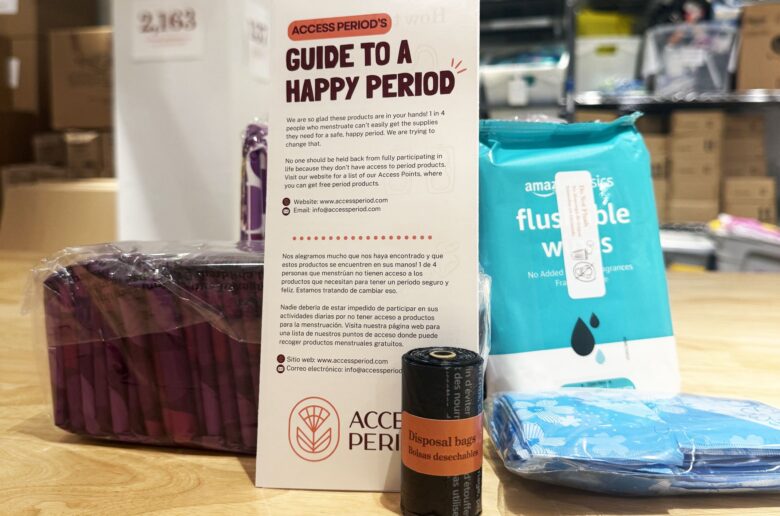
How many of us can say that at one time or another we’ve needed to purchase products like tampons, birth control, and pregnancy tests?
Yet for many people and for a number of reasons, access isn’t always easy.
Barriers to basic reproductive and sexual health resources are impacting the well-being and everyday lives of Omahans, but where federal government programs may be falling short, some local initiatives are picking up the slack.
Access Period is one organization working to provide free menstrual products in the area.
It began when founder Kristin Lowrey started a small project to collect period products for Partnership 4 Hope’s free store.
“People were very relieved, very excited when we did have products available,” she said. “So I just wanted to do a really tiny project for them, and make sure that they always had supplies.”
Lowrey quickly learned that there weren’t good processes or systems for acquiring and distributing period products. In talking with other nonprofits, she was hearing they were “too expensive” and “too complicated,” and that food and housing took priority.
Still, it was a need everyone seemed to recognize.
“There are all these people who care deeply about people having access to period products and other basic needs. And there needed to be someone in the middle,” she said.
Enter Access Period. Lowrey founded the nonprofit in 2022 and acts as an intermediary, working with organizations that are already serving the community rather than trying to serve people directly.
“They are already reaching them,” Lowrey said.
Access Period provides free menstrual products through three programs: self-serve access points, community partnerships, and school partnerships.
There are 11 self-serve access points across Nebraska that offer free supplies like tampons — as they cleverly put it — with “no strings attached.”
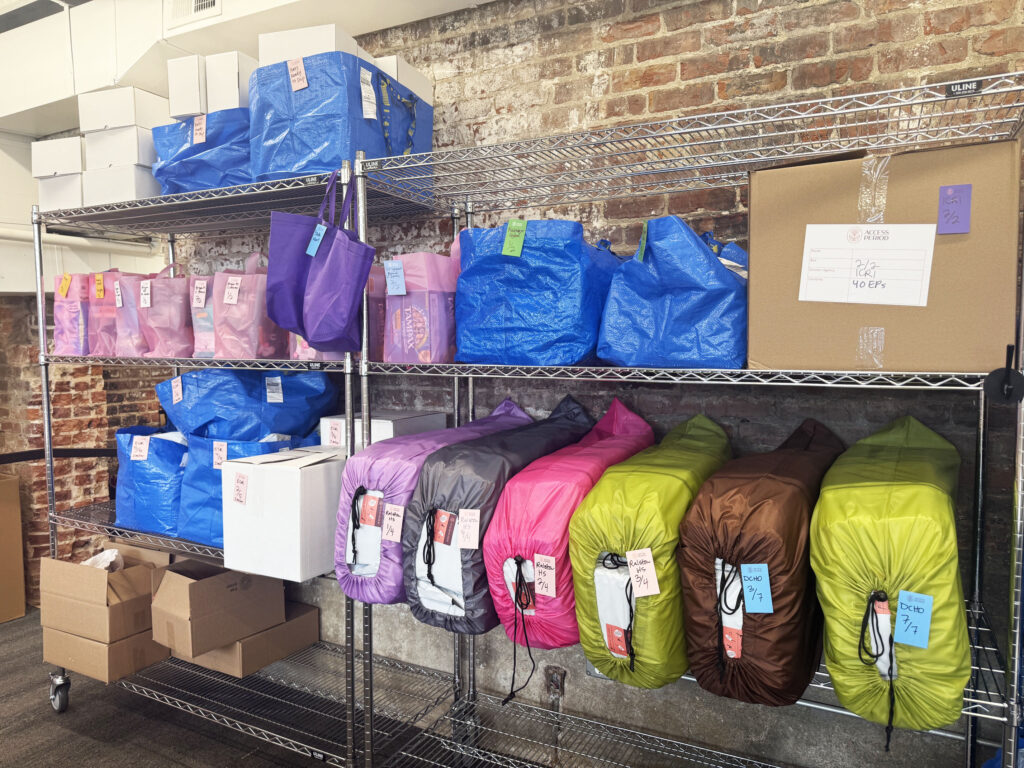
Additionally, they partner with 70 nonprofits that request supplies and distribute them to community members.
The average person needs about 25 period products a month, so a one-month kit is stocked accordingly. A three-month kit includes 75 products. These kits not only include tampons and pads, but also personal wipes, liners, and disposal bags.
Serendipitously, as I was touring Access Period’s operations, one of their partners came in to pick up supplies.
Deidra Devers, senior coordinator with Creighton University’s Upward Bound program, told me about the impact Access Period has had on the students she works with.
“It’s a college prep program for first generation, low-income students, and so the population that I work with, sometimes they just don’t have, like, the basic necessities, or whatever the case may be,” Devers said. “Thanks to this program, we’re able to actually make that happen for us.”
Access Period also partners with approximately 150 schools statewide. These partnerships range from individual nurses who previously had to purchase supplies out-of-pocket, to comprehensive programs like the Sarpy County Period Project, which provides free menstrual products in every restroom.
Half of the products Access Period distributes stay in the Omaha area, and the other half goes throughout Nebraska.
When it comes to lack of access, Lowrey said the root barrier is the shame and stigma that’s still associated with menstruation.
“People think that period products are like this luxury, not a necessity,” Lowrey said. “It’s just seen as something that’s really private, and so people aren’t a lot of times even asking for them at food pantries.”
Another issue is that menstrual products are generally not covered by WIC or SNAP, despite the fact that a significant portion of the population menstruates and 1 in four teens and one in three adults struggle to afford period products.
Lowrey is on a mission to reduce these barriers, and people want to help.
Volunteer groups visit Access Period’s warehouse to help stuff bags with period kits. Local businesses are contracting with the nonprofit to stock their bathrooms with free supplies. Lowrey said it’s “surprisingly inexpensive,” even for high-traffic destinations like the Kiewit Luminarium.
One of Lowrey’s dreams is to provide period kits to every student in Nebraska going through puberty education. Currently, health educators lack supplies to even show students what they are or help them visualize how they work. With products in hand, she hopes to help students feel more comfortable with periods.
As far as how she feels about the impact her work is having, Lowrey doesn’t want people to be overly grateful. She sees it as meeting an essential need, and just wants people to be able to live their lives without unnecessary barriers.
“When we can all participate, when we’re all present, that is when the world is as it should be,” she said. “This is not just a woman’s issue. It’s everyone’s issue to make sure that everyone can fully participate in life.”
Access Period isn’t the only local effort working to close these gaps. The Douglas County Health Department is also working to provide free health products through its Health Resource Vending Machines program, partnering with organizations like Access Period to keep them stocked.
In addition to period products, they dispense STI test kits, pregnancy tests, emergency contraception, condoms, and harm reduction products like naloxone, commonly known by the brand name Narcan, and fentanyl test strips.
It began when community health assessments showed that people wanted access to the health department’s free resources outside of normal business hours. Thus, the idea for vending machines was planted.
Dr. Leah Casanave, division chief of community health, nutrition, and clinical services, explained that while other vending machines exist, theirs are outside and accessible 24/7.
To reduce barriers related to the stigma someone might feel visiting the vending machines, she said they were thoughtful about stocking other essentials as well as those related to sexual or reproductive health.
“We were one of the first ones, I believe, that really started branching out and adding all the other additional items to it,” she said.
This includes seasonal items like COVID tests, insect repellent, and protective winter gear.
They determined where to put the machines by analyzing data related to suspected overdose calls, unhoused populations, and STI rates by geographic region. To pinpoint locations, they targeted their established relationships with community organizations in these hotspots.
They continuously evaluate which products are needed most.
“What we do then is we look at all the data from the dashboard of the machine,” Casanave said. “So it tells us what goes kind of flying off the shelf, if you will.”
Casanave said the most popular products dispensed are Plan B, pregnancy tests, condoms, and lubricants.
“The cable gun locks always go very quick, too,” she added. “The reason they’re probably not as high on the list is because I can only fit seven in a row. So they’re constantly selling out every time.”
Casanave explained that while some of the products in the machine can be controversial, tax dollars aren’t funding the initiative. It’s all made possible by grants and donations from community partners like The Sherwood Foundation, Women’s Fund of Omaha, Region 6 Behavioral Health, and Access Period.
The partnership with Access Period initially developed after they noticed people were coming into their STI clinic and taking handfuls of period products, and they couldn’t keep it fully stocked. They turned to Access Period for support, and when it was time to find partners to help fill the vending machines, it felt like a natural fit.
Casanave said they are always looking into what products they should stock in the vending machines, and expect to add tobacco quit kits, diaper changing kits, and sunscreen in the near future.
Whenever possible, she goes directly to the community for feedback.
“I am an extrovert by nature, and anytime I see someone using the machine, I stop and ask them, ‘How’s it working? What would you like to see?’” she said.
The responses they have collected have been positive, and people appreciate the quick access, but the very nature of the machines is to offer a private way to get essential health supplies, 24/7.
“I’ve left it very anonymous,” said Casanave. “I don’t want to collect anything that folks will think I will be able to pinpoint who they are. We’ve kept everything very simple, but enough to get me the data I need in order to support funding this program long term.”
The usage speaks for itself. Since launch, nearly 22,000 products have been dispensed across the five locations.
The vending machines are located outside the Douglas County Health Department, Washington Branch Library, American Dream, Siena Francis House, and Nebraska Urban Indian Health Coalition.
Additional machines are being planned outside Yates Illuminates and Milton R. Abrahams Branch Library.
They are also working on sourcing a south downtown location that will provide access without alienating vulnerable populations who may be deterred by the proximity to the Douglas County Corrections Center.
Access to basic health resources can prevent disease, reduce unintended pregnancies, and improve quality of life. Across Omaha, nonprofits, public health entities, businesses, and private donors are coming together to help fill critical gaps in care and access.
As Lowrey put it, “Only when all of our most basic needs are met can we realize our full potential.”