

Editor’s note: This story is part of a collaboration between The Reader and Flatwater Free Press examining Omaha’s future streetcar.
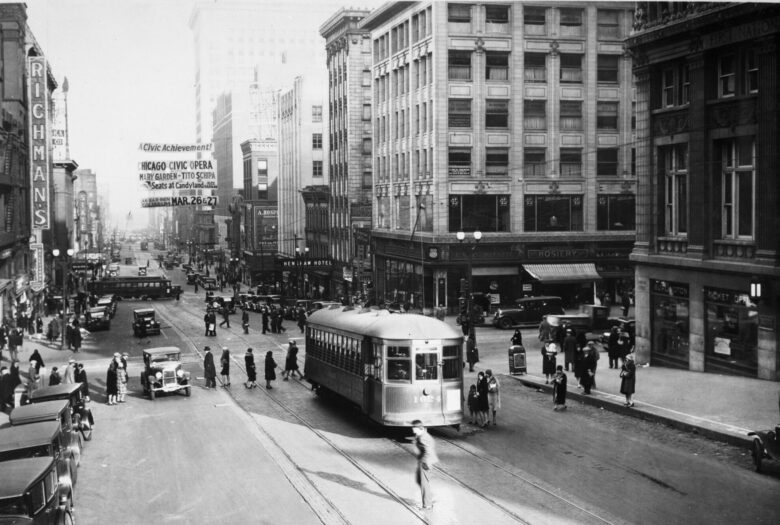
The day after officials and businessmen took a ceremonial final trip on Omaha’s streetcar in 1955, junkers lit nearly a dozen trolleys on fire at a scrapyard by the Missouri River.
Local leaders at the time saw getting rid of the outdated trams as helping the city realize forward-thinking plans to accommodate commuters and remedy bottlenecks in the urban core. They thought the answer was adding more one-way streets, more lanes for automobiles, more parking lots and new highways.
But today’s urban planners believe that in reorienting Omaha for cars, their midcentury counterparts unintentionally drained the life out of downtown.
City planners in the 1950s thought transit followed development. Now, they know it’s the reverse — transportation can drive development and help remake the city, said mayoral adviser Steve Jensen.
That’s what planners are hoping to accomplish with the in-progress streetcar. And that project could lead to downtown Omaha becoming less car-centric and closer to the vibrant urban environment that existed before the city abandoned rail transit. Leaders are looking to reinstate two-way traffic on many downtown streets and to make space for walkers and bikers.
Jensen and other streetcar proponents envision parking lots transformed into apartment buildings, new storefronts filled with businesses and sidewalks teeming with pedestrians.
The new streetcar won’t solve all of Omaha’s public transportation problems given the challenge of serving a sprawling, low-density metro, said former Omaha Planning Director Marty Shukert. But it will make the city’s core more maneuverable without a car, he said.
More abstractly, the streetcar will bring a “cool factor” to the heart of the city, said Shukert, who has “sacred memories” of riding the old trolley as a child.

“That’s why a streetcar can do what a bus can’t,” he said.
The little streetcars that couldn’t
The half-page advertisements were splashed across a dozen local newspapers in the weeks leading up to the 1954 midterm elections: “Modernize Omaha’s Traffic,” the ads declared, alongside a drawing of a streetcar slashed through with an X.
Omaha’s streetcars were on the chopping block that election — voters would decide whether to replace the last of the city’s “antiquated, slow street cars” with “new, modern buses,” allowing cars to get around faster, the ad said.
Backed by a U.S. senator, a Husker football legend and some of the richest businessmen in town, the ad blitz paid off on Election Day.
Nearly 65% of voters approved the ballot measure, giving the Street Railway Company long-term control over the city’s bus service and condemning the remaining streetcars to the wrecking yard.
For many Omahans, from then-Mayor Johnny Rosenblatt to neighbors of the old streetcar, the switch to an all-bus fleet felt like progress.

“For years, these streetcars have been waking me up at 5:17 a.m. Now I can get some sleep,” a Dundee resident told the United Press when the trolleys stopped running.
After World War II, a flood of automobiles hitting the roads presented downtown Omaha with new problems: heavy rush-hour traffic, a severe parking shortage and declining streetcar ridership. An out-of-town consultant hired by the city offered solutions.
Chicago traffic engineer George Barton recommended Omaha build thousands of parking spots on public land, convert most downtown streets to fast-moving one-ways and eliminate the streetcars running down the middle of streets, according to a series of city reports released from 1949 to 1954.
Switching to buses would help relieve traffic congestion, city leaders and the Street Railway Company both agreed.
The city converted 15 downtown two-way streets into one-ways. It approved measures to widen lanes and raise speed limits on main roads like Dodge and Farnam streets.
“The movement of the car was front and center. That was the No. 1 priority,” said Julie Harris, director of Bike Walk Nebraska.
Away from downtown, the city was having a growth spurt.
Omaha’s land area nearly doubled between 1950 and 1970 as it gobbled up suburban and undeveloped areas west of 72nd Street.
Omaha’s land area has more than tripled since 1950 as annexations pushed city limits farther west. Low-density suburban developments make up much of the added lands.

At the same time, the city’s population dispersed. The number of residents per square mile dropped more than 25% as city dwellers decamped to the fast-growing suburbs, according to a Flatwater Free Press analysis.
New office complexes, shopping centers and public schools popped up as Omahans moved west.
By the 1960s, Interstate 80 offered car commuters six lanes of “superhighway” to travel between the old city and the new suburbs.
City planners across the country veered from dense urban development patterns and opted for sprawl in response to what the public desired, Shukert said. Amid the baby boom, young families wanted to own homes with their own yards, and buying a car allowed them to do it farther from the urban core, he said.
As the places where people lived and worked spread apart, mass transit — let alone fixed-rail streetcars — could no longer serve commuters efficiently, Shukert said.
Postwar timeline
1947
Streetcars narrowly outnumber buses in Omaha, but the transition to buses is underway. Buses replace streetcar service on Sundays.
1951
Only three of the eight streetcar lines that ran in Omaha at the end of World War II remain in service.
1954
Downtown Omaha’s busiest roads are converted to one-way streets. Speed limits are raised across the city.
Omahans approve a measure to make the Omaha & Council Bluffs Street Rail Company an all-bus franchise, effectively voting streetcars out of existence.
1955
The last of Omaha’s streetcars are taken out of service and fully replaced by buses.
Omaha annexes more than 6,700 acres of suburban developments, extending its city limits west of 72nd Street.
1957
Work begins near Gretna on Interstate 80, which will later connect urban Omaha to the western suburbs and Lincoln.
The city’s western expansion paired with the focus on car-dominant city planning kicked off a decades-long decline in much of the urban core, said Jensen, the mayoral adviser.
Businesses and entertainment venues that anchored downtown gradually moved west, leaving empty storefronts and a sea of parking in their wake, Jensen said. Between 1963 and 2014, downtown added 13,000 parking spots but lost 21,000 jobs, according to a city analysis.
“The more parking you build, the fewer buildings you have. The fewer buildings you have, the (fewer) jobs,” Jensen said. “You ended up in this cycle where you just wipe out your downtown.”
The one-ways and wider streets made car commuting more efficient, but the high-speed driving they encouraged made walking and biking feel less safe, Harris said.
“Walking got engineered out of our daily routines,” she said.
The city needed something to help bring vibrancy and investment back to the urban core, Jensen said.
The streetcar fit the bill, he said.
Back on track
The resurgence of streetcars — much like their disappearance — is a reflection of public preferences, said Robert Cervero, a professor emeritus of city planning at the University of California, Berkeley.
Bringing back the once-discarded mode of transportation has plenty of recent precedent. Since 2000, more than a dozen American cities have launched modern streetcars, including Seattle, Atlanta and Kansas City.
Across generations, people are starting to favor walkable urban districts and neighborhoods where housing and shops are woven together on the same block, urban planners said in interviews.
“Everybody wants to be in a Brooklyn kind of environment,” Cervero said. “The streetcar can be an economic lever to help trigger that kind of transformation.”
City leaders and walkability activists have long agreed on what Omaha should do to create those types of spaces — at least on paper.
Downtown should be a dense, mixed-use environment “where you can live everyday life without using a car,” a 2010 plan stated. For two decades, city reports have consistently called for safety and accessibility improvements for pedestrians, cyclists and transit users. Omaha’s master plan repeats similar objectives, like adding bike lanes and maintaining and building sidewalks.
But city leaders haven’t consistently turned those ideals into action, said Harris, the Bike Walk director.
“Every time we go through these exercises in our city, the recommendations are always the same,” Harris said. “But we don’t have the equivalent amount of action to implement the things.”
The city’s commitment to the modern streetcar could be the catalyst that moves the needle, project supporters say.
The city is banking on the idea that the streetcar will allow more land in the urban core to be used for residential and commercial buildings instead of parking, Jensen said.
Because it will offer an alternative to cars, new apartments and office buildings won’t need to offer quite as many parking spots — a major appeal to developers, said Mike Moylan, CEO of Shamrock Development. The banks are starting to buy that logic when financing new projects, he said.
A key part of the plan hinges on making the most of existing public parking. For example, a city-owned spot can be used by a commuter on weekdays and by a resident on nights and weekends, Jensen said.
That way, real estate currently devoted to underused surface lots can be put to better uses, he said.
Just as eliminating the old trolley came with one-way streets, walkability activists hope the new streetcar will bring back two-ways. A soon-to-be released study could be a step in that direction.
The yearslong study lays out the possibility of reverting one-ways to two-way traffic, adding bike lanes and dropping car lanes on streets in the urban core, said city engineer Austin Rowser.
Over the last few decades, the city has converted one-ways with positive results, including Cuming and Burt streets near Creighton University and Farnam Street in Blackstone, said Bob Stubbe, head of Public Works. But making the change can be costly and challenging on streets with parking garages oriented for one-ways, he said.
Two-way traffic, narrower lanes and bikeways “make it less attractive to go fast,” improving safety for pedestrians, said Todd Nichols, a member of activist group Strong Towns Omaha.
Local Strong Towns leader Noah Mahlberg hopes the design adjustments come with other moves to make living without a car easier in Omaha. Integrating the streetcar with other transportation options and making Metro Transit buses free to ride, just like the streetcar, would be beneficial, he said.
Metro CEO Lauren Cencic envisions the streetcar complementing the bus system with people using ORBT to come into the urban core from out west.
The goal isn’t to get Omahans to stop driving — it’s to give people more options for moving around the city, Cencic said.
Retired U.S. Rep. Earl Blumenauer said he has seen streetcars spur the kind of results Omaha’s urban core needs in his own backyard.
The Democrat from Portland, Oregon, backed the first modern streetcar project 30 years ago and said the rail system has helped his city reorient its core around people over car traffic. Omaha, he said, is on track to do the same.
“I think this is going to lead to a renaissance of how people think about downtown Omaha,” Blumenauer said.
The Flatwater Free Press is Nebraska’s first independent, nonprofit newsroom focused on investigations and feature stories that matter.