

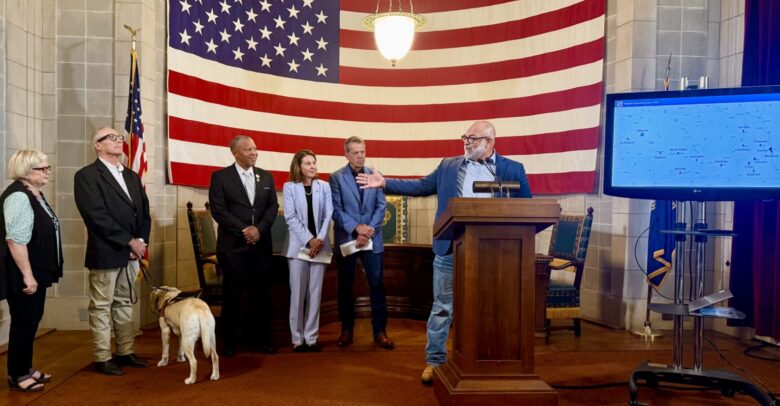
A handful of Nebraska mayors — including one who has watched his town’s biggest employer flee — stood with Gov. Jim Pillen on Wednesday to announce the governor’s 28 picks for tax incentive-eligible opportunity zones.
The recommendations span the state, from Scottsbluff in western Nebraska to Omaha, where 10 areas were selected.

One of Pillen’s census tract selections is in Lexington, home to the former Tyson Foods plant, which in the next few days will fully close, said Mayor John Fagot. About 3,000 jobs were lost earlier this year as production ceased. Fagot expects an opportunity zone designation to help strengthen his town.
“We’re going forward,” Fagot said during a press conference at the State Capitol. “We’re going to build our community, we’re going to go forward in every aspect.”
Pillen expects opportunity zone federal incentives to help create jobs and boost construction of affordable workforce housing — a need laid out in various reports and widely discussed in the Nebraska Legislature and city governments.
Fagot said he foresees more housing construction in his town as well. Some might think the Tyson shutdown opened up housing stock, but he said the city hasn’t “had a whole lot of exodus.” Many former Tyson workers took jobs in nearby communities.
In naming his recommended slate, Pillen said he foresees incentives encouraging public and private partnerships and sparking economic development.
“My expectation is there’s going to be a lot of wood being thrown in the air quickly, a lot of concrete going down, because there are a lot of people really excited,” said Pillen.
Congress originally established the federal opportunity zones program through the Tax Cuts and Job Act of 2017. Its purpose was to promote investment and drive growth in low-income and economically disadvantaged communities. Parties that invest in designated zones can benefit from tax incentives.

The program was extended permanently under the 2025 law President Donald Trump calls big and beautiful. The so-called Opportunity Zones 2.0 program takes effect in 2027. Pillen called it a “significant upgrade.”
He and Larsen said there were enhanced provisions benefiting rural areas, stricter eligibility criteria, more reporting and accountability requirements, and an updated capital gains deferral provision. Investors can roll capital gains into a qualified opportunity zone fund and defer or reduce their existing capital gains taxes. If the investment is held for at least a decade, capital appreciation generated by the investment becomes tax-free.
U.S. Housing and Urban Development Secretary Scott Turner visited Omaha in May, appearing with Pillen and Ewing, in part to promote opportunity zones.
Nebraska was allowed to nominate a quarter of areas deemed eligible under federal criteria. Larsen said 112 were eligible, and the 28 picked by Pillen were submitted to the U.S. Treasury Tuesday for certification.
She described the interest in the zones as extraordinary, saying cities submitted applications for 107 of the 112 eligible areas.
Among the 28 are 10 in Omaha and five in Lincoln, the state’s two most populated and urban cities. Others are in Alliance, Ogallala, North Platte, McCook, Lexington, Hastings, Columbus, Norfolk, Fremont, Bellevue, Crete and Beatrice.
Larsen said state officials, in narrowing candidates, looked for investment readiness, economic needs and potential community benefit before submitting their preference to the governor.
Pillen said the state tried to get ahead of the rest of the nation in naming recommendations, but said at least one other state was ahead of Nebraska.

“We want to lead the way but we want to make sure we play winning ball,” he said.
Larsen said an early start allows communities to start recruiting investors to tap the incentive to develop housing and other eligible projects.
“By doing it this early we’re giving communities, we’re giving developers and we’re giving those officials time, more time to go out and get those investments so that we get the bigger bang for a buck and those investments land right here in Nebraska.”
State officials said that Nebraska has been a leading state in attracting investments into opportunity zones under the first iteration of the program, ranking second, they said, among Midwestern states in opportunity zone investments per capita.
When asked Wednesday for an example of a successful use of the program so far, Larsen named a few projects in opportunity zones, including the Millworks Commons and Capitol Districts in downtown Omaha. However, she said that reporting requirements under the existing program set to end this year offered the state little insight into specifics on how incentives were used or the impact. She expects improvement in the next phase.
Also at the press conference were Omaha Mayor John Ewing, Norfolk Mayor Shane Clausen and McCook Mayor Linda Taylor.
Clausen said an opportunity zone designation offers Norfolk another way to compete, another tool for economic development and a way to lure developers.
Ewing foresees opportunities for more affordable housing construction in the nominated tracts. “I greet this news with hope.”
Taylor said a designation is an “important piece” to further economic development in southwest Nebraska. “We have a lot of small communities around us and we all depend on each other.”