

Whether or not the term “elevated horror” should be used to describe any of the more thoughtful entries in the genre, there is no arguing that writer/director Adrian Chiarella’s Leviticus is “elevated.” At least in the sense that it towers far above It Follows, a movie that it will be inevitably compared with. Okay, fine, maybe you can argue about that. But you definitely shouldn’t argue with me about it, as I am gonna be simply wildly unpleasant during that conversation.
Whereas It Follows still reads as a boring and cold tsk-tsking at sexual discovery, Leviticus points a finger where said finger should be pointed: at the bigots who wield religion as a weapon. “Religion can and should be wielded as a weapon” was pretty much a literal verdict made by the U.S. Supreme Court recently. Thankfully, this film takes place in Australia, where the law of the land is “Watch out for that spider/snake!”
The film opens with a snake and references a spider in its very first scene. We meet Naim (Joe Bird) and Ryan (Stacy Clausen) as they are doing what teenage boys love to do. They are throwing stuff at other stuff. While doing so, they also begin to throw themselves at each other. The spark between them is electric and is entirely new to Naim. In just a few sparse scenes, the thrill of young love is evident. Then comes the crushing blow of betrayal, as Naim spies on Ryan making out with Hunter (Jeremy Blewitt).
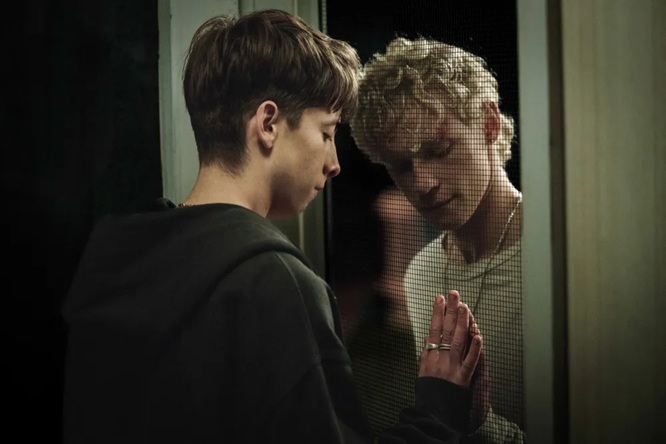
Not long thereafter, Hunter and Ryan are called before a “faith healer” who uses a Zippo lighter and some uninspired chanting about flame to…apparently tether them to a poltergeist? Whenever they are alone, the boys see an apparition that takes the form of the person they most desire. That apparition then tries to murder them. The whole “running from invisible bogeymen tied to sex in a mumblecore horror flick” thing is what sets up the inevitable collision course with It Follows.
Naim’s mom, Arlene (Mia Wasikowska), recognizes that her son has the same inclinations as the other faith-healed fellows and subjects him to the same procedure. The remainder of the film refreshingly spends little time on “rules” and exposition and lets the metaphors and implications freely flow over audiences. The result is a lightly scary, remarkably well-acted, and poignant reminder about the cruelty with which queer youth are too routinely treated.
The script may be light and lithe, but Chiarella’s true talent on display here is in his ability to coax completely believable and complex performances from young actors. Absolutely every single performer in every single role is believable, which also means that casting director Nikki Barrett has earned whatever Australian kudos are. The film is tight, lean, and resists overselling and overexplaining its message. Its scattered imperfections are forgettable, forgivable, and dwarfed by the promise of the artists involved.
What a terrible time it must be for young people who love differently than what a restrictive, reductive, simplistic, and often ugly society demands of them. They likely don’t need a horror allegory to place their experience in context. We do though. Those of us who don’t belong to that community under siege can definitely stand to ingest at least a microdose of the fear and oppression being offered up.
Grade = A-
Other Critical Voices to Consider
Lisa Laman at The Spool says “Many stories of the queer experience unfold in the distant past, either accidentally or intentionally arguing ‘things are better now.’ Leviticus, by contrast, is grounded in the here and now. Chiarella has crafted a workthat unflinchingly depicts homophobia and conversion therapy practices in the age of smartphones, delivering atmospheric thrills and startling jump scares.”
Lexi Amoriello says “In Leviticus, queer anxieties manifest as a physical, predatory presence. By having the entity resemble the person the victim desires most, the film blurs the boundary between love and danger while raising thought-provoking questions about identity, sexuality, fear, and desire.”
Alex Wheeler says “that’s the real-life horror Leviticus throws in your face. Not the supernatural monster but the deep-rooted bigotry that would drive even a mother to torment her son.”