

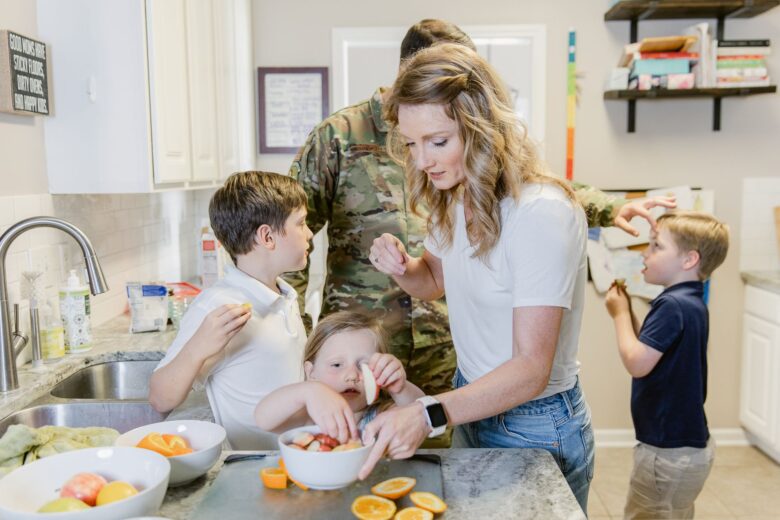
Every time Heather Campbell and her family move, she has to find a new vet, car shop, pediatrician and grocery store. They’ve moved four times in the last five years, the most recent move happening this summer to Mississippi. Campbell is from Nebraska originally, and went to college in Lincoln.
“I have a grocery store that I love, and we left it. That’s a lot when you need to go pick up something at the store, and you don’t know this store keeps peanut butter and jelly with the Little Debbie snack cakes,” Campbell said. “That’s not where I was looking for peanut butter and jelly, and it’s something that small that you’re like, in weeks and weeks since we’ve moved, I just want something to feel familiar.”
And every time they move, Campbell and her husband, who is an officer in the Air Force, have to figure out childcare. Now that her kids are 10, 12 and 13 years old, it’s a little easier. When they were younger though, Campbell said she sacrificed working at one point because there weren’t many childcare options and it was better for her family if she stayed home.
“Where we live, where we go to school, our community — that all changes all the time. Whether or not Daddy’s home changes, but the one thing that’s constant for my kids is that mom is there, and that mom will come when you call,” Campbell said. “That’s a privilege, but it also is a really big responsibility that I’m not willing to sacrifice for work at this point.”
Finding childcare is a challenge for military families, especially when they are relocating often. Also, normal childcare hours often don’t match military families’ schedules. Even if they do find childcare that fits their needs, there isn’t always space for their kids.
In Omaha, the largest childcare gap is near Offutt Air Force Base, according to data from the Buffett Early Childhood Institute. Walter Gilliam, executive director of the institute, said there’s a large number of military families and not enough childcare to meet that need.
“There’s just not enough childcare anywhere in the state,” Gilliam said. “There’s not enough childcare in any of the towns within Nebraska, but when you couple the lack of childcare with that much need, it means that an awful lot of families just simply cannot access the care they need in order to be employed.”
There is usually a childcare option on base. However, Gilliam said for every one family getting childcare on base, two receive it off base.
“The problem of childcare for the military cannot be solved on base. There’s just not enough capacity,” Gilliam said. “The community around the military installations has to be resilient in its childcare in order to be able to support military families. That’s where military families receive their care every day.”
Campbell said the on-base childcare isn’t always the best option — they self-report incidents so families don’t know any abuse that may happen, the pay isn’t great for staff and they are overworked. She added that off-base options may not be affordable, and the family may not qualify for any childcare subsidies.
“It’s really, really difficult to consistently navigate that, knowing that what works in Fairbanks, Alaska, is not the same as Panama City, Florida, or Hampton Roads, Virginia, and so knowing that you have to completely relearn the climate every single time is just a lot,” Campbell said.
Campbell tried several options for childcare when her children were younger, including a center, staying home herself, hiring someone to come to her house and eventually, a home-based daycare on base.

She added that there should be more variety in options for families. For example, while there’s sometimes vouchers that cover the cost of childcare on base during a move, Campbell said it would be helpful to use that voucher off-base or to cover the costs of a family member staying with them to help watch the kids.
“Sometimes it’s just not available in the way that on paper with legislation it looks like we have this policy, or it looks like this program exists, but the actual lived experience is not necessarily how it looks on paper,” Campbell said.
Gilliam said 77% of military families say they need two incomes to support their families, making childcare a necessity.
“Childcare is the job that makes other jobs possible,” Gilliam said. “In this case, that means that childcare is what’s necessary in order to make sure that we have a ready nation that’s able to respond to military threats around the world.”
Representatives from the Buffett Early Childhood Institute and the National Military Family Association went to Washington, D.C. in July to share more about the challenges facing military families with childcare. Gilliam said both of the congressional briefings they did were filled with staffers wanting to learn more.
“Our military families make huge sacrifices for us,” Gilliam said. “The very least that we could do as a nation is to make sure that when they are sacrificing to protect us, that we also protect their children. I think we owe that to them.”