

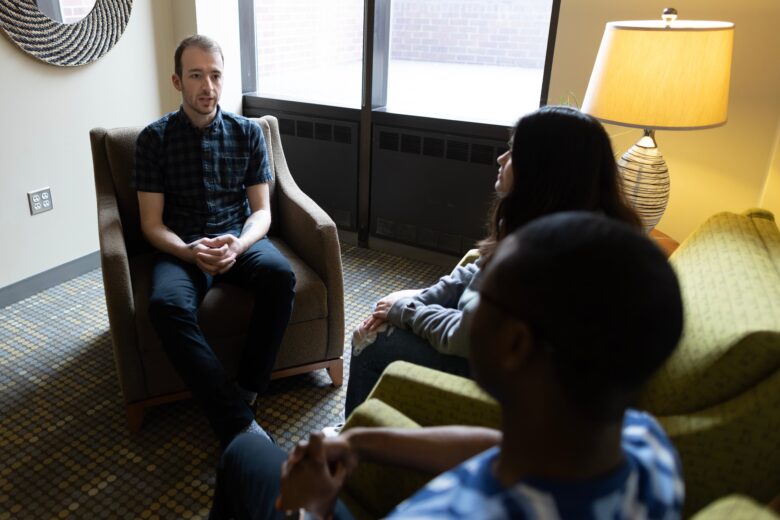
The University of Nebraska at Omaha Community Counseling Clinic is celebrating 50 years of operation.
Through the clinic, students get first-hand experience counseling while offering community members affordable mental health services. Dr. Tina Chasek, counseling department chair and a professor, said the model was groundbreaking when it debuted in the 1970s.
“Not many people, number one, were doing clinical mental health counseling back then,” Chasek said. “Second, to offer services to clients in the community as a training model is unique, and it’s still unique today. There’s very few.”
Currently, the program provides the first 100 hours of clinical work for about 75 students a year in its clinic in Roskens Hall. There were 3,250 counseling sessions held last school year. Each session costs $15, which has been the price since the clinic opened, Chasek said.
Curtis Wilson, a UNO student and clinical intern, said he used to work for a nonprofit with teens aging out of foster care. He saw the challenges of finding affordable healthcare firsthand.
“This clinic really fills that need within the community in providing access to high-quality, affordable mental health care that is great for more people to know about, so that they can take advantage of it,” Wilson said. “It really provides a valuable resource to underserved populations here.”
The clinic used to only train six students a semester, but Chasek said the students starting their hours outside of the clinic had a harder time.
“What we were finding, some of those students going out into the community to do their practicum were struggling, and the ones that were in our clinic were doing much better in their internship,” Chasek said. “We made the decision about three years ago to bring all of our students into the clinic.”
She said there is no lack of community need. The clinic has a waiting list of people wanting to meet with one of the students.
“We know the community needs what we’re offering,” Chasek said. “If we had more space, we could do more, but we’re kind of out of space.”
Since the clinic is a teaching space for students, all of the appointment rooms have audio and video recording. Clients are told this several times before coming to their first appointment, and any recordings are only accessible on-site at the clinic and are protected with firewalls.
Students are able to watch those sessions back to see what they did well and what they could improve on. The recordings also allow supervisors, who are doctoral level- and master’s level-trained clinicians, the chance to give valuable feedback.
“Our students are just excellent, the feedback we get from the community and the clients,” Chasek said. “A lot of them follow their counselor into the internship if they can, and so they want to go with the student. That says a lot about the care they’re receiving here, to me.”

Wilson said he’s also found community through the clinic with other students, especially during that transition from purely academic to clinical work and the worries and concerns that come with that.
“The camaraderie and community also fosters development,” Wilson said. “It promotes a higher quality of development that can only happen when you’ve got this cohort of folks all experiencing the same thing.”
In the next 50 years, Wilson hopes to see the clinic expand to train more students and offer mental healthcare for more community members. He added that he hopes to see a streamlined referral system for nonprofits in the community.
Chasek said she’d love to see more physical space for the clinic, more parking and more grants to help fund the clinic. Mostly though, she wants to see the model UNO has created spread to other communities across the state and country.
“I think the bigger goal is, turn this into a national model, so that we’re looked at in Nebraska as the gold standard of how you train your clinical mental health students to do those things while they’re in their academic training,” Chasek said.
There is an event on Tuesday to celebrate the clinic’s 50th anniversary from 4-6 p.m. in Roskens Hall.