
Rain clouds covered the Omaha sky as Arshpal Singh’s semi sped down Interstate 80.
Near the 84th Street exit, the California driver lost control. The truck, carrying 13,000 pounds of candy, jackknifed and smashed into the concrete median, taking out a light pole. Singh, who was traveling slightly above the speed limit in wet conditions, got ticketed on suspicion of careless driving.
The day after the crash, an Omaha police officer who responded to the scene sent the citation in an email to Douglas County Sheriff Aaron Hanson and asked him to “look into this driver.” The sheriff promptly forwarded the message to U.S. Immigration and Customs Enforcement.
“Is this guy on your radar screen? This could have been fatal,” Hanson wrote to ICE officers Jason Francke and Matthew Miller last September.
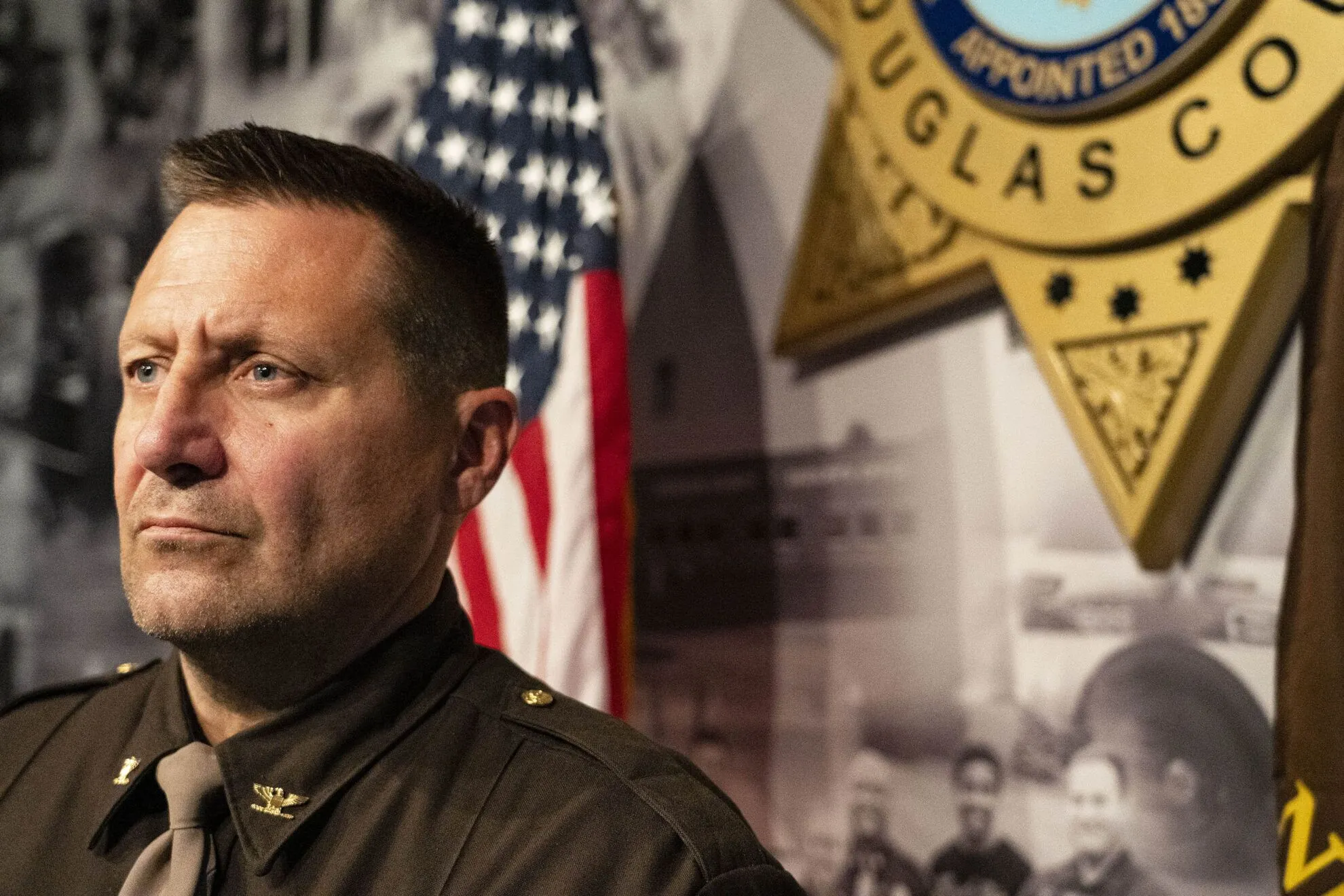
Douglas County has no formal contracts to work with ICE, but the Flatwater Free Press found that its sheriff has regularly shared information on local incidents and affairs with immigration officials. The behind-the-scenes collaboration puts the Republican Hanson at odds with Democratic county leaders who oppose President Donald Trump’s immigration crackdown.
Since January 2025, Hanson has sent dozens of emails to ICE employees, occasionally referring specific cases like Singh’s to the agency, according to heavily redacted emails obtained by Flatwater through a public records request.

Hanson said collaborating with ICE on criminal matters is part of keeping Douglas County safe from bad actors who are in the country illegally. Hanson said the north star guiding his cooperation with ICE is the high-profile case of Eswin Mejia, an undocumented immigrant who killed 21-year-old Sarah Root in a 2016 car crash while driving drunk.
“I refuse to allow an innocent citizen in my community to be victimized by a criminal if I could have instead cooperated earlier with our partners in the federal government and removed that criminal from our community,” Hanson said in an interview.
Immigrant advocates, though, say Hanson is undermining trust in local law enforcement by elevating low-level offenders to ICE’s attention.
Douglas County Board Chairman Roger Garcia said the sheriff is “pushing the limits” of his authority by informally working with ICE. If immigrants know that county law enforcement is referring cases to the agency, they might be fearful to report crimes or call 911, said Garcia, a Democrat.
“They will think that local law enforcement is just going to send their name on to ICE,” he said.
Law experts say Hanson’s frequent communication with ICE is completely legal since Nebraska doesn’t have a “sanctuary” law that would limit cooperation with immigration authorities.
But other local law enforcement agencies have less robust relationships with ICE than Hanson.

The sheriffs of Lancaster and Sarpy counties said they have little contact with ICE. The Omaha Police Department may have referred specific cases to immigration officials on rare occasions when relevant to a major criminal case, but officers aren’t allowed to make informal referrals, a spokesman said.
Michelle Root, Sarah’s mother, backs Hanson’s approach. Sharing information with ICE on dangerous criminals could save the next innocent victim or help a family like theirs get justice, she said.
“We don’t want to see another family have to go through what we had to,” Root said. “We need to have things in place to protect the American citizens and the legal immigrants that are here.”
Brainstorming with ICE
Two months after Trump’s inauguration last year, Hanson sent an email to two local Homeland Security officials.
The subject line: “287(g)” — the name of a federal program that taps state and local police to enforce immigration law as an extension of ICE.

Hanson floated joining the program so that deputies could take custody of undocumented immigrants who get released from the Douglas County Department of Corrections before ICE can detain them, according to the March 2025 email. The sheriff added that he was open to talking about giving one deputy 287(g) status to “assist ICE with high risk criminals.”
After meeting with Hanson later that month, ICE deportation officer Jason Francke wrote in an email to him that their collaborative brainstorming “could lead to real change in reducing crime in Omaha with potential to be a model to the entire state.”
More than 2,000 law enforcement and correctional agencies, mostly in red states, have signed onto the 287(g) program since Trump’s return to office. But the Douglas County Sheriff’s Office isn’t among them.
Hanson never joined the program, but he said the problem he saw with the Douglas County Corrections remains since suspected criminals can post bail without local judges, police or correctional officials checking on their immigration status.
It’s a gap that Mejia exposed in 2016 after the crash that killed Sarah Root, Hanson said.
Mejia bailed out of the Douglas County Jail, fled to Honduras and was on the run until federal officials arranged for his extradition last year. Earlier this year, he was sentenced to 20 to 22 years in prison.
Michelle Root supports Hanson’s previous proposal. If someone had contacted ICE when Mejia posted bail, she said, her family wouldn’t have had to endure a decade of heartache before getting justice.
“The majority of reasonable people in this county, regardless of how they feel about ICE, do not support a revolving door of people committing serious crimes and being released back out into our community when they’re in the country illegally,” Hanson said.
Garcia said he didn’t know Hanson had explored a 287(g) before reviewing records obtained by Flatwater. The sheriff should be consulting the County Board on major contracts with the federal government since it approves the sheriff’s budget, he said.
The board, which oversees the jail, wouldn’t support an agreement with ICE to use deputies’ time or county resources for immigration enforcement, Garcia said.
“I disagree with (the Sheriff’s Office) ever getting involved with immigration enforcement,” Garcia said. “If ICE needs to do something, let it be on their dime and with their personnel.”

As an elected office holder, Hanson said he doesn’t “have to ask the County Board’s permission to have any conversation with my peers.”
Mark Martinez, Hanson’s Democratic opponent in the November election, said enforcing immigration law isn’t part of the sheriff’s job, noting that his administration would “not divert personnel, time (or) tax money to assisting, collaborating or working with ICE.”
“My professional opinion is that that’s not a local responsibility,” Martinez said.
The Nebraska State Patrol, which joined the 287(g) program a year ago at Gov. Jim Pillen’s direction, has since helped fill the public safety gap surrounding the Douglas County Jail, Hanson said.
Under the agreement, troopers have taken custody of 38 Douglas County inmates on ICE’s behalf before their release from the jail, State Patrol spokesman Cody Thomas said. Troopers then transported the inmates to other jails, where they remained detained by ICE as their immigration cases played out, he said.
ICE did not respond to a detailed list of questions. During a recent visit to Omaha, Homeland Security Secretary Markwayne Mullin said the State Patrol’s 287(g) agreement helps protect the public from criminals who would otherwise be loose in the community.
“Thank goodness we’re in a state that works with us, and it keeps your public safe,” Mullin said at a press conference.
Last October, Hanson pitched the County Board on a different kind of deal with ICE than the 287(g) he had proposed months earlier.
If the county jail agreed to hold people detained by ICE, it would allow Omahans in ICE custody, like those arrested during the Glenn Valley Foods raid, to be near their families and lawyers as their cases played out, he said. Plus, ICE would pay the county millions of dollars to house the detainees, he noted.
The County Board’s Democratic majority shut down the proposal without holding a vote.
“The true humanitarian choice is not to detain mothers, fathers, and workers who have no criminal record,” four Democratic County Board members wrote in an open letter to Hanson.
Paper trail
The Douglas County Sheriff Office’s lack of a formal agreement with ICE hasn’t stopped the sheriff from working with the agency on cases that come across his desk.
Flatwater identified a half-dozen times where Hanson forwarded ICE-specific cases from law enforcement reports and community tips since January 2025, but the total number of referrals could be higher. Records obtained by Flatwater are heavily redacted and include only some of the emails between Hanson and ICE officials.
The alleged offenses prompting Hanson’s referrals range from careless driving to sexual assault and armed robbery. In one case, Hanson asked ICE officers about the legal status of a man referenced in a community tip as a “dangerous vagrant.”

Hanson said he forwards cases to ICE when suspects present certain “identifiers,” such as not having a driver’s license or previously using different names. But there’s a clear boundary in the sheriff’s collaboration with the agency, he said.
The Sheriff’s Office does not work with ICE on civil immigration cases where there is no evidence of a crime, Hanson said. It would never refer victims or witnesses to ICE, he added.
“What you will not find in here is any emails (to ICE) that say, ‘Hey, I’m concerned about this cleaning lady who we contacted during an accident,’” Hanson said in an interview.
Omaha immigration attorney Nathan Dallon said Hanson’s “shadowy” ICE referrals suggest he is seeking to punish low-level offenders that he believes got off too easy with the local courts.
“He’s going to be referring over people he can’t tag for real crimes, but he wants them off the streets because he might have a political motive or … a prejudice,” Dallon said.
Hanson said that’s not true, noting that every case the Sheriff’s Office has referred to ICE “represents a significant offense.” Cooperation between the agencies has yielded positive results, he said.
Deputies helped federal authorities find a Salvadoran MS-13 gang kingpin in Omaha last year.
ICE detained one of Hanson’s referrals, a woman convicted of armed robbery, after her prison sentence ended, the sheriff said. The Sheriff’s Office recently called on ICE to help locate several fraud suspects living in other states.
Some red states, such as Texas and Florida, require local officials to work with ICE, while some blue states, such as New York and Illinois, bar that kind of cooperation through “sanctuary” laws.
In states like Nebraska where no law governs collaboration with ICE, it’s fairly common for local law enforcement to informally collaborate with the agency, said César Cuauhtémoc García Hernández, a law professor at Ohio State University.
Republican County Board member Mike Friend said that the Sheriff’s Office doesn’t appear to be overstepping its bounds by collaborating with ICE when someone is accused of breaking the law.
Immigration enforcement is a “political football” right now, Friend said, but local law enforcement has worked with federal authorities for years to maintain public safety.
Garcia argued that even though the sheriff’s collaboration with ICE isn’t illegal, it goes against “the spirit of the local funding that’s been approved for just local law enforcement.” Hanson said the Sheriff’s Office doesn’t allocate any staff or funds to aiding ICE.
The OPD officer who asked Hanson to look into Singh, the California truck driver, told the sheriff in an email that the case felt similar to a Florida case “where the driver spoke little to no English, had a California license, and killed a family making an illegal U-Turn.”
Hanson said in an interview that “some states are issuing commercial driver’s licenses to individuals with questionable immigration status, many of (whom) cannot read or speak English, which is a real concern for highway safety.”
Francke, the deportation officer, told the sheriff by email that Singh initially arrived illegally in 2022 but had gotten legal authorization to work while his application with U.S. Citizenship and Immigration Services was pending.
Singh, who did not return phone calls, later pleaded guilty to an infraction: failure to maintain lane.
The Flatwater Free Press is Nebraska’s first independent, nonprofit newsroom focused on investigations and feature stories that matter.