

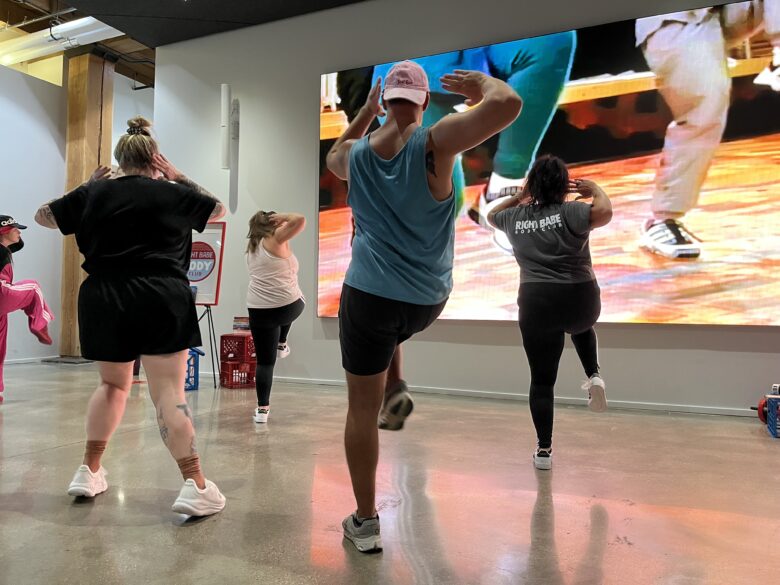
A drum machine thumps as 20 pairs of high-top white sneakers lift and squeak, driven on by encouragement from Missy Magnuson, the founder of the Right Babe Body Club in Omaha.
Magnuson started the club as an experiment to get people thinking less about fitness as a closed ring, and more about exercise as a social circle.
She’d always wanted to teach an exercise class, and her first instinct was Jazzercise, a dance program she’d been involved with for years.
However, Magnuson said there were barriers to teaching the courses, especially for those who don’t have the time to dedicate to the practice.
“The instructors there don’t follow a tape,” she said. “They memorize everything, the whole hour-long class. It always intimidated me.”
But then, a lightbulb came on.
“What about VHS tapes?”
By reviving the camp and candor of the workout tape craze of the ’80s and ’90s, she hoped to create a more welcoming health environment; by her estimation, fitness these days has become too serious.
“If you throw humor in there, everybody’s going to relax,” Magnuson said.
“It’s also intriguing, it’s funny, it makes you curious. It just creates a common ground for conversation.”

She’s found some success. Her group has grown steadily over the past few months. Through once a week classes, she’s learned that whether ironic or nostalgic, people of all exercise experience levels have a soft spot for the VHS workout fad.
Magnuson said she leans into that to bring out the better parts of what the old tapes promote: functional, regular exercise for everyday fitness.
“There are people like me who are interested in obscure, weird things. On the other hand, I do want to create a space where we are moving our bodies, working our muscles, and learning fundamental things.”
And according to Dr. John Noble, a sports psychologist at the University of Nebraska at Omaha, Magnuson might be onto something.
He said that finding some sort of common ground with others goes a long way toward sticking with a lifestyle change.
“If you can find a group with similar interests, that social support is built into that group,” Noble reasoned. “You don’t want to let the group down by not being there to give your insights. So you’ll want to be consistent with that, and that’ll be helpful in the long run.”
Of course, fitness choreography goes beyond the revived Mylar and canned tunes, but the motivations seem to remain.
At the decidedly quieter Lotus House of Yoga in Omaha, Mary Clare Sweet’s been offering hybrid dance classes for years. She said no matter what the latest app promises to track, it’s the feeling of dance that keeps people coming back.
“Your enjoyment, and the feeling of euphoria you’re feeling when you’re dancing, supersedes the amount you’re worrying about a calorie counter,” she said.
Noble agrees. He said a person enjoying their activity as opposed to measuring it can be one of the biggest indicators of someone’s willingness to maintain those positive changes when it comes to exercise.
“Enjoyment is part of intrinsic motivation. When we can do something for an intrinsic desire because we like it, we’re more likely to stick with it.”
Sweet said she’s seen that firsthand, time and time again, especially in the years during and just after the pandemic.
In that time, the fitness world saw a boom in gadgets, trackers, programs and apps partly as a necessary response to a more isolated workout environment.
Psychologically speaking, Noble said those instruments can be helpful, but they don’t necessarily give anyone a leg up in sticking with healthy habits.
“For four, five, or six months, they get all gung-ho, but typically what happens is they go back down the slide and fall back into old habits after that newness wears off.”
Sweet said that’s a big reason why interest in hybrid dance has consistently grown; her classes aren’t meant for measurement, but rather for movement. The way she teaches dance is low impact, and even lower pressure.
“I think that points to the consistency that people can maintain with more fusion-like classes,” Sweet said.

And as unscientific as it sounds, both Sweet and Magnuson said there could be something to all forms of dancing that can’t really be measured, tracked, or optimized. Also, it’s just fun, they said.
But first time attendee Josh Falewitch has a different word for the class.
“It is way more difficult than you would think. It’s pretty challenging,” he said.
Ultimately, though, the credits start rolling, and after congratulating newly-found friends, draining a water bottle, and catching his breath, he reflects fondly on the blistering 90 minutes.
“It’s such a challenging thing, but it’s so cool to learn it and be in sync with someone else doing it,” he said. “Collectively, as a group, there’s something really cool about all doing the same movement together and learning it together.”